

Office worker Yue Xi regards herself as a stay-at-home type, devoid of much athletic ability or inclination. Yet in the space of just three hours during a trip to Shanxi’s Baquan Gorge for this year’s May Day holiday, she reached the park’s highest point, the 1,529-meter Yuhuang Peak, and traversed a dozen more mountains before hiking through the canyon at their foot.
What’s more, the 28-year-old managed this seemingly arduous expedition through the scenic area’s emerald peaks and jade-green waters without breaking a sweat. After the trip was finished, she still had the energy and enthusiasm for a meal with friends that evening in the downtown area, a two-hour drive away.
Yue overcame the athletic odds thanks to a series of innovations mostly unique to China’s scenic areas. She rode a shuttle bus to an elevator, on which she ascended halfway up the mountain in around a minute. She then boarded a cable car to the summit, followed by a second cableway that whisked her over 13 mountains and more than three kilometers down to the canyon floor. The whole journey took around half an hour in total, and Yue recalls the experience with satisfaction. “I got what I wanted: to be in nature, enjoy the wonderful views up on the mountain, and relax,” she tells TWOC. “If it had involved serious hiking, I would never have considered going.”
Read more about ourdoors fads in China:
- Why China’s Youth Are Seeking Solitude in the Wild
- Primal Fear: Why China’s Children Are Becoming More Nature-Averse
- The Trails and Tribulations of China's Outdoors Boom
In recent years, the concept of “painless hiking (无痛爬山)” has become popular among young Chinese like Yue. The trend, which sees wannabe mountaineers take advantage of modern facilities and infrastructure to navigate the country’s outdoor sites, is perhaps best encapsulated by a witty aphorism that has become popular online: “Didn’t climb a single step but didn’t miss a single sight.” In 2025, the Shanghai Youth & Children Research Center included “wonang travel (窝囊旅游),” literally “wimpy tourism,” an umbrella term for painless hiking and similar experiences that cater to young people’s desire for exploration while prioritizing safety and comfort, in their list of 2025’s hottest words for China’s youth. Data from Meituan Travel, meanwhile, shows that searches for “wonang hiking,” a term often used alternatively with painless hiking, increased by 84 percent last August, while on Weibo the hashtag “Scenic Areas now Offer Painless Hiking” has nearly 16 million views. The online surge is playing out on the ground as well—Baquan Gorge, the scenic area of Yue’s vacation, received more than 2 million visits in 2025, up nearly 70 percent on the year before.
The wonang fad signals a shift in the way young people are choosing to travel in China. Since 2023, “special forces-style tourism (特种兵式旅游)” has been the modus operandi of the country’s travelers, as they rush from one viral spot to another to make the most out of limited holidays. This trend was epitomized in the 2023 case of a 30-year-old man from Chengdu, who confounded the internet by reaching the top of all five of China’s sacred mountains during that year’s five-day May Day holiday, climbing throughout the day and traversing thousands of kilometers by train at night, before returning home in time for work after the holiday.

Wonang drifting, often in slow and shallow waters, makes another popular trend alongside painless hiking (VCG)
“Chinese people travel in such a tiring way that we often need another vacation to recover from the last one,” A traveler under the handle “Nagi” concluded in a post on Douban, a community-based social media platform centered on culture and niche interests, last August. She decided to quit the checklist-style approach to travel after a trip to Indonesia with her mother last year. “My mom and I were so exhausted from all the running around that we canceled the next day’s trip. Without any must-see spots to tick off, we were at a total loss as to what to do. Changing our flights was too expensive, so we committed to idling away the day by the pool without thinking about sightseeing or photos,” Nagi recalled in the post. “We finally started our vacation on the last day of our holiday.”
Inspired by this new approach, Nagi, who lives in Beijing, later joined the online interest group “Successful Tours for Lazy People,” which has attracted more than 10,000 members since last July with the slogan, “Getting out the door is already a success; coming home without being tired is the ultimate victory!” Last October, she indulged in painless hiking at Zhejiang’s Tianyu Mountain, riding an escalator to the top for sunset at the summit, and enjoying the local fish soup at nearby Qiandao Lake for dinner. “It was the perfect experience,” she wrote on her blog.
The wonang trend itself might be a new phenomenon, but the construction of infrastructure at Chinese mainland tourist attractions has a much longer history. Cableways first emerged in the 1980s, and in 2002, the Bailong Elevator at Zhangjiajie’s Wulingyuan Scenic Area, the first of its kind in China, opened to the public. After a 2015 upgrade, it was crowned by Guinness World Records as the highest outdoor lift in the world, and has become an attraction in its own right, rivaling the park’s spectacular quartz-sandstone. Go-karting tracks, toboggan chutes and human-sized conveyor belts have all sprung up at scenic areas across the country since then in an effort to entice sightseers.
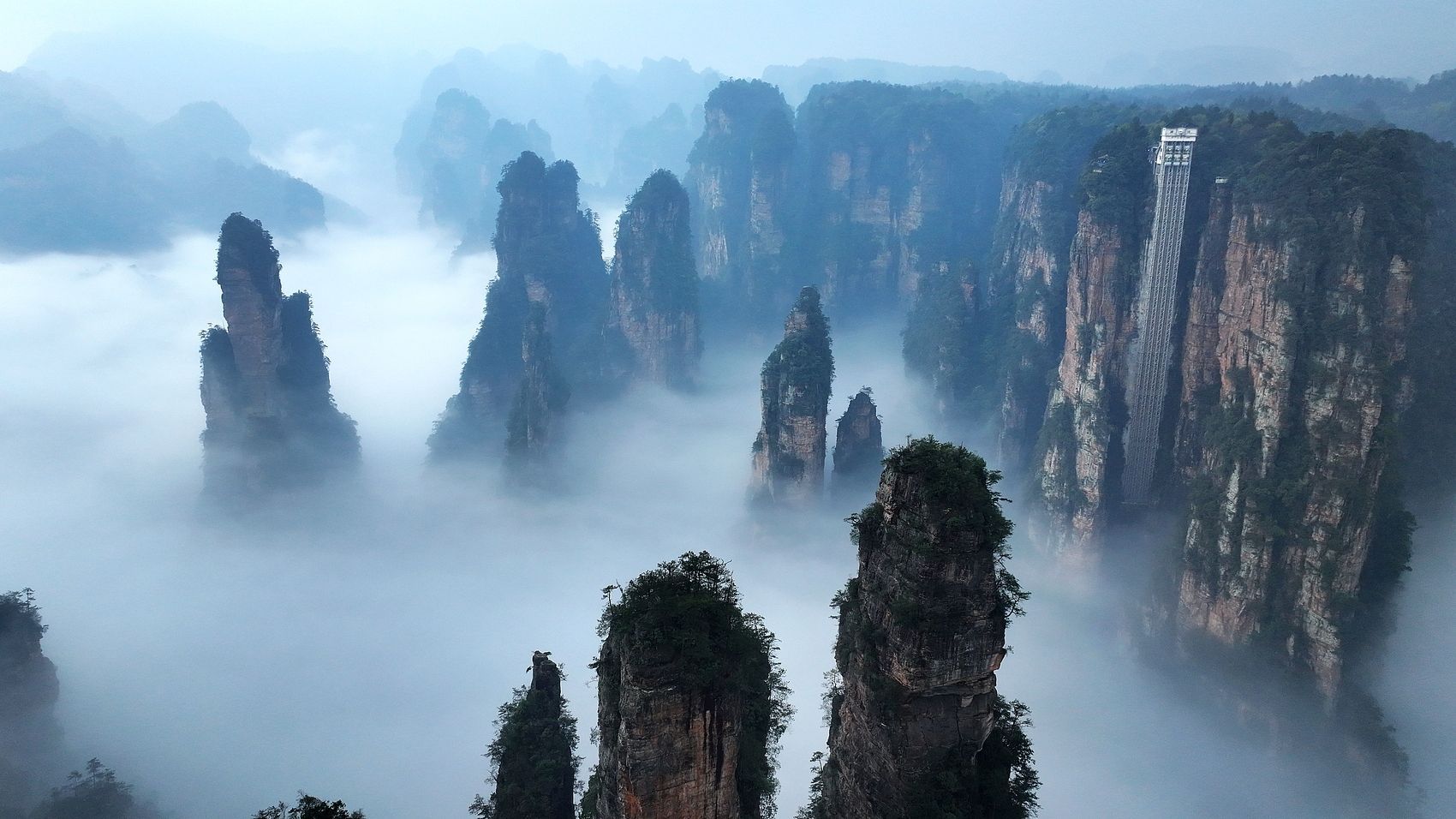
Towering 326 meters, the Bailong Elevator in Zhangjiajie is the first of its kind in China and remains the highest outdoor lift in the world (VCG)
Tianyu Mountain itself is one such site that has successfully gained significant traction online since opening new facilities to the public in 2022. Visitors and netizens alike have been wowed by news stories and videos showing a series of escalators that condense the 350-meter ascent into a ride of around 10 minutes, replete with a built-in handrail cooling system that mists passengers to relieve them from the summer heat. The construction and maintenance costs of these extravagant installations—at tens, even hundreds of millions of yuan—haven’t deterred more and more sites from their construction, nor visitors from paying more to use them. According to a 2023 report by Shanghai Observer, a local digital news platform, the revenue for Tianmen Mountain, another of Zhangjiajie’s scenic areas, reached more than 1.25 billion yuan in 2019, five times that of 2014, the year its new escalators were put into use.
Escalators, in particular, are an attractive investment for park management. They are generally perceived as safer than cable cars and offer greater carrying capacity, making them better suited to relieve overcrowding at popular spots. Crowd management has become a key issue with the growing popularity of hiking in China over the past decade, especially during national holidays—one infamous case from last March saw visitors stuck until 10 p.m. waiting for a cable car to descend the mountain at Mount Huangshan.
These rides also make mountain hiking more accessible to older adults and visitors with disabilities who might otherwise be unable to participate. The 104-meter-long escalator at Zhejiang’s Shenxianju, for example, was installed to make the climb easier for senior visitors and children. Gu Qiaolu, deputy marketing manager at the state-owned company operating the scenic area, told Zhejiang news platform Tide News in October 2023 that “even young people can find climbing a mountain tiring. Our goal is to make the ascent as effortless as walking through a shopping mall, without taking away the joy of connecting with nature.”
Yet while many applaud the convenience of these installations, there is growing concern over their environmental impact. A recent online debate saw netizens clash over a case of overdevelopment at the Baoquan Scenic Area in Henan after site management opened nearly 30 escalators in the wake of the painless hiking trend. A representative of the scenic area defended the decision, arguing that the facilities were primarily concentrated in steep areas with many steps to improve access for visitors. Detractors, meanwhile, lamented their impact on the enjoyment of traditional hiking as well as the damage to the area’s natural scenery.
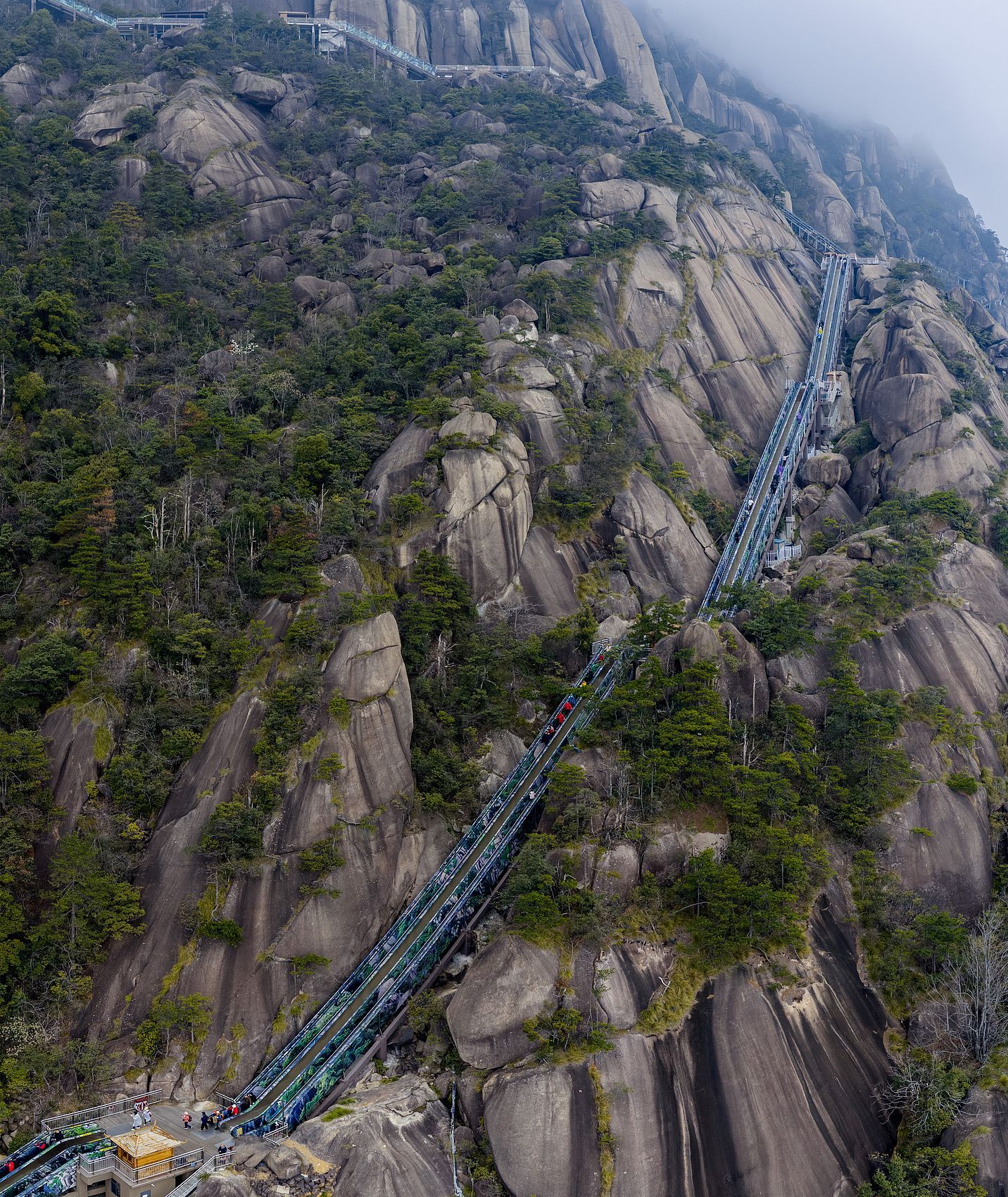
The more than 750-meter-long escalators in Jiangxi’s Lingshan Scenic Area have shortened the previously four-hour journey to around 20 minutes. Advertised as the longest lift on a cliff precipice in Asia, it has also faced controversy over the cost of nearly 130 million yuan and environmental damage. (VCG)
For Huang, a hiking enthusiast from Shanxi who agreed to be identified only by her surname, the appeal of visiting mountain destinations lies in the “tiring yet joyful” climb itself, the dopamine and endorphins the body releases along the way, and the “deep satisfaction and serenity” that come with reaching the summit. “It can be exhausting, but it can also make me feel alive and full of life,” the college student tells TWOC. “I like to take my time on the way to the summit and simply take in the surroundings. The climb gives me the space to work through many of the things that have been weighing on my mind.”
In Huang’s view, the cable cars already available at most scenic sites are sufficient. Adding more elevators and escalators would not only diminish the joy of the climb but also harm the environment. ”A true nature lover wouldn’t want to see such large-scale facilities,” she says. “Once it’s full of all those facilities, how is that different from hanging out in large green spaces in the city?”
Many tourist attractions, sensitive to these concerns, are trying to cater to different visitors’ needs by maintaining traditional hiking routes alongside the painless alternatives. At Shanxi’s Baquan Gorge, after the initial elevator ride, visitors can choose whether to hike for around an hour or take the four-minute cableway to the summit. Others, including Mount Huangshan and Mount Tai, offer a more bespoke, low-impact solution, renting wearable AI-powered robotic exoskeletons which reportedly halve the climbing time and save hikers up to 50 percent of the energy.
Yue, the office worker from Shanxi, doesn’t think one way of getting to the top of the mountain is inherently superior to the other. “Elevators and cable cars are simply tools. Those who like hiking can just skip them,” she says.
Peak Convenience: The Rise of Painless Hiking is a story from our issue, “Weight of the Nation.” To read the entire issue, become a subscriber and receive the full magazine.
Related Articles