A comforting balance of savory, sweet, and tangy flavors, stir-fried tomatoes with eggs is often many people’s introduction to Chinese home cooking, thanks to its simple preparation and two universally accessible ingredients. But this classic dish is a relatively recent invention—tomatoes only arrived in China in the 1600s, and remained ornamental for another century. On the other hand, humans have been eating eggs for longer than we’ve been human.
In China, when it comes to eggs from domesticated chickens, the story goes back millennia. The remains of domesticated chickens found in central China date back 8,000 years, and the oldest chicken eggs discovered were from 2,800 years ago.
In 1974, in a state-owned orchard in Jurong, Jiangsu province, at the lower reaches of the Yangtze River, archaeologists unearthed a ceramic jar patterned with geometric designs from a Western Zhou dynasty (1046 – 771 BCE) tomb. When they opened it, they found dozens of neatly arranged eggs, long petrified, inside. The tomb’s owner was likely an ordinary citizen, judging by the tomb’s modest scale and the absence of valuable burial objects. But the eggs suggest a hope that the deceased would continue to have nourishment in the afterlife.
The Egg Across China’s Kitchens:
- How to Make Southern China’s Famous Oyster Omelet
- Eggs-traordinary Recipes
- In Search of the Authentic “Jianbing” Pancake
The humble egg’s cultural journey goes far beyond the kitchen. As in many cultures around the world, China’s creation myths and legends feature the egg as a symbol of origins and life. References to the chicken egg abound in medical texts and historical recipes, offering a glimpse into daily life in ancient China. Even today, eggs continue to appear on festival tables, at weddings and birth celebrations, and on other special occasions as an auspicious food.

The earliest chicken eggs found in China date back 2,800 years and are now on display at the Nanjing Museum. Archaeologists have kept most of the eggs in their original jar to prevent further damage. (VCG)
In the classic Chinese creation myth, the universe existed as a formless chaos resembling a gigantic egg. A giant named Pangu (盘古) was born inside and later grew to stretch between heaven and earth. After his death, his body transformed into the elements of nature, from which humanity emerged.
One of the earliest dynasties, the Shang dynasty (1600 – 1046 BCE), traces its origin to a mythical egg: Yin Qi (殷契), the ancestor of the Shang people, was born after his mother swallowed a bird’s egg. A similar story is told for the Qin dynasty (221 – 206 BCE), whose ancestor Da Ye (大业) was also born from a swallowed egg.
Many of China’s ethnic groups also have their own egg-born creation myths. According to folktales of the Zhuang people, for instance, the universe begins as a giant egg with three yolks, which burst to form the sky, the earth, and the human world.
The egg has long been a prized food in ancient China, though it was referred to in historical texts as jizi (鸡子) or jiluan (鸡卵), rather than today’s jidan (鸡蛋). Another dish as ubiquitous as stir-fried tomatoes with eggs is stir-fried chives with eggs. Foodies may be surprised to know that the combination goes back more than 2,000 years: Discourses on Salt and Iron (《盐铁论》), a historical text from one century BCE, mentions a dish called “chives with eggs (韭卵)” appearing in the markets. Cooking techniques, however, were still limited: frying and stir-frying had yet to become common, as cooking oil remained scarce. With chives used more as a seasoning, eggs were likely boiled or steamed.
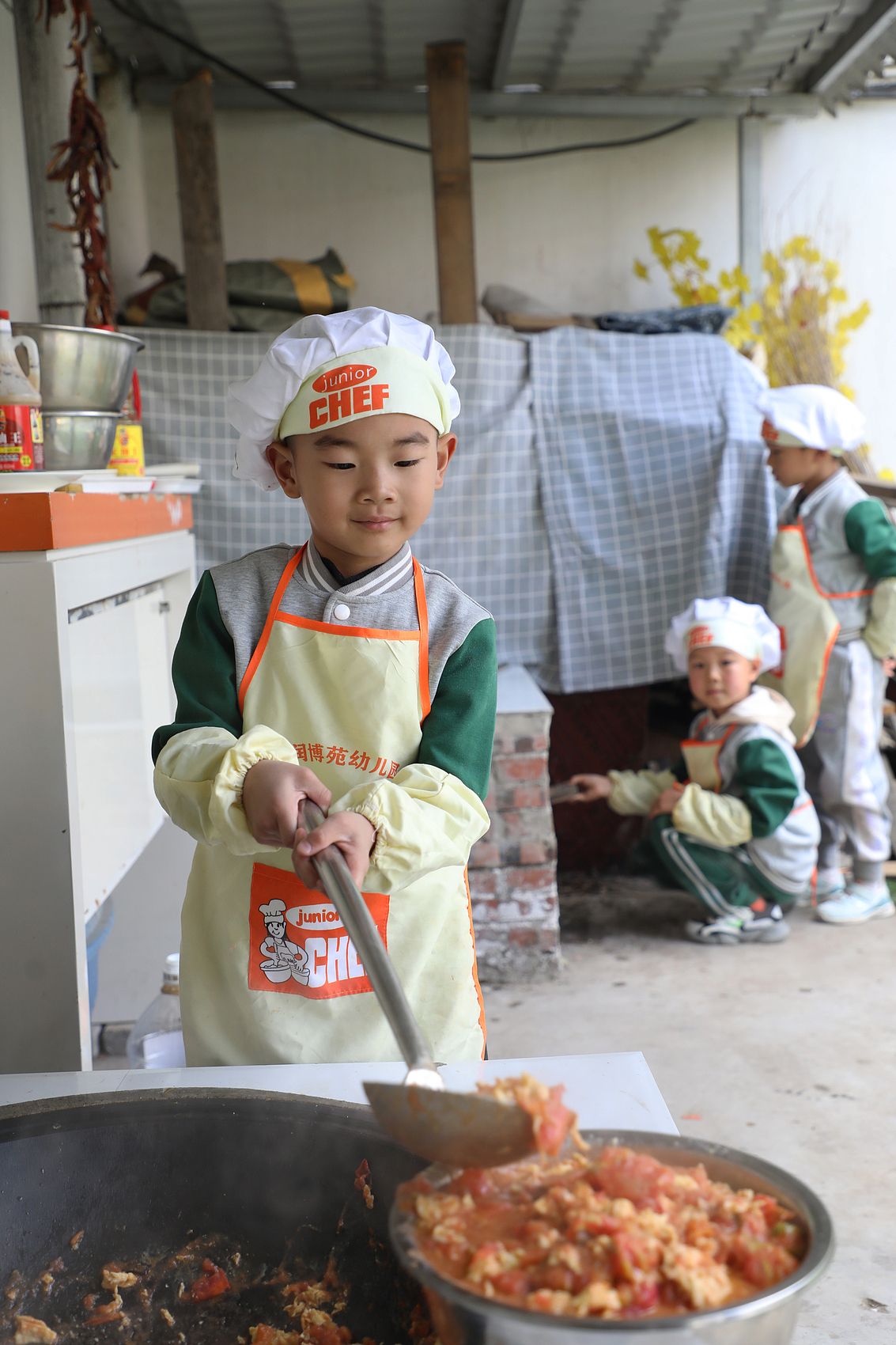
A kindergartener in Tangshan, Hebei, learns how to cook one of China’s most beloved home-style dishes, stir-fried tomatoes with eggs, at school (VCG)
The earliest known recipe for stir-fried eggs appears in the Essential Techniques for the Common People (《齐民要术》), an agricultural encyclopedia written by Jia Sixie (贾思勰) in the sixth century. The book records a recipe known as “stir-fried eggs (炒鸡子法)” in detail: “Break the eggs into a copper pan, stirring until the whites and yolks are well mixed. Finely chop scallion whites, add salt and fermented soybeans, and stir-fry with sesame oil. It is fragrant and delicious.”
Though the cookware and seasonings have changed over the centuries, the basic technique—beating the eggs, heating the oil, and stir-frying quickly—has endured for nearly 1,500 years and evolved into countless variations today: egg stir-fry with green peppers, with chives, with bitter melon, and many more.
The same book also records a “poached egg (瀹鸡子法)” recipe: “Break the egg into boiling water; when it floats to the surface, remove it promptly, cooked just right, and season with salt and vinegar.” This is the same as today’s poached egg.
Many more beloved egg dishes enjoyed today have echoes in ancient culinary texts. The 16th-century agronomist and gastronome, Song Xu (宋诩) records a “braised egg” recipe in his dietary therapy and health preservation work, Song’s Book of Nourishing Life (《宋氏养生部》), resembling today’s tea eggs: “Briefly cook the eggs, crack the shells, then simmer them with soy sauce, salt, and tea in a vessel, over chaff fire until thoroughly infused, and leave them to mature for several months.” The same book also describes egg noodles: “Mix eggs with water, blend the whites and yolks thoroughly, knead into dough, roll out thin, fold and cut into fine strands.”
A classic recipe of steamed egg custard can be found in Recipes from the Garden of Contentment (《随园食单》), by the 18th-century gastronome Yuan Mei (袁枚): “Remove the shell, place the egg in a bowl, beat it a thousand times with bamboo chopsticks, then steam. It will be exceptionally tender.”

Eggs take on different flavors across Chin. A specialty from Hengyang, Hunan, Hengdong roasted eggs are first roasted over a wood fire, then sliced and stir-fried with green chili peppers and spices, creating a smoky, fiery dish. (VCG)
If these recipes show how versatile eggs are in the kitchen, their role in traditional Chinese medicine is just as varied. The Classic of Herbal Medicine (《神农本草经》), China’s oldest surviving pharmacopoeia compiled in the second century, already lists eggs as a medicinal ingredient, noting that they “mainly treat fever, burns, and convulsions.” In the 16th century, physician Li Shizhen (李时珍) went further in his Compendium of Materia Medica (《本草纲目》), distinguishing between the white and the yolk. He wrote that the egg white treats latent heat, red eyes, and sore throats, while the yolk nourishes the blood and treats diarrhea and postpartum disorders.
Beyond the kitchen and the pharmacy, eggs also held a place in traditional Chinese festivals. Much like the familiar Easter egg tradition, ancient Chinese people also decorated and painted eggs to celebrate the arrival of spring. A sixth-century book on folk customs, Records of the Seasons of Jingchu (《荆楚岁时记》), describes this practice during the Cold Food Festival in early spring: “Carve eggs, then boil them. This was believed to awaken the vitality stored through winter and help all living things flourish again.” The text further records that “wealthy households once ate painted eggs,” while ordinary people continued the practice of dyeing eggs in blue, red, and other colors, carving them with designs, exchanging them as gifts, or presenting them as offerings.
Later, painting eggs and carving eggs merged into a single practice known as “engraved eggs (镂鸡子),” which flourished throughout the Sui (581 – 618) and Tang (618 – 907) dynasties. The Tang poet Bai Juyi (白居易) captured this in one of his poems on spring: “Where is spring at its finest? In homes celebrating the Cold Food Festival, delicately engraved eggs gleam, while colorful ornaments sway gracefully like blooming flowers.” The practice died out in modern times, as the Cold Food Festival itself faded into obscurity.
Eggs also appear at key moments in Chinese life rituals. Traditionally, at weddings, newlyweds give red-dyed eggs as return gifts to guests; when a child is born, red eggs are also presented to friends and relatives to share the joy.
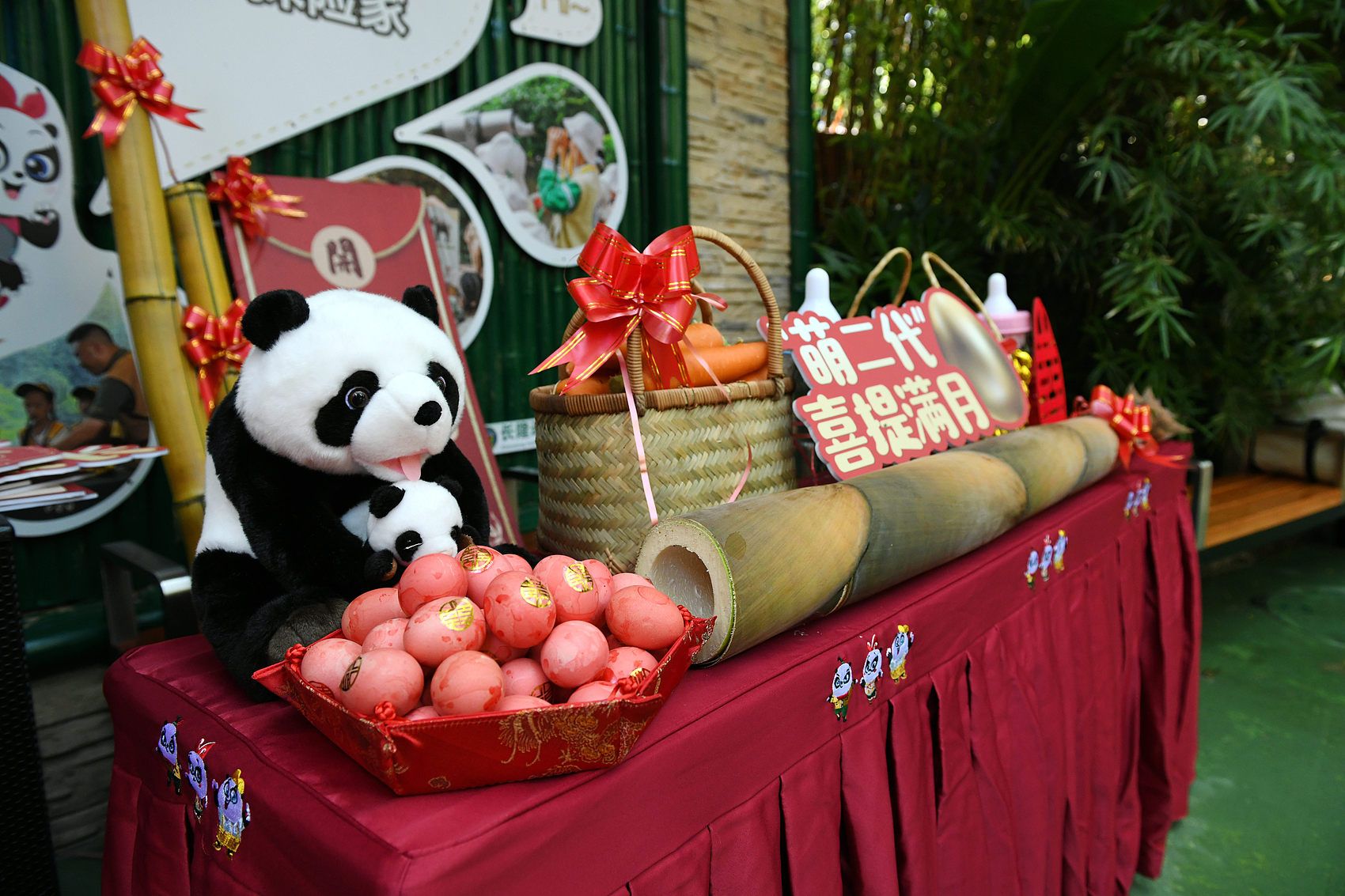
A zoo in Guangzhou, Guangdong, gives out red eggs to visitors to celebrate the one-month anniversary of its newborn panda cub in 2024 (VCG)
In the days of backyard poultry farming, egg production was limited. Eggs are often reserved for the sick, the elderly, and children, as they offer an important source of protein and nutrition. It was not until the 20th century that they became an everyday food in China. In the 1980s, state-owned farms with modern poultry breeds and farming techniques made eggs affordable and accessible. Since 1985, China has been the largest egg producer in the world, and now accounts for more than 38 percent of the world’s total.
On China’s vibrant culinary map today, the egg remains one of the most versatile ingredients. Rich in natural umami, with a creamy yolk packed with fats, it often takes center stage in regional specialties: stir-fried eggs with jasmine flowers from Yunnan in the southwest, with wild onions from Inner Mongolia in the northwest, with toon shoots from the lower reaches of the Yangtze River, with soybean paste from the northeast, and with seafood from the southeast. And that is only the beginning.
From a burial item 2,800 years ago to a daily staple today, the egg has traveled a long road on the Chinese table. That journey traces shifting lifestyles, changing customs, and a Chinese imagination of life itself.
Related Articles