For over a decade, The World of Chinese has been offering modern Chinese-language instruction from street talk to social phenomena to character tales. With 129 officially recognized dialects (方言), though, we have barely scratched the surface of everything there is to learn.
On select Fridays, TWOC will be presenting a basic lesson on speaking like a native of a certain region of China.
Tang dynasty poet Li Bai (李白) famously wrote: “Jinghu Lake is bright as moonlight, and the pale skin of Shaoxing ladies is like snow.”
Birthplace of 20th century writer Lu Xun and the ancient calligrapher Wang Xizhi, the city of Shaoxing in Zhejiang province flaunts attractive waterways, ancient stone bridges, and delicate black canopy boats. Alongside its rich cultural history, the city has its own distinctive dialect.
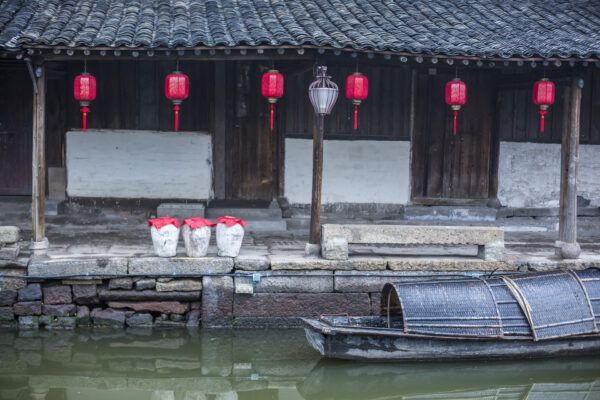
A classic Jiangnan (south of Yangtze River) impression found in Shaoxing: black-canopy boats and rice wine (VCG)
Part of the Wu family of fangyan, along with the speech of Shanghai and Hangzhou, the Shaoxing dialect is spoken in the city and surrounding counties. Made famous by Shaoxing opera, or or shaoju (绍剧), Shaoxing fangyan has 55 vowels, eight tones, and a sing-song quality. Here are a few characteristics of the dialect:
The dialect retains certain words from older forms of Central Plains Chinese that have been replaced in standard Mandarin. For example, “today” (今天, jīn tiān) is pronounced 艮朝 (kin tzao) in the Shaoxing dialect, using the character “day” (朝) from classical Chinese. Similarly, “morning” (上午, shàng wǔ) is pronounced 上昼 (zaon tzer), using the classical character for “daytime” (昼).
The Shaoxing dialect also includes some unique auxiliaries which can change the tone of a sentence. For instance, to turn a normal phrase into one with sarcastic overtones, locals use the pronoun “rory” (下叶). “Rory, noo ze pi nga li hei” (下叶,你裁比伢厉害) is a sarcastic way to say, “Wow, you’re so much cooler than me.”
Perhaps due to Shaoxing’s long and storied cultivation of rice wine, certain measure words have developed differently from standard Mandarin. The measure word for a ”sip” is kǒu (口) in standard Mandarin, but its pronounced ”hae” (呷) in the Shaoxing dialect. “A sip of rice wine” (一口黄酒) is pronounced “y hae lao jiu” (一呷老酒).
The measure word for shrimp is zhī (只) in Mandarin, but in Shaoxing, it is pronounced “tzao” (召). For example, “a shrimp” (一只虾 in standard Mandarin) is pronounced “y tzao hoo” (一召虾).

A Jiangnan snow scene (VCG)
The best way to talk like a local, of course, is to curse like one. Given Shaoxing’s gentle reputation, it’s said that locals sound tending even when shouting at one another. Judge for yourself:
- 阴思主!
Yinn si ju!
You selfish bast–d!
阴思 means “selfish desires,” and 主, which directly translates to “ghost,” is an insulting name for a person in the Shaoxing dialect. This phrase is usually hurled at someone who betrays the cause of a group for selfish gains.
畜生! 脸孔要勿要哉。
Choo sang! Lian kong yau fo yau zai.
Animal! Have you no shame?
脸孔要勿要哉 more literally translates to “Don’t you want your face?” This insult is a more direct version of the previous.
小娘喇逆子,搞七廿三!
Xiao niang la ni zi, gao qie nian sam!
You illegitimate fatherless child! You have no brain!
This phrase takes things up another notch, and is not to be used lightly. 搞七廿三 is a typical Wu term meaning “entangled,” and more figuratively, an importune person who cannot see a situation clearly.
Related Articles