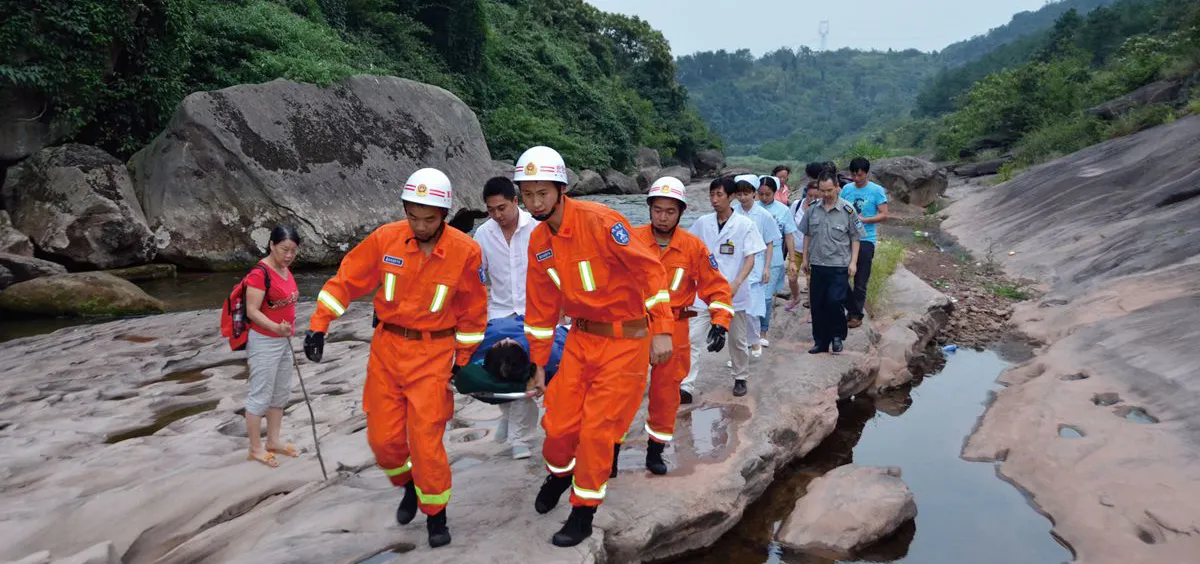

Scenic sites are demanding irresponsible hikers pay for evacuation
Chinese tourists have had a lot of bad press in recent years. Now, fed-up administrators at domestic scenic sites have begun to hit the “unruly” where it hurts—in the wallet.
In June, a visitor surnamed Wang became the first to fall a foul of a new penalty scheme introduced last year at the Huangshan Mountain Scenic Area in Anhui province. Wang is accused of trying to evade the UNESCO World Heritage Site’s 190 RMB entry fee by breaking in through a fence, only to get stuck under a precipice. After he was safely evacuated, officials charged Wang 3,206 RMB for the seven-hour effort, which cost a total of 15,227 RMB.
While many sympathized with Wang, having long complained about exorbitant entry fees at the country’s scenic spots, the incident has revived a long-standing debate over how to deal with misbehaving tourists and whether they should pay for their own rescue—and how much.
At Huangshan, rescue crews are called out an average of 300 times a year, though only a small fraction involve tourists who have endangered themselves. But the last decade has seen an increase in hikers whose adventurous habits land them in trouble, often ignoring relevant warnings or risks, then requiring considerable resources to rescue.
In 2011, the Siguniang Mountain Scenic Area revealed that it spends over 300,000 RMB annually on rescuing those who’d broken safety rules or engaged in “fatuous” outdoor activities. This April, a hiker who ventured into an undeveloped, off-limits area of Gongyu Mountain in Xianju, Zhejiang province, required the efforts of 70 rescuers working 24 hours to retrieve the nearly unconscious man from a 1,050-meter cliff.
Fatal hiking accidents have also increased steadily from 2011 to 2014, according to the Chinese Mountaineering Association; in 2016 alone, there were 311 such incidents, claiming 64 lives in total. This August, two members of the Shenzhen Blue Sky Rescue, a non-profit organization, were killed during an operation to save 24 climbers stranded on Baima Mountain in Huizhou, Guangdong province.
Rescue operations are usually paid for by local governments, scenic site administrators, or non-profit organizations, but the uptick in irresponsible behavior has prompted many to call for errant hikers to bear some responsibility. After 14 hikers were charged 30,000 RMB in 2011 for a four-day rescue operation from Siguniang Mountain, the public sided with the officials. In a suvey conducted by People.cn, 65.3 percent of 2,037 respondents agreed that evacuees who violated rules or safety warnings should bear all the ensuing expenses, and 14 percent believed the cost should be split between the government and the individuals (which was what happened); only 9.5 percent wanted the government to foot the whole bill.
However, rescue fees still attract criticism. In 2015, the Kending Scenic Area in the Ganzi Tibetan Autonomous Prefecture was accused of asking a missing hiker’s parents to pay 20,000 RMB up-front to expand the search area, though officials disputed this version of events. There was further outcry in 2016 when a hiker died of altitude sickness after his companions refused to pay rescuers.
China’s Tourism Law stipulates that tourists should pay “individual responsible” fees to relevant organizations, but offers no further specifications. Until then, best to stick to the designated trails, and keep your hands and feet inside the railing.
Rescue Fees is a story from our issue, “Tuning Up.” To read the entire issue, become a subscriber and receive the full magazine.
Related Articles