

In 1856, a young boy named Dekeng was adopted by his uncle, Chengdie. Dekeng’s father, Sendie, already had two other sons to care for him, and, eventually, carry out the rituals necessary for a peaceful afterlife.
The less fortunate Chengdie had no sons of his own, so a contract was drawn up, witnessed by other members of the family, transferring Dekeng from one brother to another in exchange for 14 silver dollars—described in the contract as “milk money.”
This exchange, translated by Madeleine Zelin in her 2004 book Contract and Property in Early Modern China, represented one of the commonest forms of ancient adoption: The transfer of a male heir from one brother to another. But adoption in late imperial China was rarely simple, and always involved careful negotiation of ritual, filial piety, law, and lineage.
A man without heirs, as was the case with Chengdie, faced many challenges in this world and the next. The Confucian scholar Mencius once declared the least filial thing a man could do was have no sons, thereby dooming a long line of ancestors to a wretched eternity as “hungry ghosts,” deprived of the regular offerings for sustenance in the great beyond.
There were more mundane concerns as well. Care of aged parents was generally—though not always—a son’s responsibility, since daughters were usually married out to another family and lineage. Having no male heir could also complicate the dispensation of property following a patriarch’s death. Wealth might be divided up among his extended clan, transferred to another brother, or even become a source of conflict in the family as interested parties laid claim to the spoils.
It was property rights, as much as bloodlines, which favored keeping adoption in the family. As anthropologist James Watson and others have noted, many lineages, in southern China especially, were effectively joint corporations with vast collective landholdings. Exclusivity meant control.
Nevertheless, bloodlines mattered, and preserving the purity of a lineage resonated with family members. For example, in Chinese Civilization: A Sourcebook, Clara Yu translates a strict set of family instructions promulgated by the Liu clan of Anhui province, circa 1870:
“Anybody who adopts a son of a different surname than ours and thereby tinges the purity of our lineage will be dealt 60 blows of the staff. Anyone who allows his son to be adopted by a family of a different surname receives the same punishment. So does anyone who, in adopting an heir from our own family, causes confusion in generational order. Such an adopted son should then be returned to his natural father, and another heir chosen in his place.”
Lineage rules were often backed by the law. Statutes in the Ming and Qing era required adoptees to be of the same surname as their new family, and foster parents were not allowed to change the surnames of their wards.
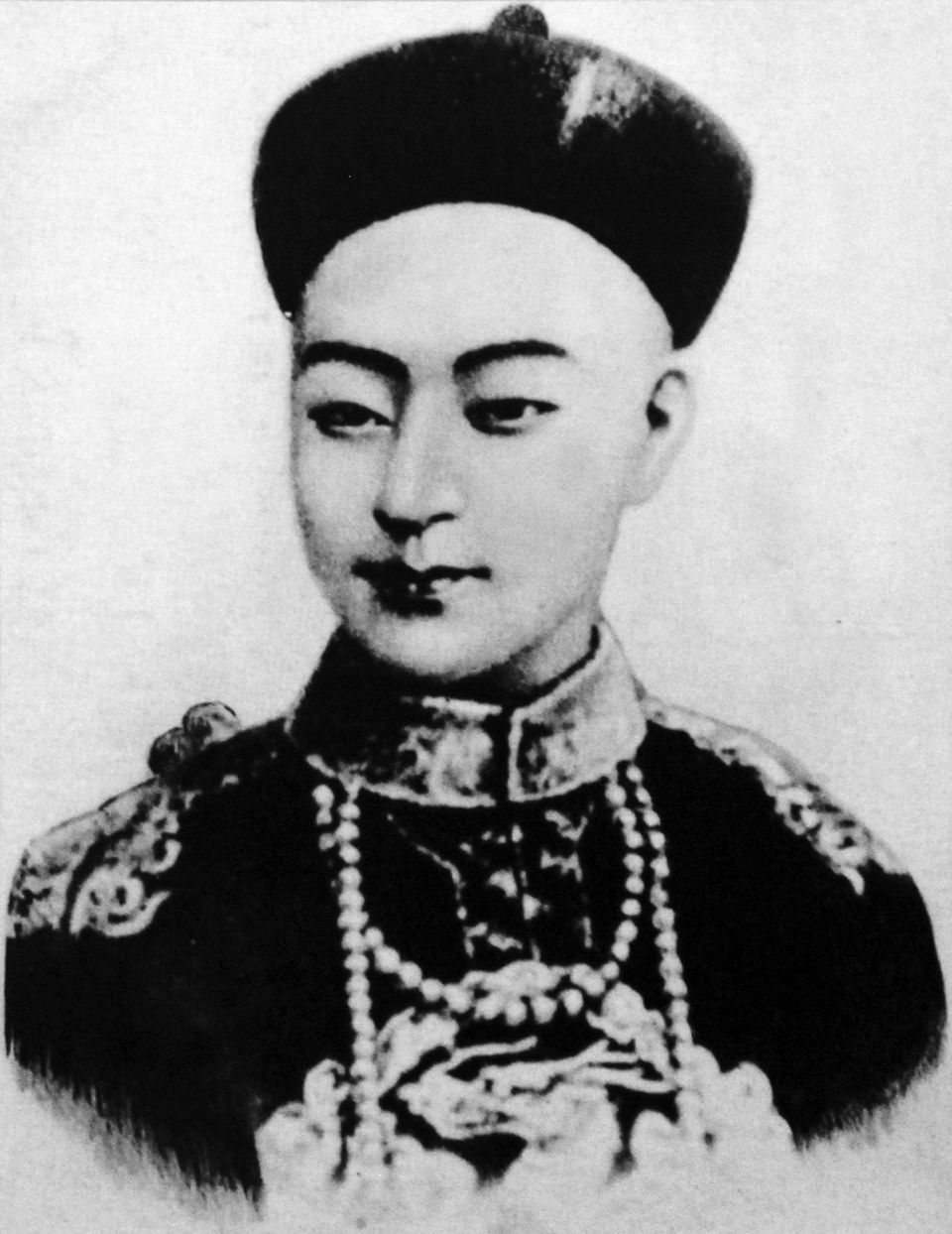
A portrait of the Guangxu Emperor, whose accession to the throne required a complex web of adoptions (Fotoe)
One of the main concerns was the potential for adopted children to be divided in their loyalties between their new parents and their birth parents. Families with daughters and no sons could “adopt” a son-in-law, a practice known as matrilocal or uxorilocal marriage.
While the arrangements varied, the children of such a union, and sometimes even the husband, would take the surname of the wife’s family, and thus provide the necessary heirs to sustain a bloodline. But such arrangements could also be complicated. Local officials were sometimes called in to adjudicate cases when the husband of an uxorilocal marriage threatened to take children back to their own families, or to settle inheritance disputes between the families of the husband and wife.
In the stratospheric realm of imperial life, adoption could often cause far more problems than it solved.
In 1521, Zhu Houcong ascended the throne as the Jiajing Emperor, succeeding his cousin, the Zhengde Emperor. The sole heir to the Hongzhi Emperor, Zhengde had the misfortune to die childless. To make this succession work, the new Jiajing Emperor had to be adopted by his uncle—who had been dead for nearly two decades. In exchange for the throne, the adopted emperor would have to perform the rituals honoring his new ancestors. Things became messy when the Jiajing Emperor proved unwilling to conduct the proper ceremonies to his deceased uncle, claiming that his loyalties remained with his birth father.
Ultimately, the Jiajing Emperor resolved the problem by posthumously elevating his birth father to the position of emperor, complete with his own imperial tomb, and executing or banishing any courtiers who took a different view on the issue of imperial adoption.
Nearly three centuries later, the rulers of the Qing Empire faced a similar problem. The coronation of the Guangxu Emperor in 1875 required his aunt, the Empress Dowager Cixi, to finesse the fact that the new emperor was a cousin of her recently deceased and heirless son, the Tongzhi Emperor. Guangxu needed to be adopted by Tongzhi’s late father to maintain father-son succession, and Tongzhi would then posthumously “adopt” one of Guangxu’s future sons to provide for the dead emperors’ ritual needs in the afterlife. Unfortunately, the plan hinged on the Guangxu Emperor having male children of his own—which never transpired, either for Guangxu or his nephew and successor, Puyi.
Among ordinary Chinese, adopting sons appears more commonly in historical records than adopting daughters, mostly because legal and social prejudices only recognized patrilineal kinship; women, who did not usually appear in the legal documents governing inheritance, were not technically “adopted” into that lineage. Nevertheless, girls could be raised outside their birth families, and records suggest that they were more available for adoption than boys, due to the same prejudices.
Though there were undoubtedly families that adopted girls for purely altruistic reasons, adopting daughters could also be a means to provide caregivers for a household or attract a son-in-law for an uxorilocal marriage. There were also instances of families adopting tongyangxi (童养媳) or “child brides,” who would one day marry one of the household’s male children (and do the chores in the meantime).
Whatever strategies a family employed, securing an heir was crucial for the parents’ comfort. Lineages required heirs to be sure that all members of the clan were accounted for in the afterlife. But adoption was never easy and could lead to complications of loyalty and legacy in families of potentially any social rank. The philosopher Mencius may have articulated the original imperative, but he also helpfully wrote of its challenges: “Heaven gives birth to two creatures,” he warned, “in such a way that they only have one root.”
The Challenges of Adoption in Imperial China is a story from our issue, “Modern Family.” To read the entire issue, become a subscriber and receive the full magazine.
Related Articles