Fresh graduate Zhao was one day into her first full-time job at a state-owned enterprise in Beijing when her boss asked her to email the neighboring department, which consisted of just two people: a senior manager and a younger colleague. It seemed like a straightforward task for the 26-year-old master’s degree graduate, except she was struck by a problem: How should she refer to them?
If Zhao, who agreed to be interviewed under her last name, addressed them together, what honorifics would be appropriate? “Manager So-and-so, Brother So-and-so” sounded too casual, while calling both men “Teacher,” a common, broadly applicable Chinese honorific conveying respect, seemed inappropriate given the difference in their ranks. Embarrassed at the thought of being patronized or seeming to need babysitting from her new colleagues right off the bat, she made an executive decision: send the email directly to the senior manager and copy the junior. That way, she’d only need to write one form of address.
However, when she hit send, something immediately felt off. After a prolonged internal struggle, Zhao went online to search for the “correct” protocol. It turned out that, according to popular opinion, she had gotten it backward: she should have emailed the junior staff member and copied in their superior. That way, the younger colleague could handle the task while the manager stayed in the loop. She recalled the message and resent it.
This seemingly trivial but anxiety-inducing decision points to more than an individual failing; it reflects a collective gap in professional etiquette and skills among China’s young graduates. For some, especially those born after the turn of the millennium, tablets and WeChat were a bigger part of growing up than PCs and email, meaning they may have had less exposure to traditional computer skills than the 1980s and 90s generation who came of age as the technology took hold in the country. This gap can extend from email etiquette to proficiency in office software such as PowerPoint and Excel. Professional communication—email etiquette, file handling, formal messaging—is rarely taught in depth in universities’ career guidance courses. The result is a cohort of young graduates expected to absorb the unwritten rules of office life by osmosis.
Read more about young graduates in China:
- Dilemma in Ivory Tower: The Employment Crisis Facing Young Chinese PhDs
- Bottom of the Class: The Woes of China’s Liberal Arts Students
- Meet the Mature Chinese Students Ditching Deadend Jobs to Study Abroad
Zhao feels this distinctly. “While the company doesn’t specifically stress these issues, my managers do value everyday etiquette,” she says. “In one meeting, they specifically mentioned that how you speak and conduct yourself, especially when dealing with superiors, is still important.”
On Xiaohongshu (RedNote), Zhao’s experience is widely echoed by thousands of posts that eagerly solicit advice on how to write an email or communicate at work. With a record 12.7 million university students expected to graduate this year and enter the workforce, the gaps in these workplace skills are becoming more evident. In July this year, the hashtag “so many college students don’t know email etiquette” topped Weibo’s trending list and drew nearly 24 million views. Many accompanying comments lamented how today’s young people have apparently lost basic office communication skills.
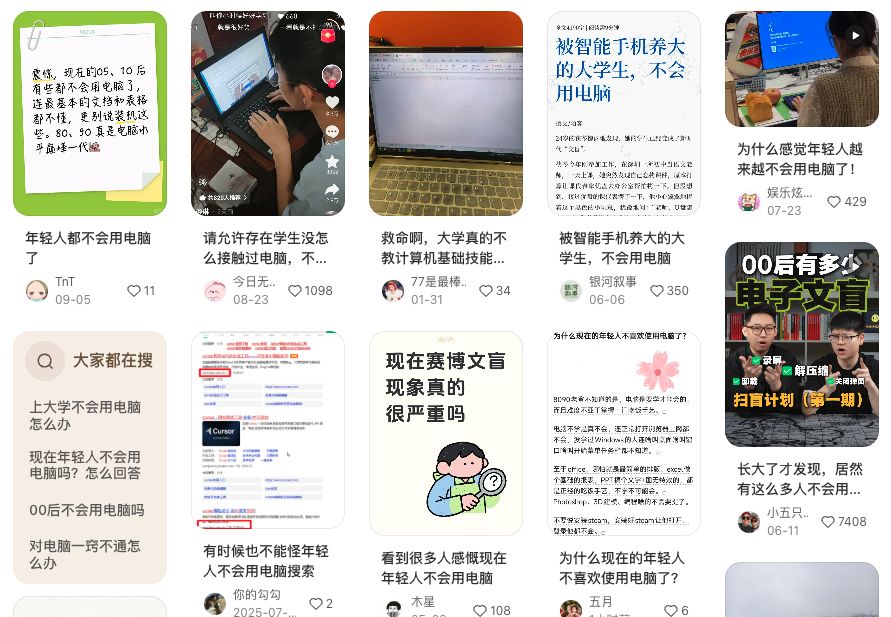
Young people’s computer literacy has also become a trending topic on social media, with many arguing that the widespread use of smartphones and apps has meant that some Gen Z users never had to learn basic computer skills that are expected in the workplace (screenshot via Xiaohongshu)
Xia Bingbao (pseudonym) is among employers bewildered by the lack of these interpersonal skills. An administrative teacher for more than 10 years at a university in Zhejiang province, the 35-year-old recalls a recent experience when recruiting volunteers and full-time teachers that left her wondering whether she and the applicants had switched roles. As she describes, a typical phone call would begin: “Teacher, hello, I’d like to ask about your school’s recruitment process. Am I eligible?” Then a pause, waiting for Xia to pick up the conversation. “They didn’t introduce themselves,” she says. “No name, no school, no context.”
She says the emails were even worse. Only one in 10 had any body text. Many applicants attached only their materials, without a subject line or any explanation of who they were. When she asked for revisions, some students were impatient. “It felt like I was the one begging them to come and work here,” she says wryly, adding that student recruitment feels very different from when she started working in the profession a decade ago.
Xia posted about her frustrations on Xiaohongshu, only to receive pushback: Some argued that all the necessary information was already included in the requested form, while others questioned the need for an additional self-introduction in the email body. She was surprised at first, taken aback by a “different generation,” until she saw a comment from someone who said they had been offered a position precisely because of their smooth communication.
“So, recruiters do value this,” Xia says, validated by the discovery, adding, “The person who receives the emails isn’t necessarily the interviewer, so many candidates think it’s unimportant and don’t pay attention to it. But it does.” If two candidates are equally qualified, she says, the one who makes a better first impression—who is polite and pays attention to detail—is more likely to be chosen.
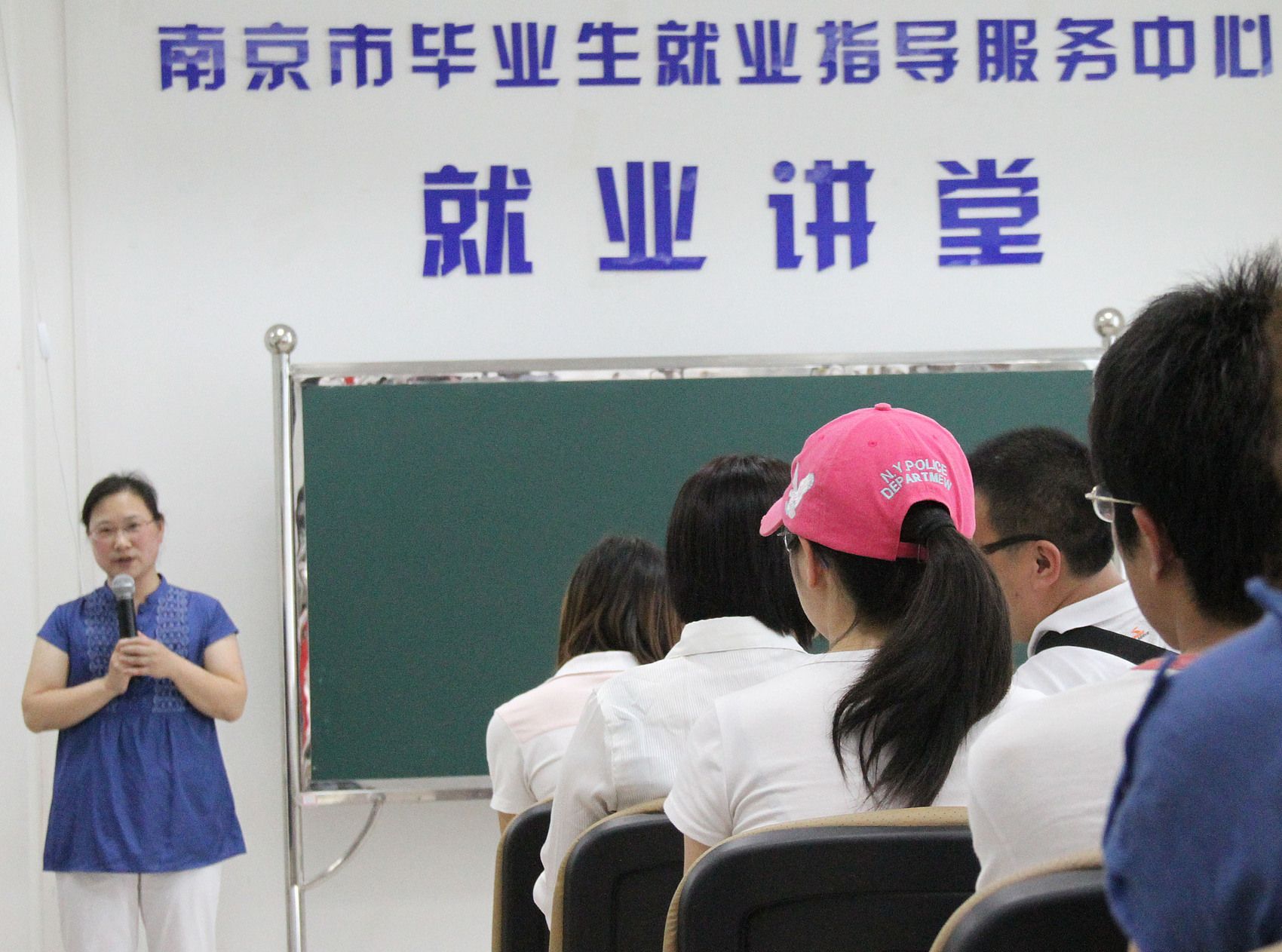
Before 2021, career guidance courses were generally offered only to third- and fourth-year university students. They were later expanded into compulsory “career education” courses for students across all year levels. Though many students have complained about them being fluff courses. (VCG)
Liu Lu, a professor of English at Peking University’s School of Foreign Languages, echoes Xia’s experience, feeling that students’ standard writing training is “generally quite lacking.” Despite the curriculum including a “practical writing” course that teaches students how to write emails and introduce their cover letters, the problems persist. “They’ll just throw a file over with no text.”
Email, Liu notes, is not a traditional Chinese medium—it is an import, with its own rules of address, composition, and purpose. “Chinese people might assume that everyone can write, but in the West there are specific fields like ‘business writing’ and ‘professional writing’—disciplines that require learning established rules and conventions,” says Liu. She adds that in the United States, nearly every university has a dedicated writing center and requires first-year students to complete a composition course. In China, there’s no such emphasis on formal communication; writing classes sit on the periphery of core curricula.
With the rise of AI in recent years, LLMs have become a tool many young workers turn to for help with day-to-day office communications. Dian, who asked to share only her last name, used to go through “500 rounds of internal warfare”—writing and rewriting, hitting send, closing her phone in haste—when messaging supervisors. The 25-year-old marketing major works in operations at an American company and now relies on AI to draft email responses and messages. “AI speaks more accurately and rigorously than I do. I honestly can’t imagine how I got by without it,” she says, with a laugh that sounds only half joking.
According to the China Internet Network Information Center, by June 2025, people under 40 make up 74.6 percent of the country’s 515 million generative AI users—the core demographic by a wide margin. A 2025 survey by 51job found that 79.1 percent of graduating students in 2025 used AI tools to strengthen their job applications, including polishing resumes, rehearsing interviews, and drafting outreach messages. For this generation, turning to an LLM when faced with a message they don’t know how to phrase is less a choice than a reflex.
Liu, the professor, worries about the shortcuts AI offers. “I believe it’s still essential to maintain one’s own independent thought. Writing itself is a form of cognitive training,” she says. “It involves weighing various factors to achieve the most effective communication.” She adds that there’s now a tendency to delegate to AI, “which, frankly, is quite concerning.”
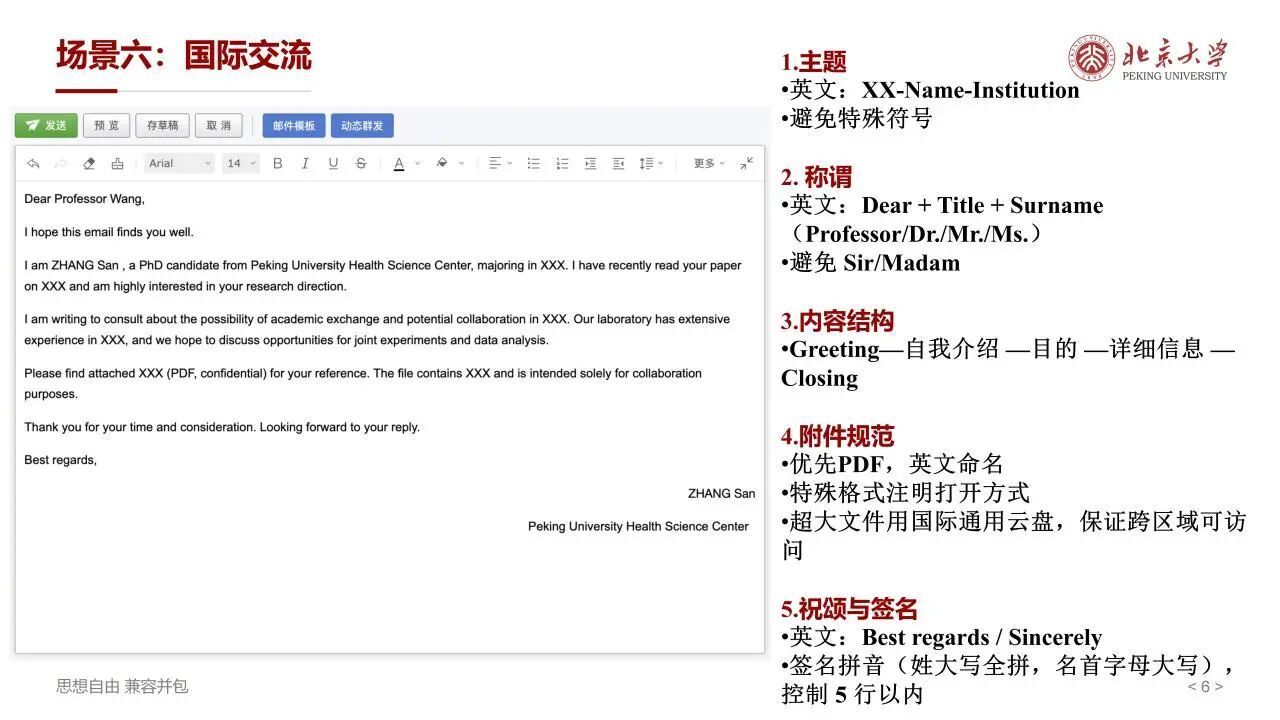
Peking University released an email writing guide in January, listing templates for six different scenarios (screenshot via WeChat)
Dian, however, doesn’t see using AI as handing over her thinking to a machine. “I see it more as a tool for polishing,” she says. “It can’t decide for me what to say in an email.”
Xia, the administrative teacher, agrees. She notes that AI can help only if the user knows what to ask for. “AI might give you something more complicated, which is not necessarily a good thing,” she says. “In any case, you first need to understand what to pay attention to when communicating in the workplace or emailing someone during a job application process. That way, you’ll also know what aspects you can turn to AI for help with.”
Educational institutions are also stepping up efforts to better prepare students for these workplace scenarios. In January 2026, Peking University released an email-writing guide for students that trended on Chinese social media. The guide covers subject lines, forms of address, attachments, and reply etiquette—basics that most young workers are expected to know by heart. Peking and Tsinghua universities have also opened writing centers, and some universities now offer practical writing courses.
“The most important thing,” Liu says, “is that they go through a learning process of their own.” Otherwise, the tools designed to help them communicate may only make the silence grow louder.
Related Articles