

On a trip home to Guangzhou over the seven-day National Day holiday, Chen Xinyi ate the same dish five times.
Baqieji (白切鸡), also known as baizhanji (白斩鸡), or “white-cut chicken,” is as unadorned as its name: a whole bird poached in water or light broth, chopped into shades of beige or yellow. But dismiss it for its simplicity, and you risk offending a whole province.
In the eight years Chen has spent studying and working in Yunnan province, 1,000 kilometers inland from Guangzhou, she only gets to relive the true taste of home during the holidays. The chicken in Kunming has its own merits, but it’s just “not as chicken-y as it is in Guangdong,” says Chen.
According to archaeologists, domesticated chickens have been clucking around China for more than 8,000 years, but Guangdong has developed a stronger appetite than most for these succulent birds. In 2024, Guangdong residents ate nearly twice as much poultry as the average person in China, while around a quarter of China’s yellow-feather chickens are raised in the province. Such is Guangdong’s almost sacred reverence for the chicken that it sometimes appears on traditional banquet menus under the alternate, mythological name “phoenix” (凤, feng).
Read more about Chinese food culture:
- Who Owns China’s Ramen?
- Dangerous Delicacies: Inside Yunnan’s Wild Mushroom Obsession
- Our Gang’s Food: The Mixed-Up Cuisine of the Magic City
The province’s poultry obsession is encapsulated in the saga of Mo’s Chicken Pot. Earlier this year, after a food blogger brought this village joint in the Shunde district of Foshan out of obscurity, some patrons allegedly drove 2,000 kilometers or waited seven hours for a taste of Mo’s medicinal broth. The visibly exhausted owner’s increasingly desperate pleas for people not to come only meme-ified the whole affair.
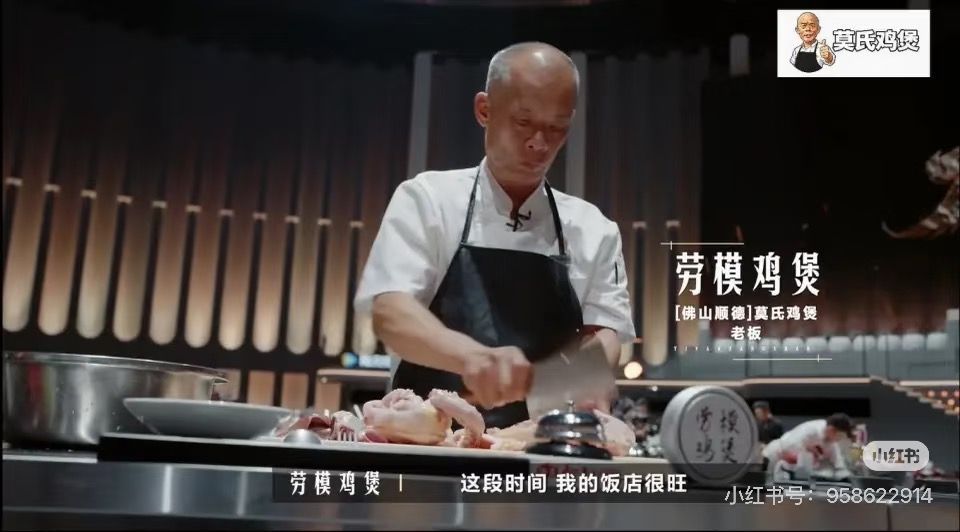
Since going viral online, the owner of Mo’s Chicken Pot has opened several new locations across Guangdong and appeared on the variety show Chef of China 2, representing Cantonese cuisine (screenshot via Xiaohongshu)
Accounts of Guangdong’s exceptionality as a chicken province often evoke a popular local truism that echoes Chen’s own analysis: “The chicken tastes like chicken.” The simplicity of this standard is intimidating in its authority, and whether an eater “gets it” is a barometer of their own gastronomic sophistication. For Chen, the simple yet powerful essence of Cantonese chicken is best described as “a hyper-concentrated experience of chicken soup, locked inside the tender yet compact fibers of the meat.” She explains that premium chicken-ness is a layered adventure: a thin, glossy skin with a springy crispness, a gelatinous, translucent layer of fat, and meat that progresses from supple richness to sweet-savory depth the closer it gets to the bone. “The harder I try to describe it, the hungrier I get,” she says.
Scientists have nailed chicken’s mouthwatering umami flavor down to amino acids and unsaturated fatty acids, both of which accumulate in greater quantities during a slow raising process. Food writer and consultant Lin Weihui, meanwhile, explains in a blog post the many factors that have to align for the optimum chicken-y taste: the right breed, raised for 110 or 120 days with a combination of free-range exercise and a diet of grains and worms. Even then, the excellence of a white-cut chicken—the most accurate litmus test of a chicken’s quality—is not guaranteed without careful preparation: a broth heated to “shrimp-eye” level—90 degrees Celsius until small bubbles form—followed by a three-step poaching method to safeguard texture, and finally a cold bath to give the skin that satisfying bounce.
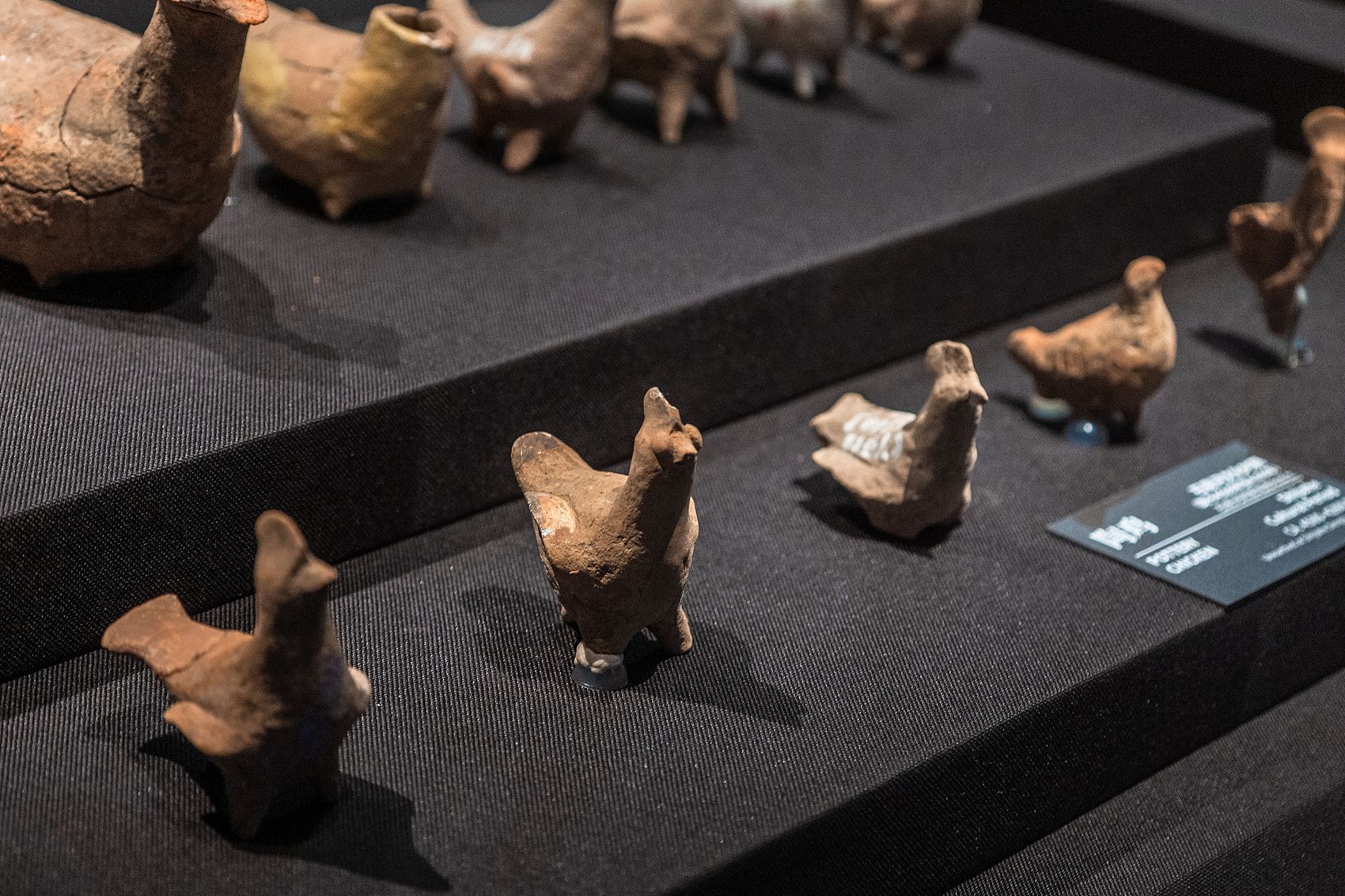
A series pottery chicken from Shijiahe culture, dating to around 2,500 to 2,000 BCE during the Neolithic period, on display at the Shijiahe Site Museum in Tianmen, Hubei province (VCG)
“But chicken-ness is not just one precise flavor,” historian Zhou Songfang, who has studied the history of Cantonese food, tells TWOC over the phone. By the middle of the last century, famous gourmands were already discussing the merits of different Guangdong chickens according to their terroir, Zhou explains in an article for local outlet Yangcheng Evening News. Whether they were fed fermented rice wine in Foshan or raised on milk from a Hong Kong dairy farm had a big impact on their eventual flavor.
Today, chicken provenance has become a matter of commercial identity and local pride. Taking a break between meals on holiday, Shenzhen-based journalist Phoebe Zhang found herself at the Chicken Culture Museum in nearby Qingyuan—an appellation so renowned that “it’s hard not to eat Qingyuan chicken in Guangdong,” Zhang writes in her blog. Qingyuan chicken is well known for its succulent meat, firm skin, and delicate bones, as well as, of course, its intense and aromatic chicken-y flavor.
Alongside chicken-shaped maps and anatomical diagrams, the museum has a whole wall dedicated to types of chicken from all over China, detailing “what they’re good at, [and] which dishes they’re good in,” Zhang recalls to TWOC over the phone. The museum is run by the largest supplier of Qingyuan chicken in China, Tinoo’s, adding to citywide branding efforts that already include geographical-indication standards and official partnerships with 66 restaurants across nine cities nationwide.
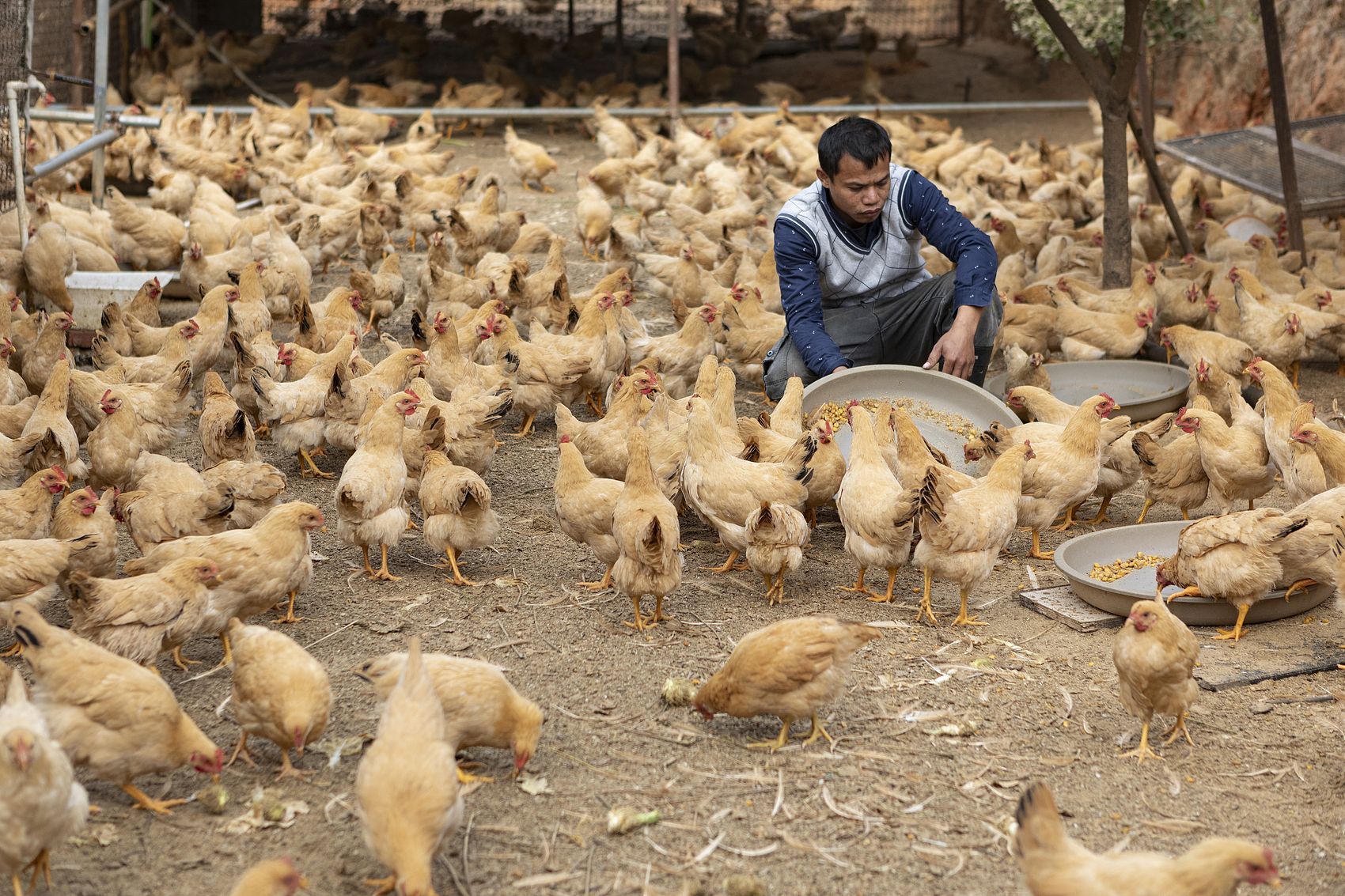
Many chicken farms in Guangdong take pride in raising free-range chickens, prized for their rich, distinctive flavor (VCG)
Yet despite the regional pride around Guangdong’s chicken varieties, the province’s most revered local staple, white-cut chicken, “might not have been Cantonese to begin with,” reveals Zhou. Lin, the food writer, points to a 1792 book documenting what later became known as Huaiyang cuisine from the Jiangsu region that praises a “white-sliced chicken” long before any trace of the same appears in Guangdong. Lin speculates, however, that the dish probably got an upgrade after it went south.
This possibility might ruffle a few feathers in Guangdong, but the distinction between China’s culinary traditions hasn’t always been so clearly defined. “Before the late Qing dynasty, regional cuisines, like Cantonese or Huaiyang, didn’t really exist as a concept,” Zhou argues. “With limited movement of the population, there wasn’t a shared market.”
In the 1840s, the opening of Shanghai to foreign trade helped to create just this kind of market for people and their cuisine. With its waterway connections and easy access to popular goods like tea and silk, Shanghai quickly became the country’s new “it” city. Foreign merchants stepped into this new world seeking introduction to the Chinese compradors with the most experience, many of whom were Cantonese businessmen who had followed new opportunities north.
With these entrepreneurs came their food. At first, Cantonese joints in Shanghai popped up to serve their own community, offering Western bites on the side to survive in a local market not yet used to their flavors. But by the early 20th century, with the growing reputation of Cantonese revolutionaries fighting to modernize China, Shanghai’s flourishing pre-war gastronomic scene was flush with well-heeled diners and literati types ready to embrace Canton-maxxing.
Around the same time, Zhou tells TWOC that Cantonese restaurants in Shanghai were splashing out on ad space in the Shen Bao, a popular daily paper founded in the 1870s, to advertise menus featuring countless chicken dishes. “Some even claimed to use the famous Xinghua chicken shipped directly from Zhaoqing in Guangdong,” Zhou says, although he doubts whether the birds could have survived such a journey given the infrastructure of the time. Zhou suspects many were actually sourced locally, but, true or not, the claims speak to the growing appeal of a proper Guangdong chicken.
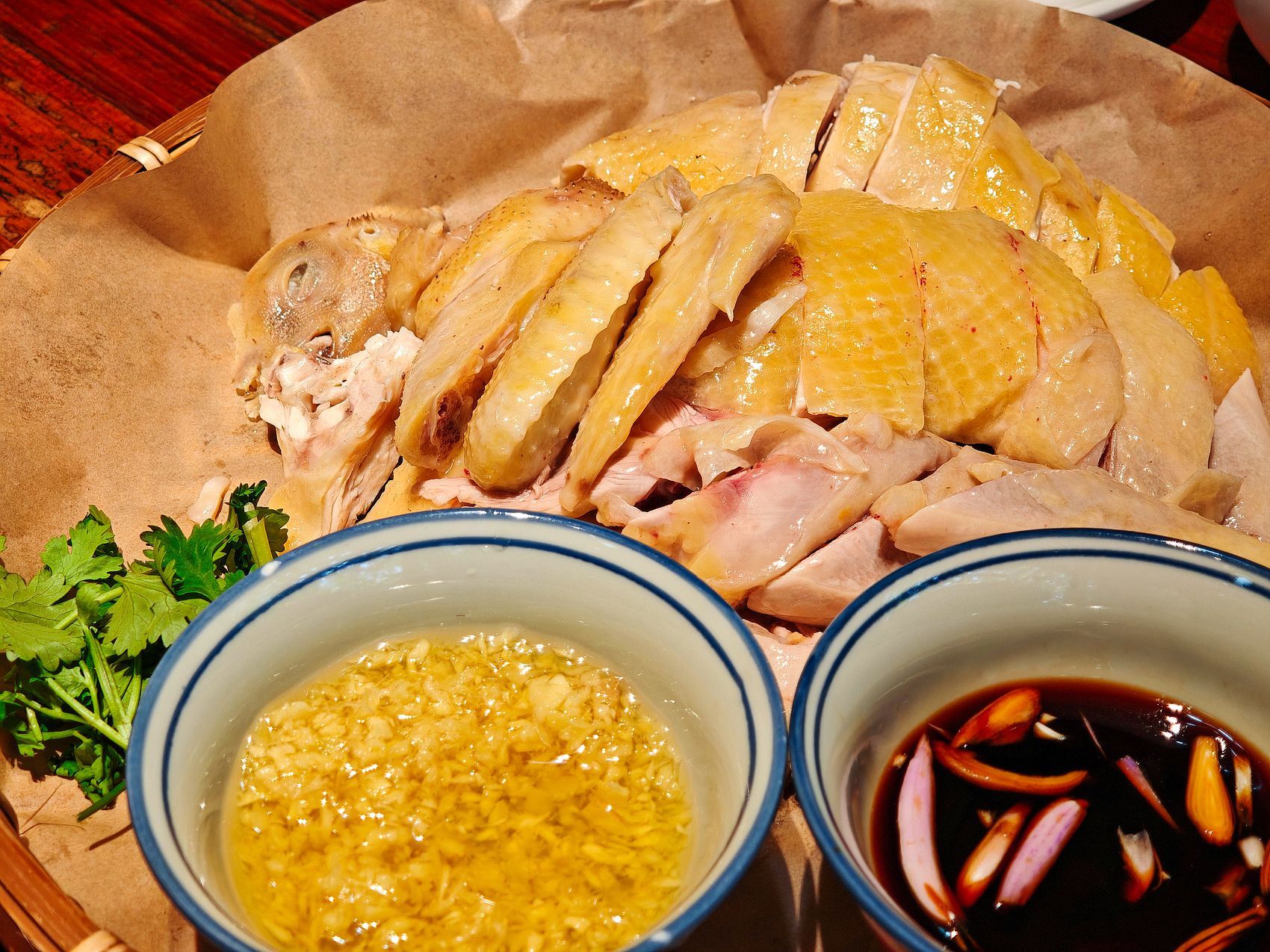
White-cut chicken is often served with two classic dipping sauces—ginger and scallion, and soy sauce (VCG)
By the second half of the century, the prestige of Guangdong’s food had spread beyond Shanghai. In the 1980s, Zhou was among the early birds to adopt Cantonese cuisine in his home province of Hunan, accessing this new culinary world through an internship at a hotel. Zhou recalls his first experience eating white-cut chicken as “a little scary” due to the pink color of the meat around the bones, a signifier of prime texture for Cantonese diners in the know. But it didn’t take Zhou long to jump on the bandwagon. The winds of reform and opening up were blowing in from the coast, bringing new experiences and opportunities: each bite of pink-fleshed chicken from the frontlines was a step into this new era.
At the same time, Guangdong began absorbing culinary influences from elsewhere, and a different bird migrated in the opposite direction. Coconut chicken hot pot combines prized Wenchang chicken from Hainan with fresh coconut water in a quick boil to create a dish undeniably Shenzhen. A popular version of its origins credits Huang Yabin, an Indonesian-born Chinese man who moved with his family to Xinglong, Hainan, in the 50s. At the time, many ethnic Chinese fled persecution in Southeast Asia and returned to China. Huang moved to Shenzhen in the 80s, and in 1996 began operating his restaurant under the name Fatty’s Coconut Chicken, bringing quintessentially Hainanese ingredients together in the same pot. Though the exact story is still a topic of debate—not least among Huang’s own family—it was in Shenzhen, a place pulsing with business innovation, that the dish was standardized and franchised before spreading nationwide.
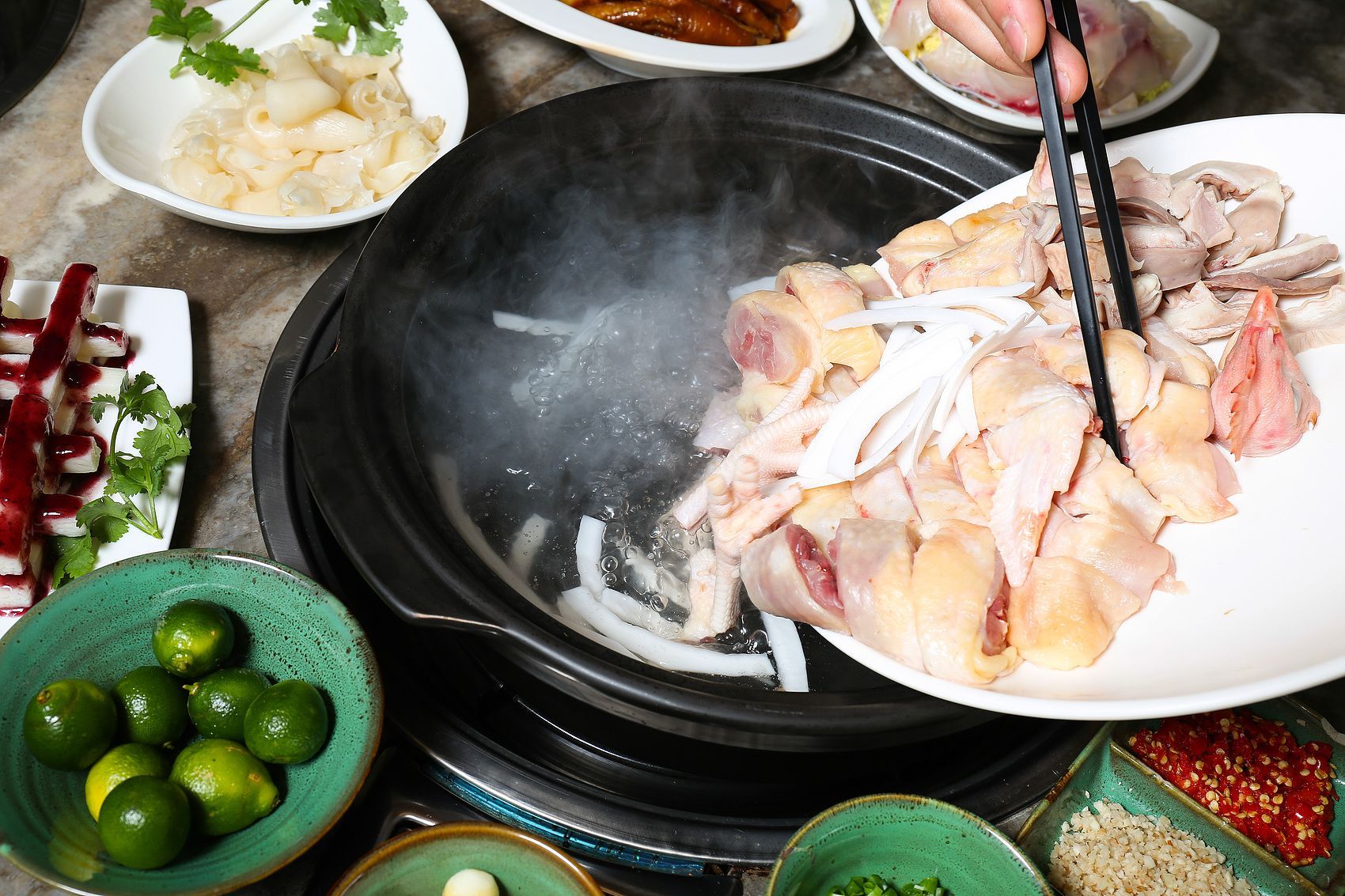
One account of coconut chicken hot pot’s origins says that, after Huang Yabin’s mother came from Indonesia to visit him following China’s reform and opening up, she improvised a dish of chicken cooked in fresh coconut water in a teahouse kitchen. Huang was so taken with it that he later made it the inspiration for his hot-pot restaurant. (VCG)
This was a gateway chicken for Zhang, the journalist and food blogger based in the city. Originally from Yangzhou, she moved to Shenzhen from Beijing in 2018. “[Coconut chicken hot pot] seems simple…but they combine everything until it feels ‘just right’,” she tells TWOC. The meat is usually served with dipping sauces, brought to another level by their synthesis of soy sauce, sand ginger, and a squeeze of calamansi. “Not just anyone can come up with this kind of combination,” says Zhang.
Dishes like coconut chicken toppled Zhang’s flawed impression of Guangdong food as “all kinds of seafood…just steamed and drizzled with soy sauce.” Now, more than 100 chickens later, she has learned that “even the plainest-looking Guangdong dishes are thoughtfully designed.” On trips back to Beijing, she can discern a frozen, non-chicken-y chicken in a single bite. “To tell how good a restaurant is, order its chicken. You’ll know right away whether they put their heart into it,” she says.
A popular line about the Cantonese diet jokes that “no chicken can get out of Guangdong alive.” But much to Guangzhou local Chen’s lament, it seems just as hard for them to get out of the province dead. Chen prides herself on cooking decent Cantonese food, but white-cut chicken is a dish she gave up on after just one try. A tele-consultation with family back in Guangzhou to diagnose the problem pointed to weak supply, despite the bird in question bearing a Qingyuan label. All Chen can do for now is look forward to her next trip home.
Related Articles