It is Shuangjiang (霜降), the Chinese solar term known as Frost’s Descent, a fortnight that runs from late October into early November. In much of China, the air becomes crisp, and the persimmons turn orange. In villages from Shaanxi to Sichuan, grandparents impart the same wisdom: only with Frost’s Descent does a persimmon truly sweeten, for the cold drives out the astringency and concentrates the sugars, transforming a puckering fruit into something closer to honey wrapped in paper-thin orange skin. To bite into a frost-kissed persimmon is to taste autumn: warm, golden, and fleeting.
In China, the persimmon is not only a fruit but a cultural fixture. It has been fermented into vinegar and wine, steeped into tea, and worked into every corner of the Chinese kitchen. Its name, shi (柿), is a perfect homophone of shi (事), the word for “affair” or “matter,” creating a pun that is as much a part of folk culture as spring couplets. Calligraphers write the phrase shishi ruyi (事事如意), “may all your affairs go as you wish,” beside painted persimmons, and each autumn, social media revives the old blessing haoshi chengshuang (好事成双), “may good things come in pairs,” playfully rewritten with the fruit’s own character.
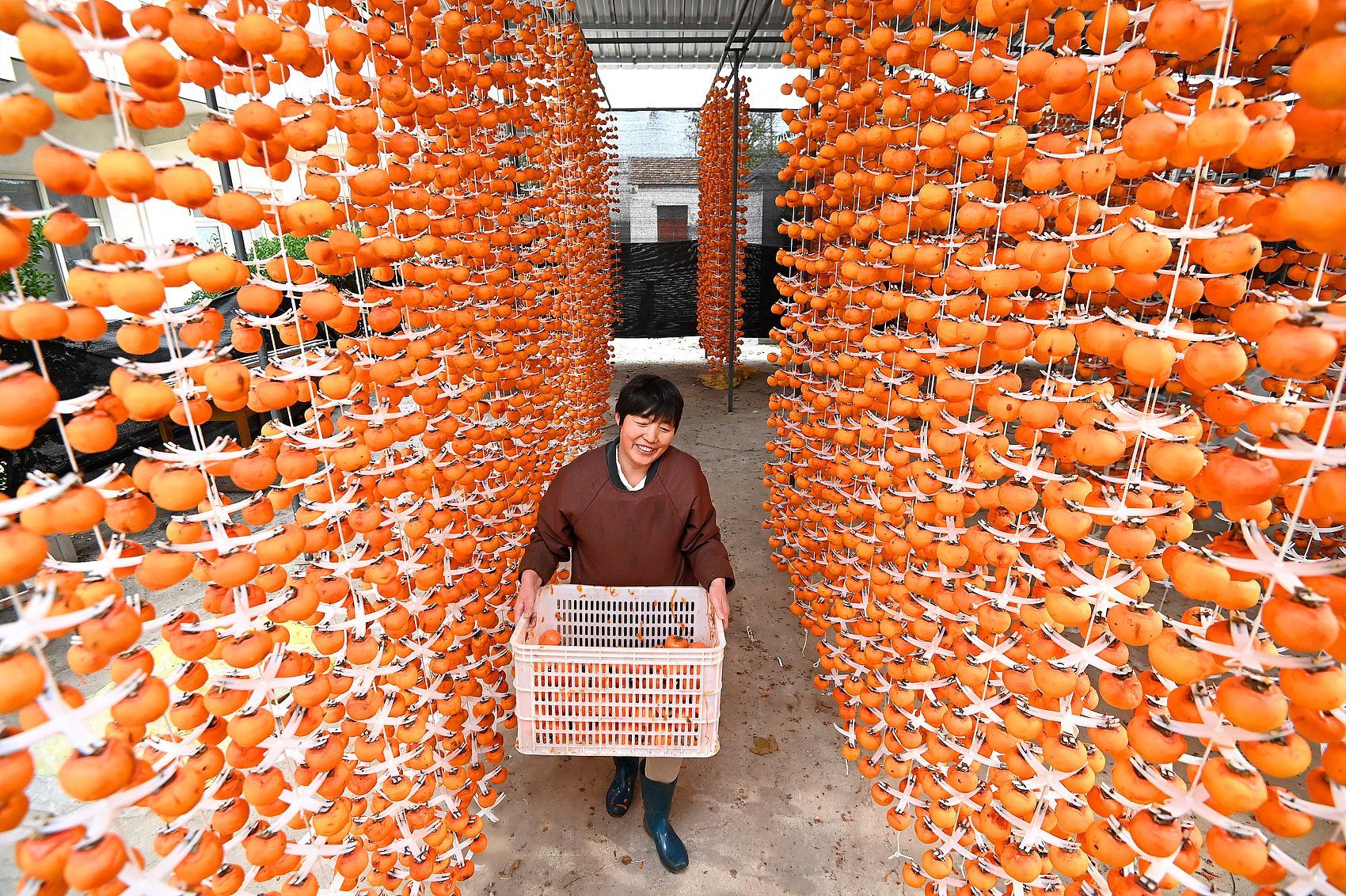
Farmers in Handan, Hebei province, process persimmons as they prepare for a bumper harvest (VCG)
Yet there is a peculiar irony hanging from the persimmon’s etymological branches. This fruit, cultivated in China for more than two millennia, bears an English name that points not to China or any other Asian origin. Instead, the word “persimmon” stems from the Algonquian languages of North America, carried across an ocean by English colonists who encountered a related fruit among the indigenous peoples of Virginia.
Read more about China’s autumn food and drinks:
- How a Tiny Flower Becomes the Scent of Autumn in China
- Chestnut Chicken: The Perfect Autumn Dish
- All the Ways to Enjoy a Taste of Autumn With Lotus Root
A tale of two trees
The American persimmon, or Diospyros virginiana, is a small tree with different roots. Ranging from the US Gulf Coast northward to Pennsylvania and Illinois, its fruit is three to five centimeters across, dark red, and prized by those who know to wait for it. Yet it remains largely a fruit of wild harvesting and home gardens, never achieving the recognition or commercial stature of its Asian cousin.
American persimmon’s earliest English reference appears in A Map of Virginia, published in 1612 by Captain John Smith, an early English colonist in North America: “The fruit like medlers, they call Putchamins, they cast vppon hurdles on a mat, and preserue them as Pruines.” Within a few decades, the word cycled through a dozen spellings—pessemmins, pishamin, posimons, phishimons—before settling into the more familiar “persimmon,” which would eventually enter both the Oxford English Dictionary and Merriam-Webster.

The Texas persimmon (Diospyros texana), native to Texas and Oklahoma, looks very different from the persimmon most people in China are familiar with (VCG)
But the persimmon most commonly eaten worldwide today is not the American species the word was born with. English colonists took the Algonquian name they heard, and it eventually came to encompass another species, Diospyros kaki—the Asian persimmon, sometimes called the Chinese or Japanese persimmon. Native to China, it reached Japan in the seventh century and Korea in the fourteenth. In everyday Chinese speech, it is called shizi, in Japanese, kaki, and in Korean, gam. In 2023, China produced around 80 percent of the world’s persimmons, and yet in English, none of these names prevailed.
The fruit itself is just as difficult to pin down—characterized by both sweetness and astringency, the mouth-puckering quality that makes an unripe persimmon feel like chewing on wet chalk. Astringent varieties, typified by the heart-shaped Japanese Hachiya, demand waiting until the fruit softens to jelly, while non-astringent types, like the squat Fuyu, can be eaten crisp as an apple. China has its own distinguished array, from the Mopan persimmon of Beijing, flat as a millstone, to the pointed Fuping persimmon of Shaanxi, whose flesh becomes shibing, the dried persimmon cakes that have graced imperial tables and village pantries alike.
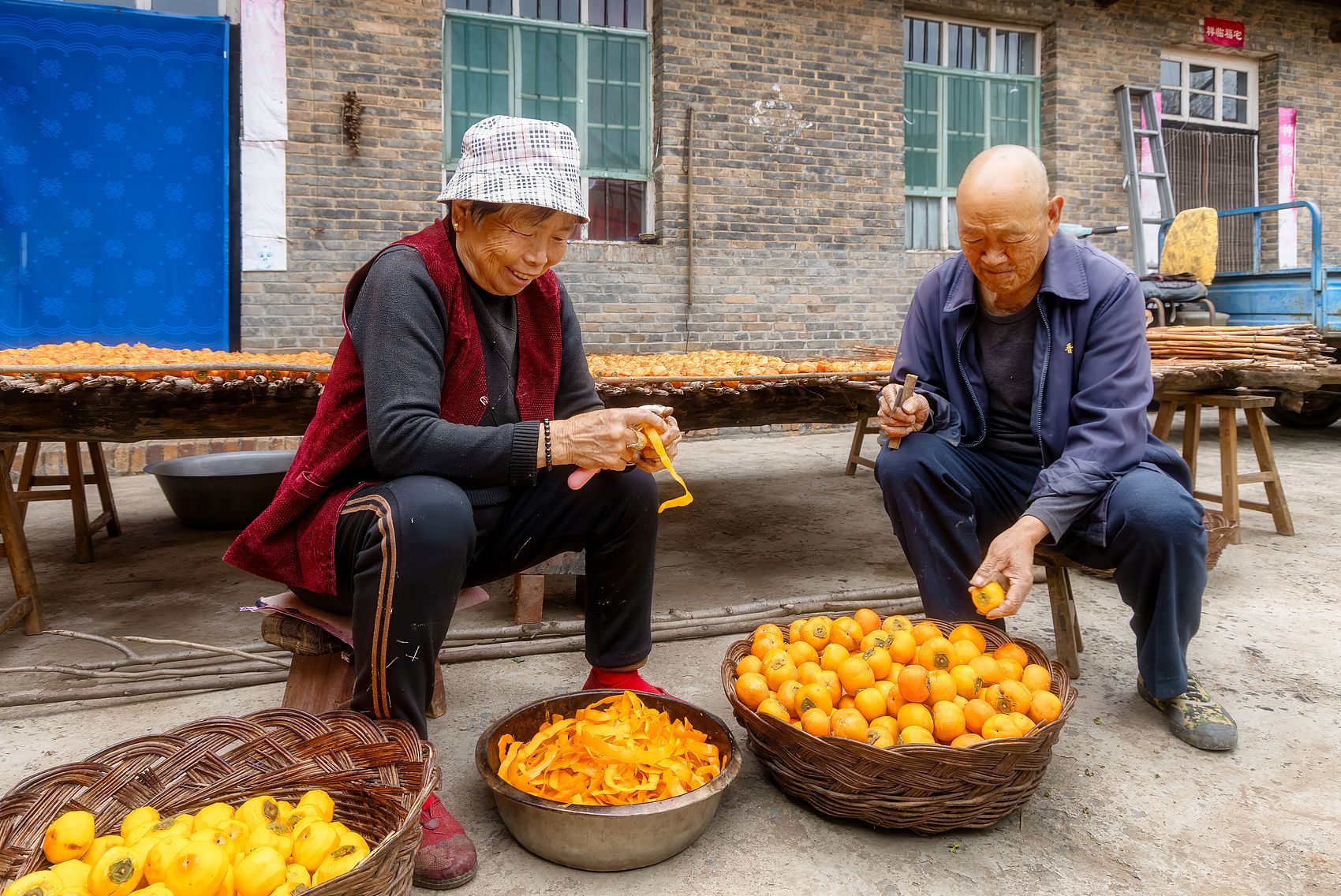
Golden persimmons cover the farmyards in Shandong as villagers busy themselves picking fresh fruit, peeling it, and laying it out to dry (VCG)
The persimmon’s astringency comes from soluble tannins that break down as the fruit ripens, and each region favors its own methods of coaxing out the sweetness, an art honed over generations. In Japan, the fruits are wrapped in paper and left to blet, a ripening process that lets them soften and sweeten until they yield to the touch. In China, meanwhile, grandmothers hang strings of persimmons from the eaves to dry into shibing, swaying like lanterns in the winter wind—a practice as much about patience as preservation.
Going global
In the 19th century, Diospyros kaki embarked on its own transoceanic journey distinct from its American cousin, traveling from East Asia to the Mediterranean and the Americas, finding fresh soil and new hands. Today persimmons appear in markets from Sydney to São Paulo, where the fruit took root in the 1890s and grew into a local staple.
As the tree became established in Europe, variations of its Japanese name took root in French, Italian, Spanish, and German, where the fruit is commonly known as kaki. English alone persisted with an Algonquian word that remembers Virginia rather than East Asia. The Japanese name did eventually register in English, recorded as early as 1727 in a translation of German writer Engelbert Kaempfer’s History of Japan, but primarily as a botanical term, never as the everyday word for the fruit on the supermarket shelf.
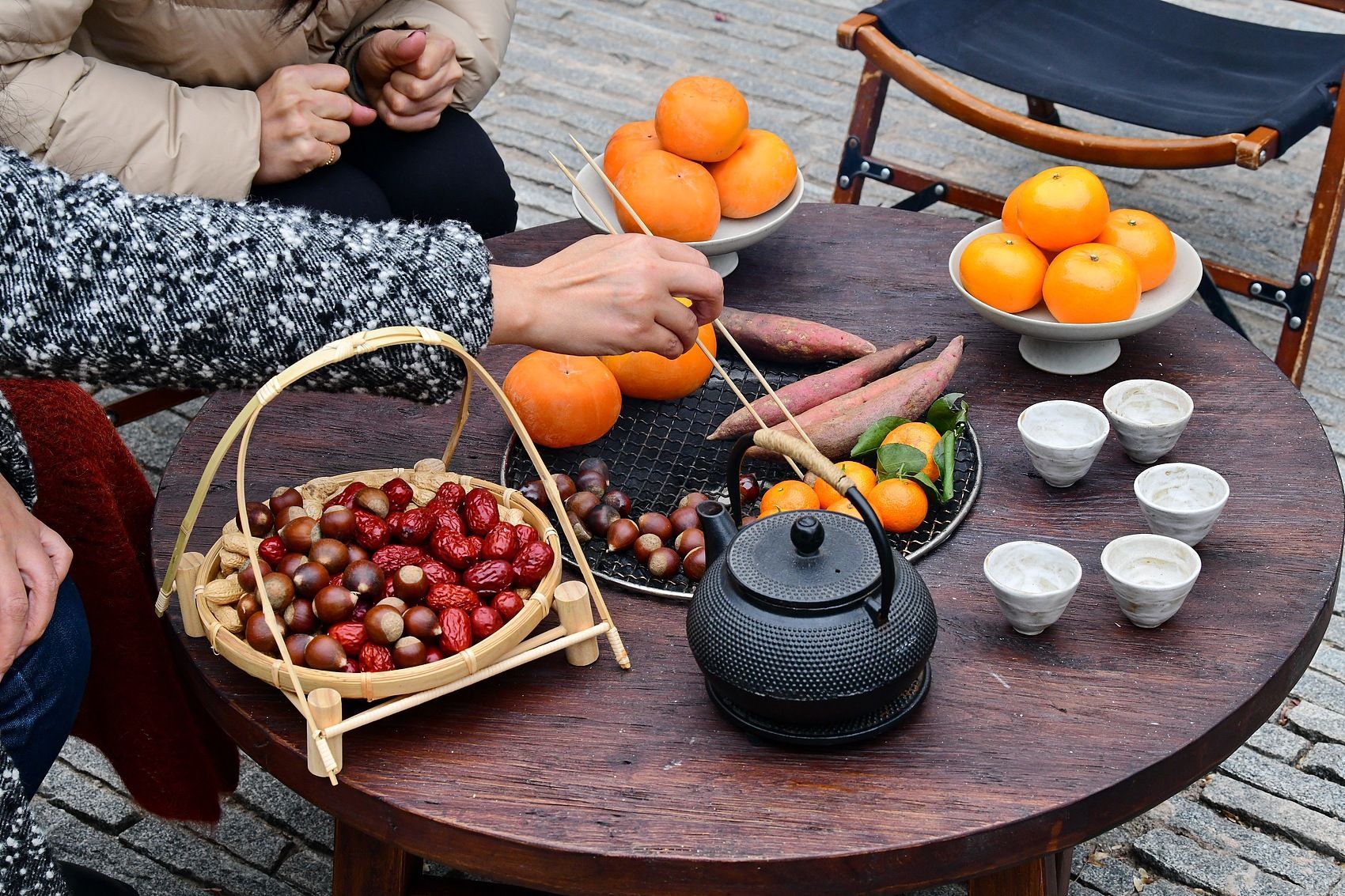
Persimmons are a staple at Weilu zhucha (围炉煮茶, “boiling tea and sitting around a stove”), an ancient practice of gathering to chat or play games over tea and snacks that has become trendy among young people in recent years (VCG)
Could this have been otherwise? Words usually travel in tandem with the things they name. When sushi arrived in the West, English swallowed the word whole along with its retinue: wasabi, nori, and umami. Karaoke also survived the journey with its romanized Japanese form intact. In each case, it is likely that the borrowed word prevailed because the thing itself was foreign and borrowing the name was easier than translating it into something else.
Such a journey isn’t unprecedented for Chinese fruit. Descriptions of lychees arrived in Europe through Portuguese traders in the 16th century and the name stuck, while kumquat, from the Cantonese for golden orange, walked straight into standard English. When something is distinctive enough, the world eventually learns to call it by its own name.
But there are alternate outcomes to this lexical process. The kiwifruit is native to China, where it is called mihoutao (猕猴桃), literally “peach of the macaque.” English first knew it as the Chinese gooseberry, even though the two fruits bear little relation besides sharing a tart flavor. The New Zealand growers who commercialized it later renamed it after their national bird, and the original name all but vanished from global trade. The name’s Chinese provenance was lost twice—displaced by the demands of international commerce.

Various types of persimmons are now available in supermarkets across China (VCG)
The persimmon sits somewhere between these two linguistic fates. It arrived in English already named, but by someone else, and for a different fruit. That is a hurdle that sushi and lychee never faced. Language is memory; words are how we remember what matters, and when a name changes, we lose some of the rich cultural associations that come with it.
The question is whether shizi—an everyday word in China, the fruit’s own name—can make the journey these other words made, carrying not just the fruit but shibing, the puns, and the whole cultural world the word grows in. It would require no decree, no campaign—only time, and enough people saying the word as they hand the fruit across a market stall.
Related Articles