Wang Yuyang (王郁洋)
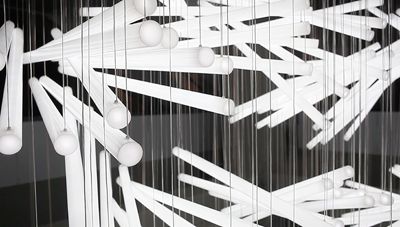
“Light, Floating Down like a Feather”
Type: Installation
Materials: Energy saving lamps
Size: Various
Time of Creation: 2012
Exhibition Record: 2012 “Reactivation” theme at The 9th Shanghai Biennial, Shanghai Power Station of Art, China
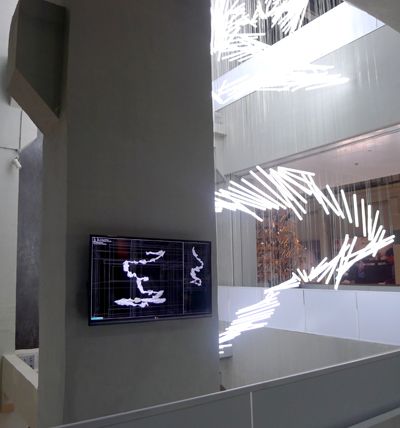
In this work, the fantasy and poetic expression “Light, Floating Down like a Feather” (《光,像羽毛一样从空中飘落》Guāng, xiàng yǔmáo yīyàng cóng kōngzhōng piāoluò) was defined by a computer algorithm. Wang used a virtual environment with its own weight and gravitational pull, and in this environment, a fluorescent tube of light falls, imitating a feather. Within this environment, the fall of the “feather” can be precisely generated with accurate calculations and figures.
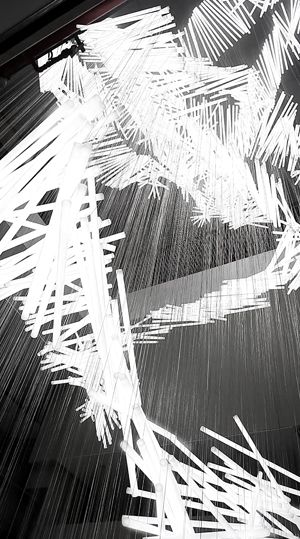
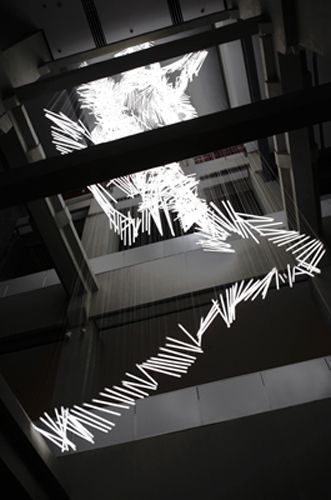
Wang uses these calculations to make a stop motion sculpture involving hundreds of lights that show the dance of gravity and resistance in time. The process of the fall is as organic as possible in his virtual world, so there are an array of variables that produce different results in the descent. With a working knowledge of physics and algorithms, distinct, non-subjective movement simulation shapes the process; but the finished three-dimensional process is even more complex.
More importantly, this work can be recreated with different, and nearly infinite, parameters, each being an individual representation of a range of forces.
Of course, those infinite probabilities, much like that on a canvas, make the artist’s choice all the more important. The method of choice and presentation is a performance in itself. This also means there is no perfect choice for form and style, just one moment caught in time through light. The elegiac phrase “Light, Floating Down like a Feather” expresses a realistic simulation of recycling.
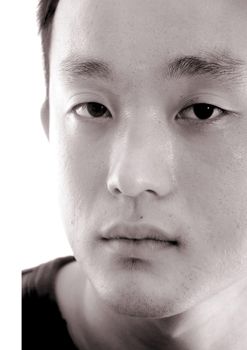
34-year-old artist Wang Yuyang, currently teaching at the Central Academy of Fine Arts (中央美术学院), believes in the concept of “letting the material speak for itself”. His experimental works, including installations, photography, video and painting, are all weapons in his expressive armory. His humorous and imaginative exploration of the human body and cognitive processes help broaden the conversation of artificial realities, the media, historical perception and body recognition. His work gives off a feeling of being multi-faceted, but the work itself always has a clear and complete identity.
Currently, Wang’s work “The Narrative of a Stack of Paper”is exhibited at a large-scale group exhibition called “ON | OFF: China’s Young Artists in Concept and Practice” at the UCCA (Ullens Center for Contemporary Art) in Beijing. – Alicia Zhang (张华阳)
Lü Huanhu (吕欢呼)
Born in picturesque Jiangsu Province, artist Lü Huanhu is renowned for her landscape paintings of plants, mountains and rivers, with simple but elegant features. She is also well-known for her work with fans, both round (圆扇 yuánshàn) and folding (折扇 zhéshàn). In ancient China, fans were often collected by the literati and nobility and were considered to be status symbols or tokens of affection between lovers. Through her work therefore, Lü combines traditional cultural and historical aspects reimagined for a modern audience. Her works were exhibited at the Nanjing Arts Institute and the Jiangsu Provincial Art Museum in 2000 and 2003 respectively, and they have been collected by many universities in the U.S. and in private and public collections in China, Switzerland and France.
Lü Huanhu on “The Blooming Peach Flowers”
Appreciate a Chinese painting is a bit different from Western painting. Chinese paintings do not need to be too picky about realism, for example, light, shadow and perspective are not stressed. To appreciate Chinese painting, you need knowledge of Chinese culture to understand the lingering charm and subtle nuances.
This painting depicts peach flowers on the shores of a river in spring. My inspiration originated from “The Tale of the Peach Blossom Spring” (《桃花源记》Táohuāyuánjì) written by poet Tao Yuanming (陶渊明) in the Eastern Jin Dynasty (317-420), which was a time of political uncertainty and infighting. The prose depicts a secluded land called the “Peach Blossom Spring” (桃花源), an ethereal utopia where the people lead an existence in harmony with nature: no wars, no politics. I really like the fable and have an affinity for peach flowers, which are a symbol of love in Chinese culture. When I named the painting “桃色灼灼 (Táosèzhuózhuó)”, I borrowed from the sentence “桃之夭夭,灼灼其华” (Táo zhī yāo yāo, zhuózhuó qí huá. The peach tree is luxuriant; brilliant are its flowers.`) from Classic of Poetry (《诗经》). In the sentence, the blooming peach flower is a metaphor for a young bride.
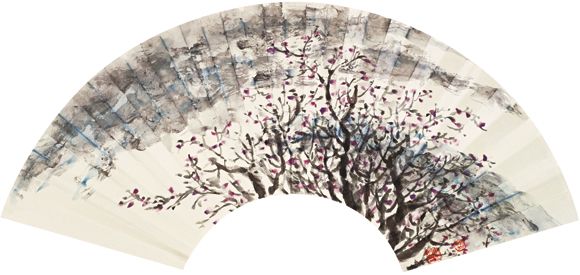
At the bottom of this work, I drew the staggered branches of peach trees with delicate ink, then painted peach flowers to points with rouge, which was used as a kind of blush in ancient China as well as pigment for painting. This color has more red in it than purple; it is quieter and more calm than red. The background for the picture is a far away river bank, and I used cyanine on this part. The two pigments—the warm rouge and cold cyanine—create a contrast, forming a special kind of simplicity.
Finally, researching the artist will help you appreciate a painting more deeply, especially if it’s an ancient work. In general, a complete work includes information from the painter. On this particular piece, there are two small seals at the bottom right, common in Chinese paintings. The top stamp is “欢”(joy), my name, but also an expression of happiness. The next square seal “栖山吕氏”, my childhood hometown and my surname. – Translated by A.Z.
Related Articles