

The event host calls for the next guest DJ. Crouching under the console, Xu Tianheng lets an intro ripple through the waiting crowd. In the lingering September heat, hundreds of college students fill up an outdoor court half the size of a soccer field. Shaking in cold sweats, he counts the tempo, jumps up for his stage debut—only to miss two beats in his self-introduction. Through the nausea, Xu does not think of Hardwell, whose tracks he is about to drop, but rather, “Did Jay Chou also feel like this for his first time on stage?”
When Xu spun EDM at that campus show in Shanghai in 2019, he was no longer the avid Jay Chou fan he used to be, but he channeled his childhood idol anyway. By the time the 32-year-old cook-by-day recalled that moment to me over the phone this April, Chou had just released his 16th album, Children of the Sun, topping charts and raking in over 100 million yuan on QQ Music, to nobody’s surprise. But Xu can’t pick one memorable song from the new album. “He is still him…but without the same kind of imagination,” Xu doesn’t hide the disappointment.
Debuting in 2000, the Taiwanese singer-songwriter swept through the Sinosphere like a tornado. To anyone growing up through those years, Jay Chou was—and still is—inescapable. For each of his die-hard fans, their early encounters with Chou’s music were explosions in their own right. But for some, his music today is more like an afterimage of those moments, and they worry he hasn’t kept up while they have.
More Stories From China’s Contemporary Music Scene:
- Rock is Not Dead in Xinxiang, China’s Former Capital of Rock ‘n’ Roll
- Chinese Rappers Are Turning Hometown Slang Into Chart-Toppers
- The Rise and Reinvention of Taiwan Music’s Influence on the Chinese Mainland
I remember Xu from our shared elementary school days in Jiaxing, a small city in Zhejiang, as the boy who signed everyone’s memory book with lines like, “Jay Chou loves you.” That fervor started with a parting gift from older twin cousins he used to trail through Jiaxing’s music stores on Saturdays, who left town for college in 2006. “Still Fantasy, Jay Chou’s seventh album, my first cassette tape—other than the English-learning ones from school,” he recalls. On the cover, Chou wears a gray blazer and a white bow tie, a defiant poker face, half-tilted into the shadows.
It was Xu’s first dose of rap. “That stuff hit hard,” Xu shares, “Then I just wanted to be like him.” But when we bid farewell to an intern teacher, Xu ripped into “Chrysanthemum Terrace”—a cinematic, slow-burning ballad steeping love and loss in classical Chinese motifs—leaving no dry eyes in the classroom.
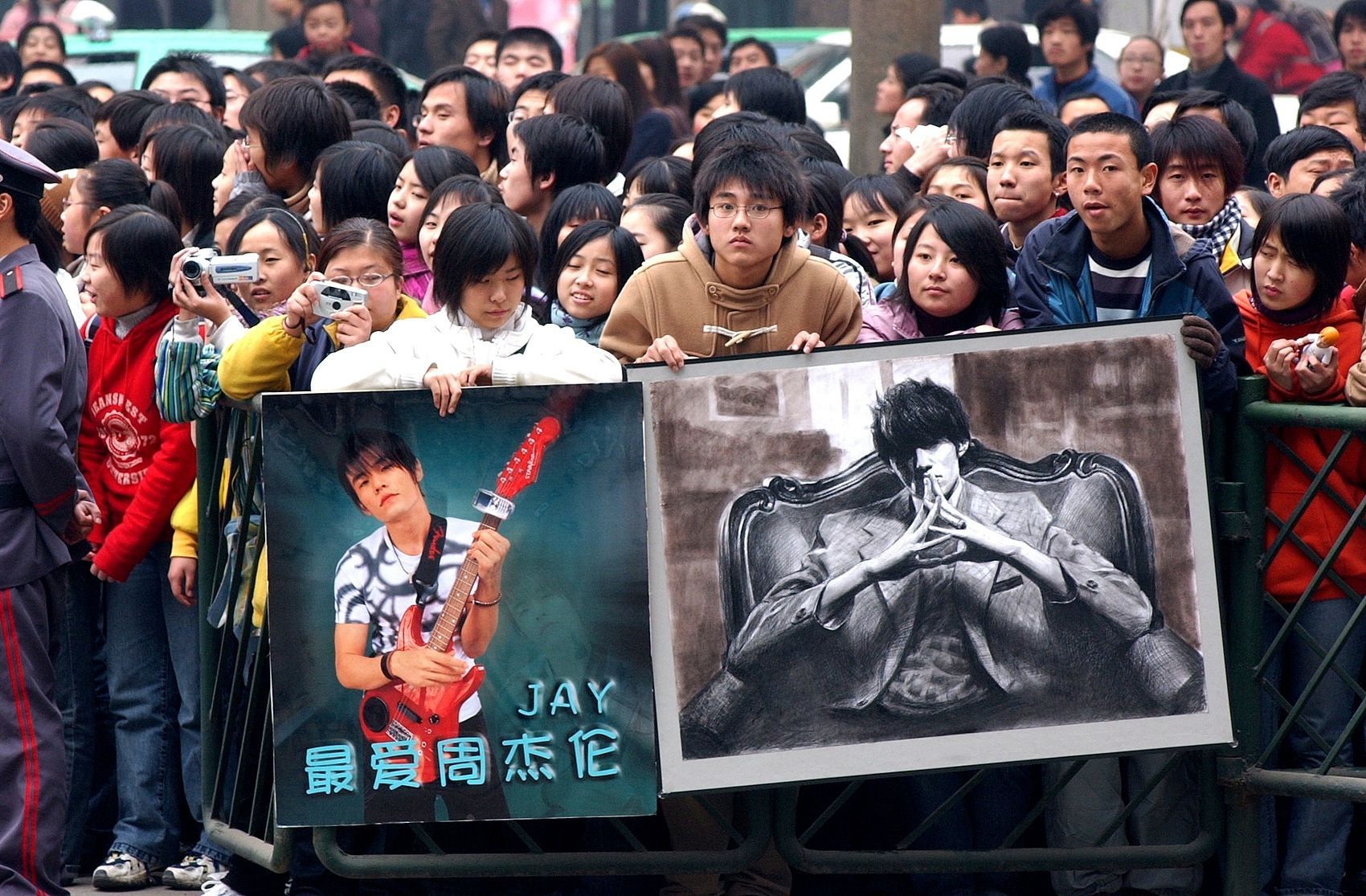
In 2003, a Jay Chou media event in Xi’an drew a massive crowd of fans. Earlier that summer, he had released his fourth album, Ye Hui Mei, named after his mother, which sold more than 2 million copies across Asia within its first month. (VCG)
For YZ Huang, a self-taught musician from Beijing, cassettes made way for CDs. Huang had already caught the bug from a Jay Chou evangelist in his class when the 2008 album Capricorn—his first—got stuck in the family car CD player after a traffic incident, becoming the perpetual soundtrack to his formative years in music. He hand-copied lyrics, received hand-copied lyrics from admirers, and huddled with dormmates around a contraband phone, guessing songs from second-long snippets. “Weird, but appealing,” Huang says, “no one else in Mandopop was writing like that.” An April article on Southern Weekly reads Chou’s syncopated beats as rebellious, arguing that they “challenged the aesthetic authority of the older generation and gave young people a sound they could call their own.”
But R&B wasn’t the only sound Chou introduced to Mandopop. He experimented with traditional Chinese styles and elements from other cultures, cooking up stories from those lands: miso soup in an izakaya or a witch’s cat in a castle. Some elements might now read as tropes, but to many mainland fans in the aughts—as Chinese kids were logging onto the internet in droves in the early 2000s—these were a window to the world.
Despite Chou’s mainstream popularity, he didn’t exactly fit the mold of a conventional star. Beyond the pervasive jokes about Chou’s small eyes, both Xu and Huang remember their parents complaining about how Chou slurred through the lyrics. Releasing a record without enunciating clearly, music critic Siva Yuan later told CommonWealth Magazine, was as shocking as having a child out of wedlock in a conservative era.
“He was reserved and shy, but with a hidden edge—keeping his ambitions under the lid, hovering on a delicate balance between self-doubt and self-admiration,” wrote Weng Jiayan, a journalist and longtime fan, in 2020 for the magazine Portrait. That’s what “made him easy to identify with,” she adds. “He mirrored the parts of us that saw no validation, yet still felt pretty good about ourselves.”
“Growing up, I was never validated much by my parents. Even now, with the things I do,” Xu says, referring to his DJing and modified cars, “they find them too flashy.” But Jay Chou and the community Xu has found around him have helped him care less about fitting in.
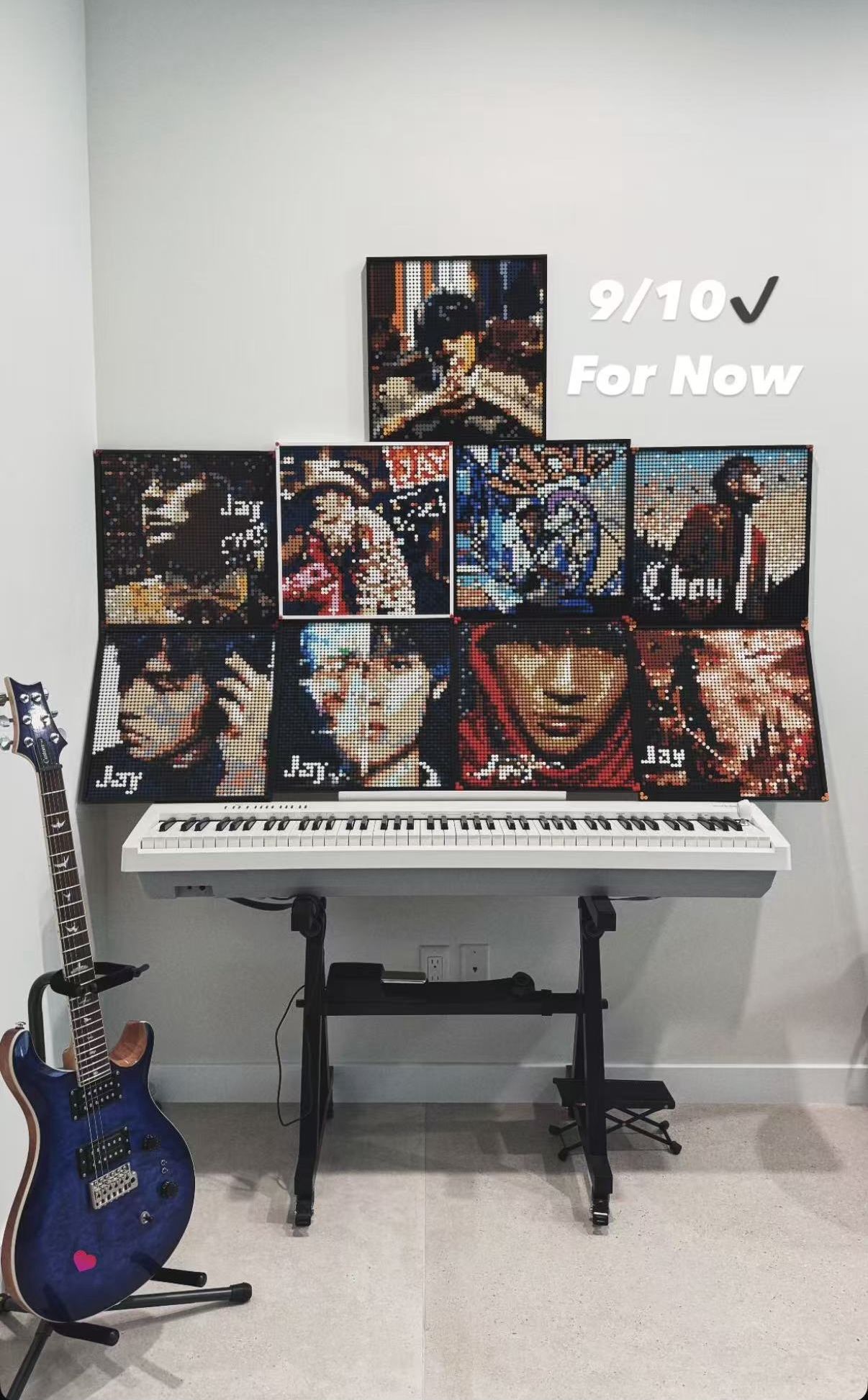
YZ Huang has assembled his favorite Jay Chou album covers in LEGO (courtesy of Huang)
Now, even Huang’s parents, who used to turn their noses up at Chou’s music, hum along when it comes on. But when Children of the Sun dropped this year, Huang posted a snarky song-by-song review on his WeChat Moments. Here’s to the first track: “The mixing is shit. The low end is a pile of buzzing headaches. Make a micro-drama if you wish. Don’t torture fans with an MV”—referring to its 20-million-yuan music video.
Huang relishes Chou’s past work. He gives me a scene-by-scene breakdown of “Little Blacksmith in Milan”—about a young blacksmith’s dream to buy a guitar—cuing attention to the bridge: “the door creaks…now it’s a real guitar [instead of the preceding MIDI]...now two guitars…now the applause…now the scratch…See what’s happening?” The MIDI guitar in the verse has become a real one. The lyrics paint a story of yearning; the wordless arrangement reveals that the blacksmith’s hope does come true, briefly, in a dream.
Huang thinks 2011’s album Wow! marks the point at which Chou’s music started to slip—the production cleaner, the swagger softer. But Weng, whose entire Portrait article is on her disenchantment with Chou, claims that the ship had sailed in Still Fantasy, the one that first got Xu hooked. Under a repost of Weng’s article on Taiwanese forum PTT, fans disagree on the precise watershed moment. But music producer He Wei had high praise even for the controversial new album Children of the Sun, saying in the previously mentioned Southern Weekly article that it shows “a musician completely at ease, creating freely on his own terms.”
“When I see people defending him, I want to diss him. But when I see people dissing him, I want to defend him,” Huang says—a sentiment common among older fans who’ve grown up alongside their idol.
Looking at Chou in 2020 is like “running into your first ex only to find a tacky rich guy,” Weng writes. “The love was real, so is the disdain.” Some female fans, like Weng, point out that women in his newer works have fallen into the Madonna-whore bore. And that the once-relatable portrayal of love has not gained wisdom with time.
Some fans moved on. Xu discovered rock in adolescence, then techno in a post-breakup slump in 2018. It led to that moment behind the DJ console—Jay Chou still on his mind.

Jay Chou has remained highly active on the concert circuit with his “Carnival” world tour (2019 – 2025), delivering over 100 performances worldwide (VCG)
Xu believes nostalgia keeps Jay Chou “on his throne.” Early fans have finally grown up to be scientists and entrepreneurs, such as when Guizhou zoologist Mi Xiaoqi named 16 newly discovered spiders after Chou’s songs in 2024.
Discussions about Chou come back so consistently that a PTT commenter calls stories like Weng’s “menstruation articles.” The most heated episode was the 2019 Weibo brawl sparked when a Cai Xukun fan questioned Chou’s relevance. Millennial Chou fans mobilized en masse to boost his ranking and briefly knocked Cai—a young idol then dominating social media traffic—off the platform’s celebrity chart.
In a deep dive on the current state of Chinese pop music, the YouTuber East Asia Beef argues that Cai is an example of the new generation of idols with devoted fans who bulk-buy his music and pump his rankings, while his songs go “unheard of outside of his fandom.” As the increasingly K-pop-inspired Chinese pop industry churns out pretty idols with no distinctive style, older fans hold on to Chou’s slurred lyrics like a treasure.
The “tiktokification,” East Asia Beef mentions—and echoes Xu, Huang, and the Southern Weekly article mentioned above—have flooded the market with “trashy, low-effort songs,” produced to be “mere sidekick[s] to videos.” In comparison, Xu considers Chou fans too spoiled for anything less.
After Mandopop, Huang got hooked on Linkin Park and eventually heard Chou inside it; both had sampled the same Fort Minor strings, and shared, he says, a core: “both simultaneously timid and powerful, fragile and strong.”
Huang hits play on a track from his first album, 10 years in the making. The first few seconds indeed recall Linkin Park’s “In the End,” but when the vocals come in, the song is undeniably laced with Jay Chou—the melody, Huang’s voice, the way he belts out high notes, even the enunciation in the rap…“Yeah, I can’t help it,” Huang says. “Not that I wanted to [imitate him], but this is where I started with music.” The story of the song follows a protagonist navigating between good and evil, as a response to the “too much fluff out there now,” he shares. “I want to bring the good stuff back—the music from that era.”
As for Xu, every time he takes his modified car to the expressway, “I have to put on ‘All the Way to the North’”—a melancholic track featured in Chou’s first screen appearance in Initial D (2005), a film about car racing. “Back in the day, I really couldn’t get into slow songs like this.” The young Xu craved the edgy and the restless, but now, he feels like a character in the slow songs.
Chou no longer seems like the beacon he had to look up to as a child. “[We both] grew up,” Xu shares, “Now he feels like an old friend I haven’t seen in years.”
Outgrowing the Last King of Mandopop is a story from our issue, “I, Humanoid.” To read the entire issue, become a subscriber and receive the full magazine.
Related Articles