Public transportation is stalled and students are squatting on their chairs to study—today, Wuhan is overwhelmed by the recent rainfalls that continue to cause serious flooding all along the Yangtze River. At the same time, residents upstream of Wuhan have good cause to be bothered—when floods hit Wuhan, these communities outside the city are unwilling volunteers who take floodwaters for the team.
According to the Flood Control Planning of the Yangtze River plan passed by the Ministry of Water Resources, 40 Flood Diversion Areas along the Yangtze River are deliberately flooded in emergencies. In other words, 6,000,000 citizens from these areas have to sacrifice their lands and take the floodwater that was supposed to submerge the city. Residents have to evacuate, watch the levees of local rivers be bombed, and their fields and houses be inundated.
Unsurprisingly, a lot of them ain’t pleased.
Some towns fall under the category of Flood Diversion Areas because they possess less wealth, natural resources, or historical significance; and others are being impoverished at the time of writing by the flood control regulations. Designated to be abandoned when major floods occur, the planning of the Flood Diversion Areas have to be based upon the utility of redirecting the floods, and adhere to the principle that “the local interests should serve the overall interests of the nation” (according to the Flood Diversion Area Safety Construction and Management Regulations of Hubei Province).
In an opinion piece published by Chinese website NetEase, last week but deleted shortly after, communities are designated as Flood Diversion Areas were compared to “children being raised by the stepmother”—with the unspoken assumption being that, well, the stepmother sucks. These towns and villages in Flood Diversion Areas tend to think they get a raw deal, for a variety of reasons. For starters, investors are scared away once they hear the phrase ”flood diversion.” Local governments in diversion sites often flout regulations to build anyway, but in this case, any assets that get flooded are not compensated for damages by the state.
Honghu, a city in Hubei Province that used to rank among the 10 Hubei cities with best economic performance, became a Flood Diversion Area in the 1970s. Since then, it has hardly attracted any investment or seen the slightest industrial development. Today, on the same rankings of Hubei cities, Honghu has fallen out of the top 50, with a GDP less than half of the national average. According to state news agency Xinhua, wages for teachers in Honghu has been among the lowest in Hubei cities, and Honghu teachers used to go on strike and picket the local government offices to appeal for better treatment.
This year, controversy around the Flood Diversion Area has risen again as the water level of the Yangtze crept up. According to the Central Meteorological Bureau of China, compared to 1998, when China experienced massive floods that killed 3,704 and made 15 million people homeless, there has been higher rainfall by 23.5 percent and higher water levels in almost all rivers in southern China.
Last week, The Global Times acknowledged the existence of the worried Anhui netizens who feared the whole province would basically be submerged in order to protect key cities like Nanjing and Wuhan downstream.
In 1954, Jingjiang, a Flood Diversion Area in Anhui was used to redirect the flood three times, during which 2,555 residents died and 18 percent of the farmland remained flooded six months later. In addition, 3,029 acres of arable land was permanently rendered unusable for agriculture.
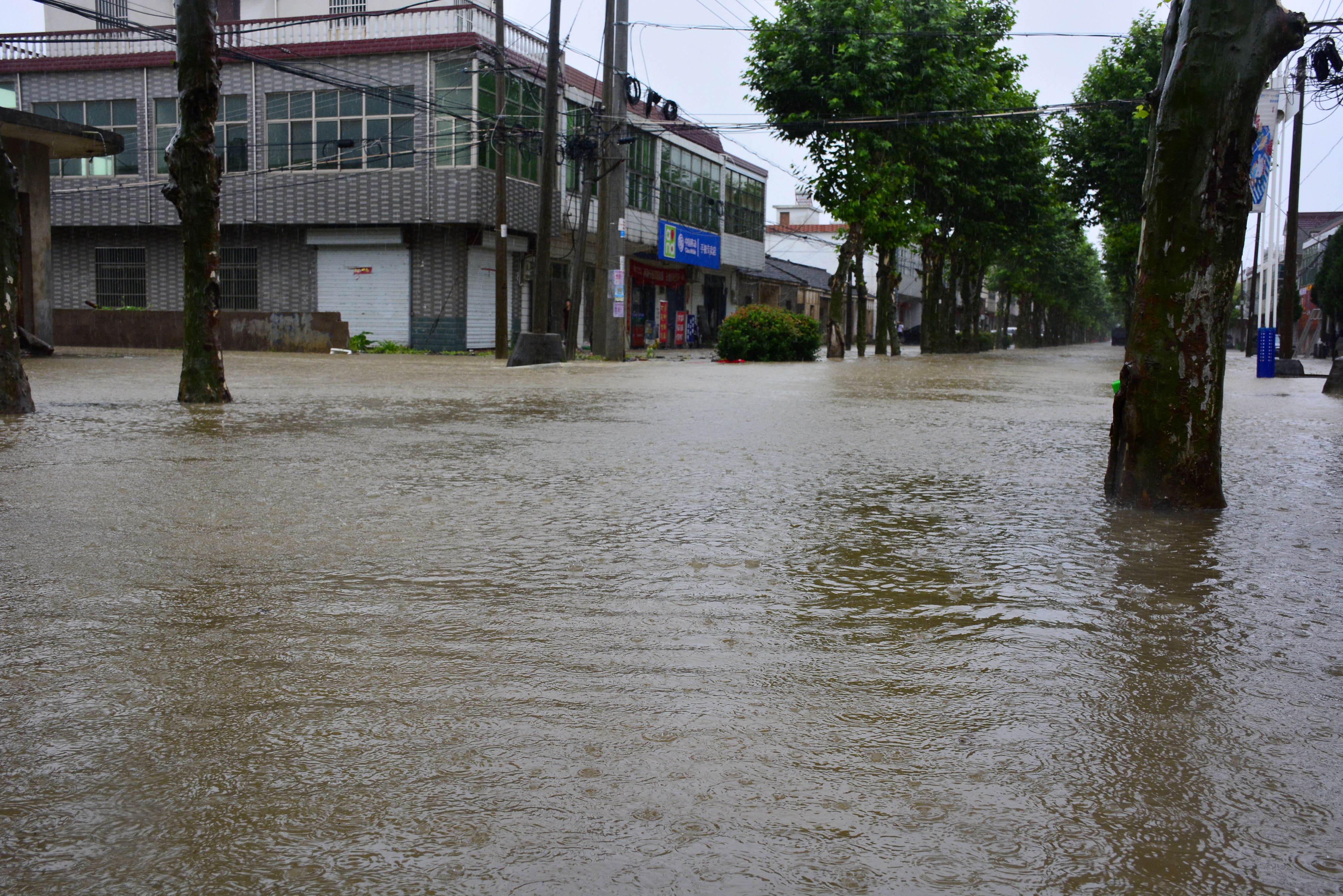
Homes and fields were submerged in Wuwei county, Anhui province, to protect the city of Wuhu in July 2016 (VCG)
In the 1998 flood, although the Jingjiang locals were mobilized by the slogan “Protect Big Wuhan” and evacuated in a timely manner, the central government decided not to blow the dam up at the last minute.
This year, another Flood Diversion Area in Anhui, the village of Wangjiaba, is expected to practice the “Wangjiaba Spirit” by “sacrificing the small home for the well-being of the big home”...for the 16th time.
Unsurprisingly, state media outlets have quoted locals who support the deliberate floodings. This, for example, is Lang Zejian, a Wangjiaba resident who has experienced multiple major floods and mandatory evacuations, during an interview with People’s Daily:
“Every time when the water comes, we have to watch our fields being flooded, helplessly. Our hearts are broken. However, if we don’t let our land be flooded, we can’t protect Huainan city upstream or Henan province downstream. [we should] ‘Sacrifice partial interests and ensure the interests of the whole.’ We are willing to dedicate and sacrifice.”
Nonetheless, there are towns and villages that don’t cheerfully dedicate themselves to protecting the overall interests of the country, and have thus been accused of “going against heaven’s will”—the People’s Daily pointed out last month, “The state has been spending a huge amount of effort to construct the Flood Diversion Areas along the Yangtze River since the 1988 flood. However in the recent years, some of these areas have been developing illegally and even become ‘prosperous communities.’ We should keep in mind that only if the water has a way out, can we control the flood and protect the safety of the whole Yangtze River basin. Conduct that goes against the ‘will of heaven’ will be subjected to revenge by nature.”
It is unclear how much effort the state has spent on constructing the Flood Diversion Areas to conquer the floods, but the Flood Diversion Areas themselves have been rather reluctant to build better dams on local rivers—it is only a matter of time for their towns and villages to become lakes and ponds and the residents to lose everything again.
Yet respondents on NetEase indicated that finding ways “to avoid sacrifices” is the more significant question, by referencing the Great Flood of 1993 in the United States. After the massive flood, the federal government bought more than 7,700 properties from residents living upstream of the Mississippi. Then in 1995, when the rivers rose again, the previous residential areas were changed to wetlands that did a better job in storing floodwaters. As a result, there were fewer heart-rending tales of dispossession or ”sacrifice.”
Looking back at the situation in 2016’s China: sedimentation problems remain unsolved in rivers, tidelands are still enclosed for cultivation, and embankment projects of the Yangtze branches are poorly designed and built—necessary preparatory measures to fight against the flood are largely absent, so that the public debate has once again ended up on “who to sacrifice first,” wrote NetEase.
Related Articles