The term “currency” conjures up images of banknotes and coins, but it has not always been thus. Most cultures initially began with bartering before moving on to precious metals then eventually notes. Now, in the age of bitcoin and WeChat Wallet, a curious form of currency has emerged which ties together the most modern ideas of electronic currency with the imagery of barter, and this currency lives only in the niche world of online live streaming.
Live streaming is, as you would expect, footage streamed on online websites, with the caveat that the action occurs in real time. Many of the first live-streaming platforms began by streaming footage of online multiplayer games to fans.
From e-sports, it evolved to include regular sports, then singers and other online celebrities started performing live as well. The live-streaming sector in China is far more varied and popular than in the West, perhaps, somewhat ironically, due to the online restrictions on lewd content. Cao Xi, a venture capitalist with Sequoia Capital, told The Wall Street Journal that “in a country where porn isn’t available, this market is pretty good.”
One thing many of these live-streamers have in common is that they receive much of their income from “virtual gifts.” The gifts themselves may be anything from flowers, to a sports car. They appear as an emoticon sent from viewer to live-streamer, who in turn can redeem it for cash. Crucially, everyone viewing the live-streaming session can see them. The higher the value, the greater the recognition for the person who sent the gift. Savvy live-streamers know how to play to their audiences and reward regular gift-givers with attention without alienating other viewers.
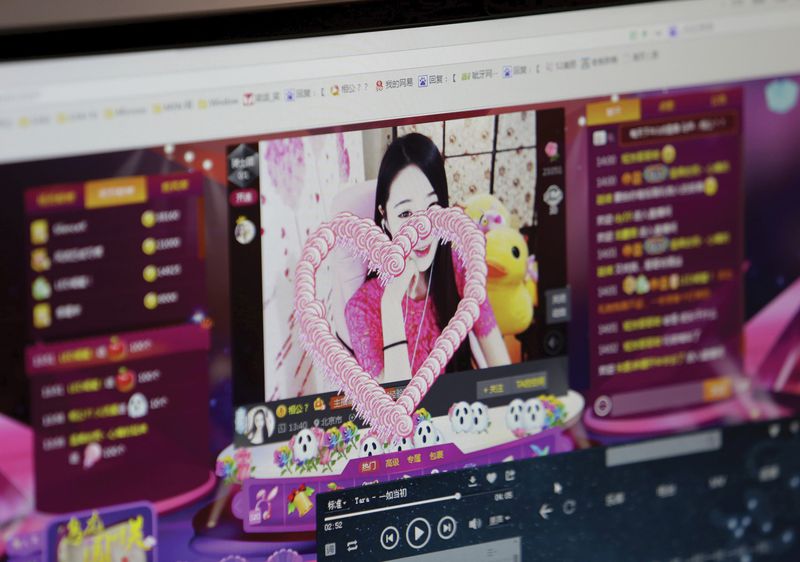
A digital gift is seen on the screen, bought and presented by a fan (VCG)
In the fourth quarter of 2015, YY.com, a popular live-streaming site, raked in 1.5 billion RMB (230 million USD) from virtual gifts. Live-streaming website companies only take a small percentage of each virtual gift’s worth, so the actual RMB value of the virtual gifts sent during this period would be much, much higher.
The live-streaming virtual gift phenomenon is now spreading from China to the US.
US-based company Live.me announced in October of 2016 that it had processed 1 million USD worth of virtual gifts. A representative from Live.me—a company which is bringing the livestreaming phenomenon to the US—told TWOC that when Live.me launched, in April 2016, it was geared toward a primarily English-speaking audience.
“Live.me is the highest grossing live-broadcasting app ever in the US,” Khudor Annous, head of marketing at Live.me, pointed out. He described virtual gifts as “a bit of emoji, gaming, and tipping, all rolled into a fun way for viewers to join in the conversation and collective experience. Virtual gifts, more than just just tipping someone a dollar, really show the broadcaster that you want to be noticed and contribute to the moment, happening right now.”
The streams of Live.me aren’t necessarily representative of a lot of live streaming in the West, however. Much of the Western community is dominated by “cam girls” or outright pornography, but in China, there are all kinds of would-be celebrities peddling any numbers of different acts from their living rooms, and turning it into revenue in the form of “virtual gifts.”
They may make their career based on being funny or being attractive, or possibly live stream to build on existing fame or as a contract obligation, as was the case with the endearingly down-to-earth Olympic swimmer Fu Yuanhui. The medium has recently broadened into shopping channels reminiscent of daytime infomercials, though the more active nature of viewing live streaming means participants are even more engaged than their TV counterparts, thus even better targets for advertising.
There are still pornographic live-streamers of course, but they are intermittently shut down and punished by the authorities, and there have been instances of somewhat absurd restrictions like a ban on eating bananas seductively.
Technode reported that 9158.com, operated by a company called Tiange, was among the first live-streaming sites to adopt the virtual gift model. Tiange specializes in amateur singers, but critics point out that its livestreamers are overwhelmingly female, and its user base is overwhelmingly male and in third or fourth tier cities. These fuel claims it is borderline pornographic, though the geographical and gender aspects also give these criticisms a certain air of elitism.
The participatory element makes virtual gifts a fascinating development for companies. Not only can it be monetized, but it’s a way of measuring both engagement from viewers and how much money they are sending to a particular live-streamer, thus defining the performers’ worth in cold, hard cash.
Incomes made through these virtual gifts vary. While the dream is to make millions, a report in Sohu Entertainment pointed out that it is incredibly rare for a live-streaming celebrity to make this much, though annual incomes in the tens of thousands, even occasionally hundreds of thousands, are much more common. The report also profiled a live-stream celebrity who goes by the online handle Xiang Gong (相公). Her product is “cuteness.”

Online hostess Xiang Gong checks her makeup before she gives a live broadcast in her bedroom in Beijing (VCG)
Personalities like Xiang Gong’s require extensive use of makeup and for performers to put on a type of sajiao (coquettishness, for lack of a better English term) act. The article also pointed out that many of these live-streaming celebrities don’t like to talk about their day job, due to the fact it is sometimes associated with sex work—even though the strict regulations mean this is rarely true.
The fact that dating app Momo has also embraced live streaming and virtual gifts also opens up another facet of the virtual-gift game. With the potential for a date actually on the table, and users able to scan for live chat-room participants using geographical proximity, the ways in which Momo is able to integrate virtual gifts with its dating platform will be keenly observed by companies as well as the authorities.
Perhaps the biggest lesson to be drawn from the entire livestreaming industry is how loneliness in the dark of night is a powerful motivating factor. Venture capitalist Connie Chan, a partner at Andreessen Horowitz, has pointed out in observations of China’s livestreaming industry that the vast majority of live-stream viewers log on late at night, most likely to alleviate a sense of loneliness with a feeling kinship.
At the end of the day, beyond the billions to be made by large companies, sending a virtual gift may not be all that different to sending any other gift: a simple act of generosity sent in the hope of buying gratitude.
Virtual Gifts is a story from our issue, “Taobao Town.” To read the entire issue, become a subscriber and receive the full magazine.
Related Articles