
Newsletter
Popular

  • Society
  • Life
  • Business
  • Language
  • History
  • Arts
  • Literature
Podcast
Video
Magazine

  • China
  • International

  • About Us
  • Our Team
  • Join Us
  • Contact Us
  • Pitch to Us
Follow Us
Newsletter
The World of Chinese logo
Sign In SUBSCRIBE
Popular
Topics
  • Society
  • Life
  • Business
  • Language
  • History
  • Arts
  • Literature
Podcast
Video
Magazine
Shop
  • China
  • International
About TWOC
  • About Us
  • Our Team
  • Join Us
  • Contact Us
  • Pitch to Us
Subscribe
Cart
SOCIETY

Walking on Fire to Celebrate Harvest Season

One Fujian village preserves the tradition of celebrating the harvest with painful acrobatics

    author Anita He (贺文文)
Anita He (贺文文)
May 3, 2022
Walking on Fire cover
Photo Credit: Li Guochao (李国潮)
00:00
Subscribe to listen to this audio

As one of the world’s oldest farming civilizations, China has created numerous festivals to pray for or celebrate a good harvest. Though many of these rituals are disappearing due to urbanization, Zhongtuan village in Wuping county, Fujian province, has held on to several heart-stopping harvest traditions.

The 15th day of the 10th lunar month is leisure time for villagers after gathering in the harvest and sowing their fields for the coming year. On this day, the farmers of Wuping hold a “day of sacrifices (醮会日)” to thank their ancestors and pray for next year’s crops.

Zhongtuan’s 1,000 residents, most of whom belong to the Lan (蓝) clan, speak the Hakka dialect but claim descent from the ethnic She (畲) people, who settled in the area between the Song (960 – 1279) and Yuan (1206 – 1368) dynasties. The villagers have become locally renowned for dangerous acrobatic stunts at their harvest festival, summarized as “climbing a mountain of swords and walking on a sea of flames.”

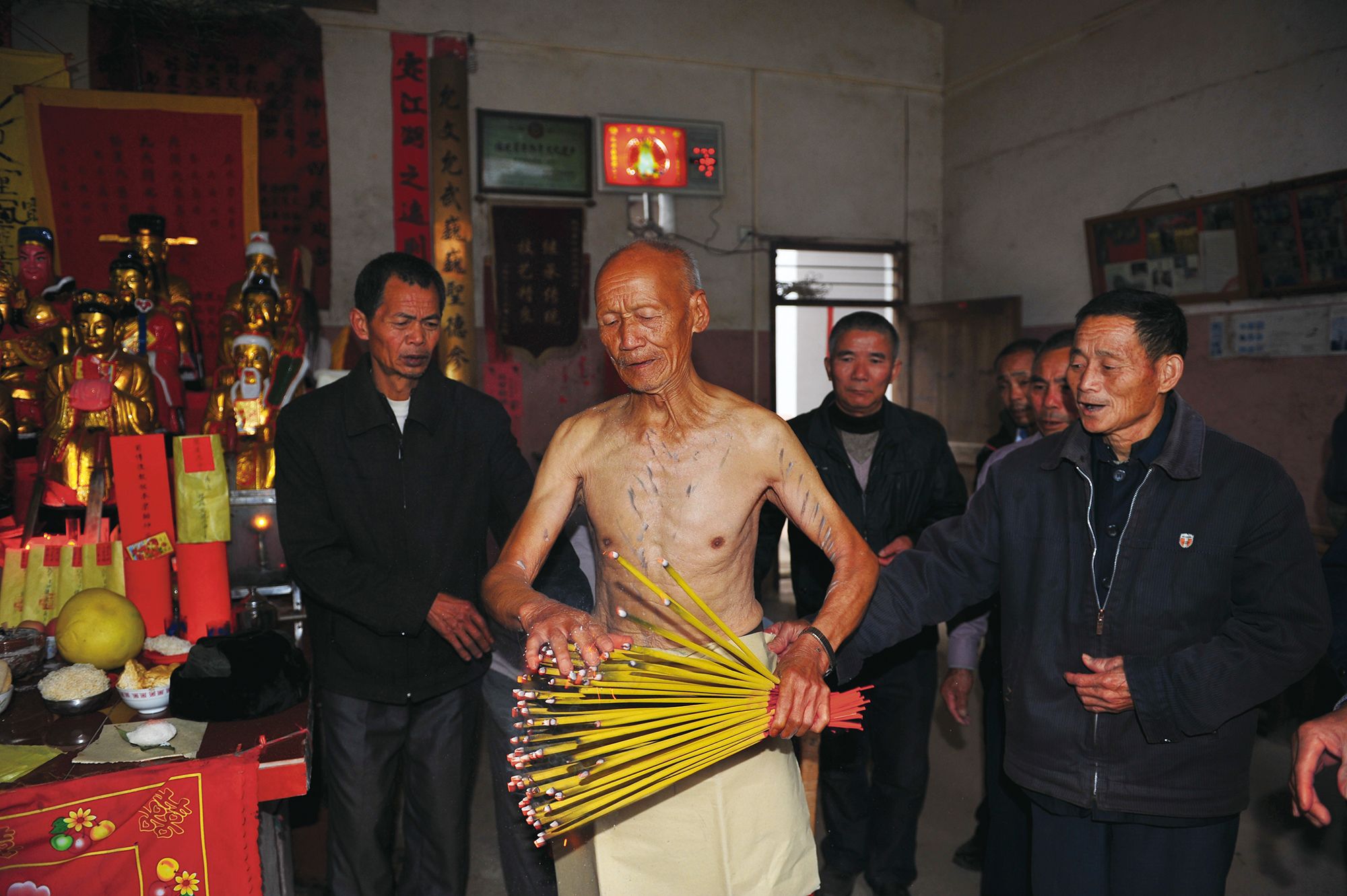
Throughout the day, firecrackers, drums, and suona pipes sound a continuous fanfare, while bare-chested farmers turn into master acrobats as they perform: climbing barefoot up a ladder with 36 sharp knives fixed to the rungs; walking barefoot across a bed of burning charcoal; plunging their bare hands into a pot of boiling oil to scoop out fried rice cakes; stepping or sitting on a nail-studded plank; stubbing out incense sticks or firecrackers on their bare skin (known as “kissing the burning incense”); and more. Miraculously, villagers emerge from each of these stunts without a scratch. How they manage this is a closely guarded secret, but these painful performances pay tribute to the hardships endured by the villagers’ ancestors, who settled in a barren mountainous region and transformed it into today’s fertile farmland.
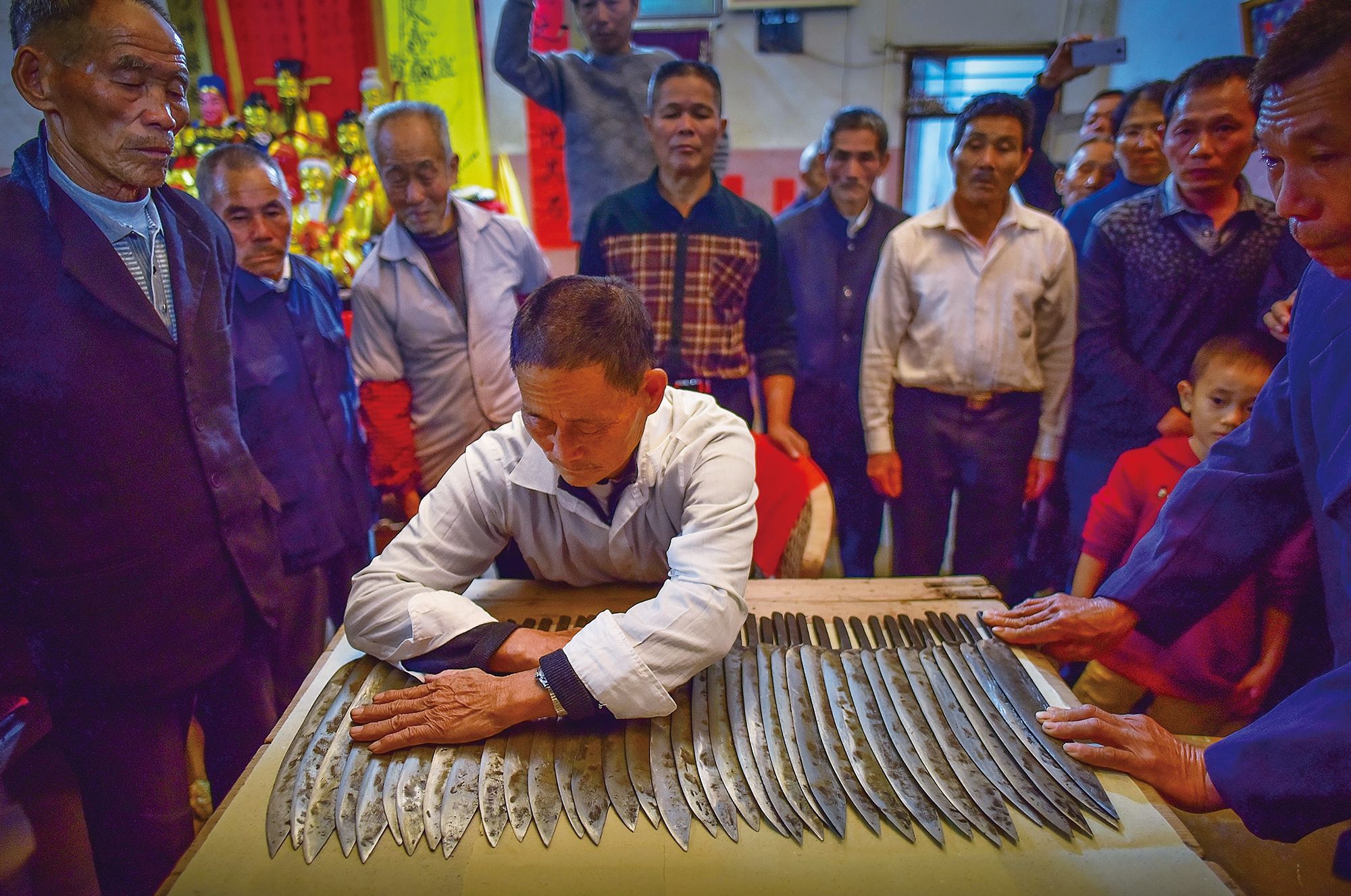
Villagers start sharpening and testing the knives three to five days before the festival
Villagers start sharpening and testing the knives three to five days before the festival

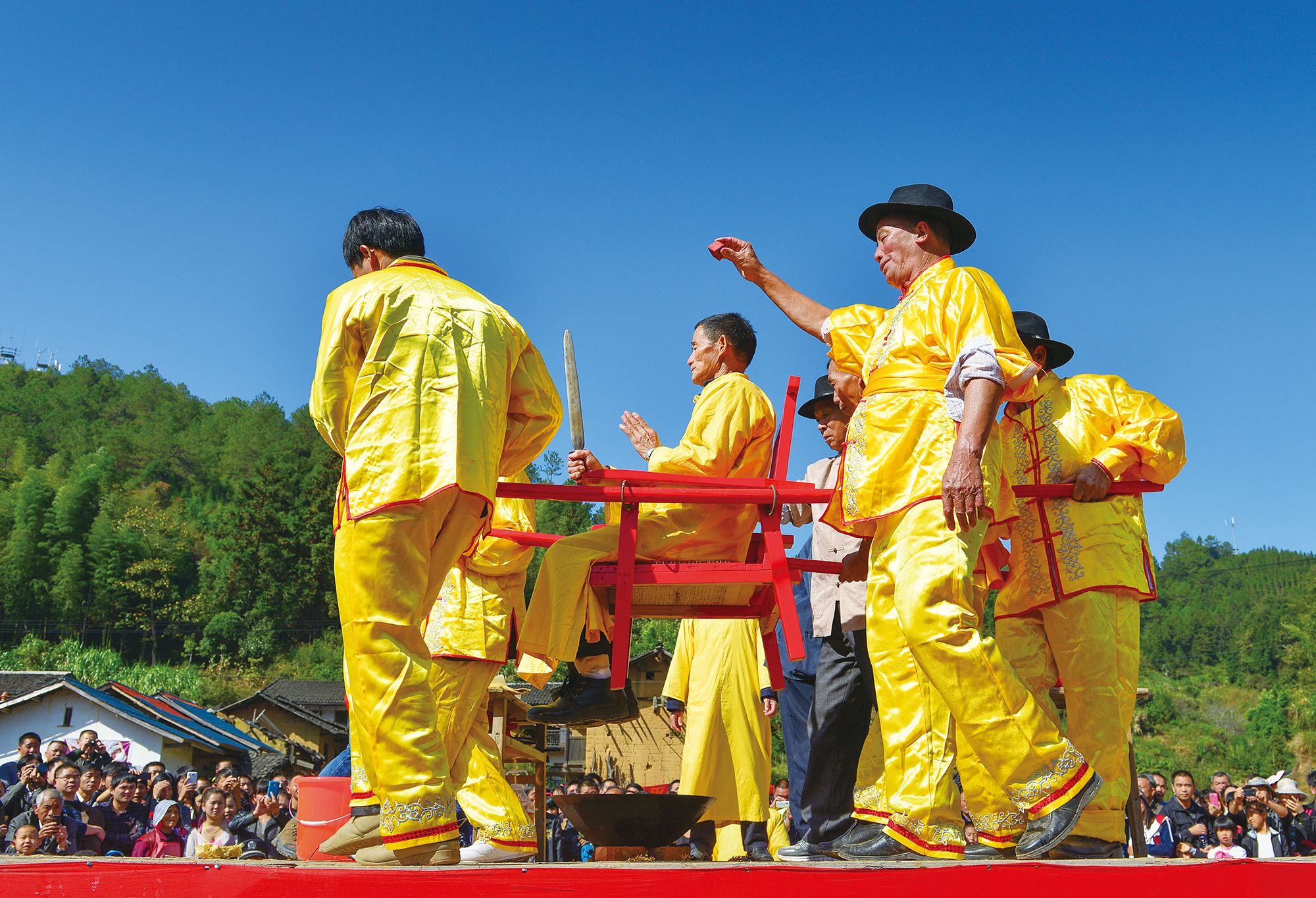
Four bearers carry one performer holding a sword in his hand in “sitting on the nail chair”

Four bearers carry one performer holding a sword in his hand in “sitting on the nail chair”

“Climbing the mountain of swords” is a ritual also found among the Miao and other ethnic minority groups in China’s southwest
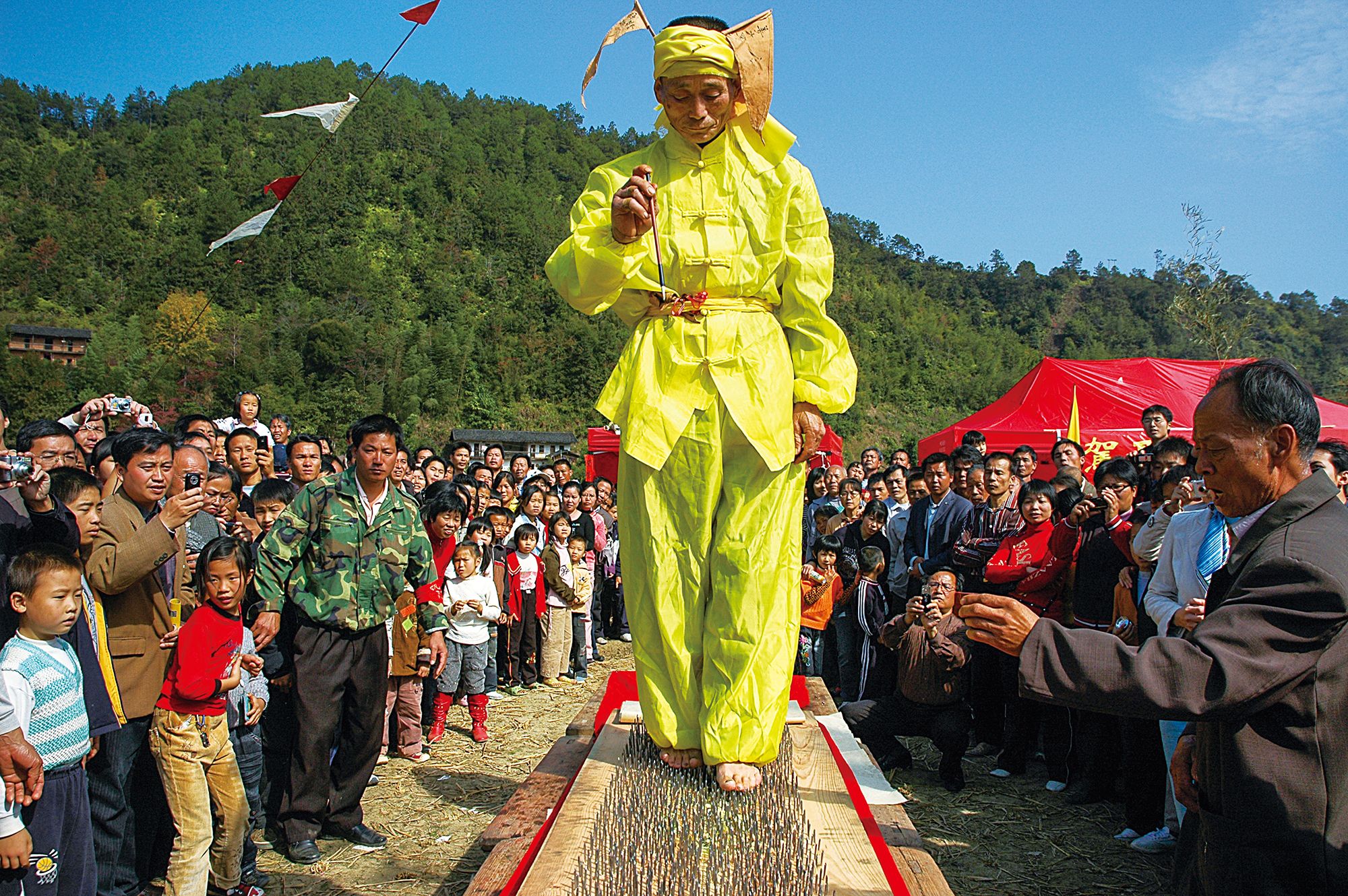
“Climbing the mountain of swords” is a ritual also found among the Miao and other ethnic minority groups in China’s southwest

How the performers avoid injury is a village secret, handed down through generations and never shared with outsiders
How the performers avoid injury is a village secret, handed down through generations and never shared with outsiders

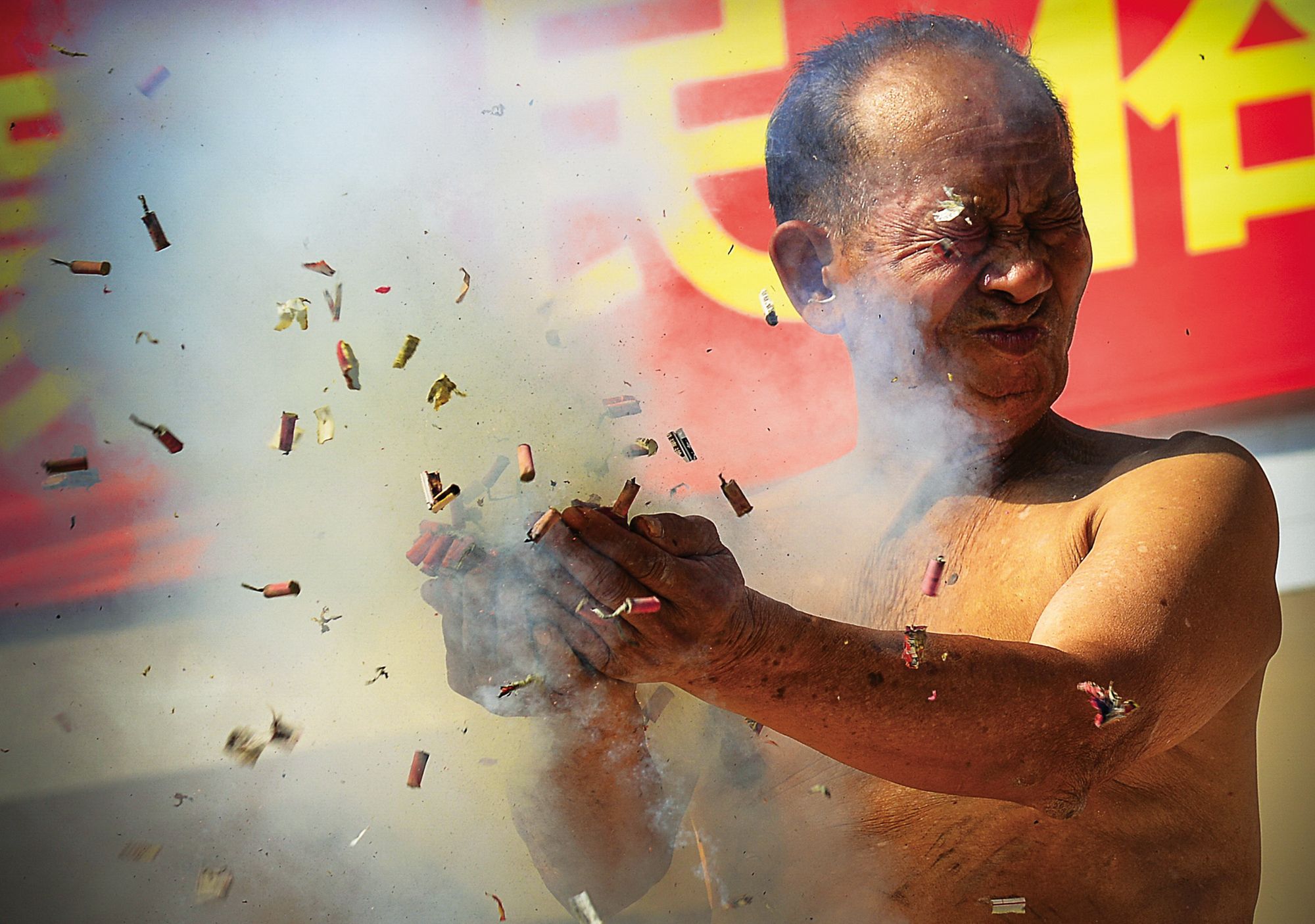
In “applauding the firecracker,” a bare-chested performer holds a firecracker in his hands as it explodes

In “applauding the firecracker,” a bare-chested performer holds a firecracker in his hands as it explodes

In “lifting the rice bucket,” the performer lifts up a container of rice, using a sharp sword inserted in the middle as a handle
In “lifting the rice bucket,” the performer lifts up a container of rice, using a sharp sword inserted in the middle as a handle

Performers of “kissing the burning incense,” mostly men in their 60s and 70s, snuff out the flames with their fingers one by one

Performers of “kissing the burning incense,” mostly men in their 60s and 70s, snuff out the flames with their fingers one by one

The whole village gets involved in setting up the acts

The use of fire and knives are supposed to symbolize the She people’s slash-and-burn agriculture
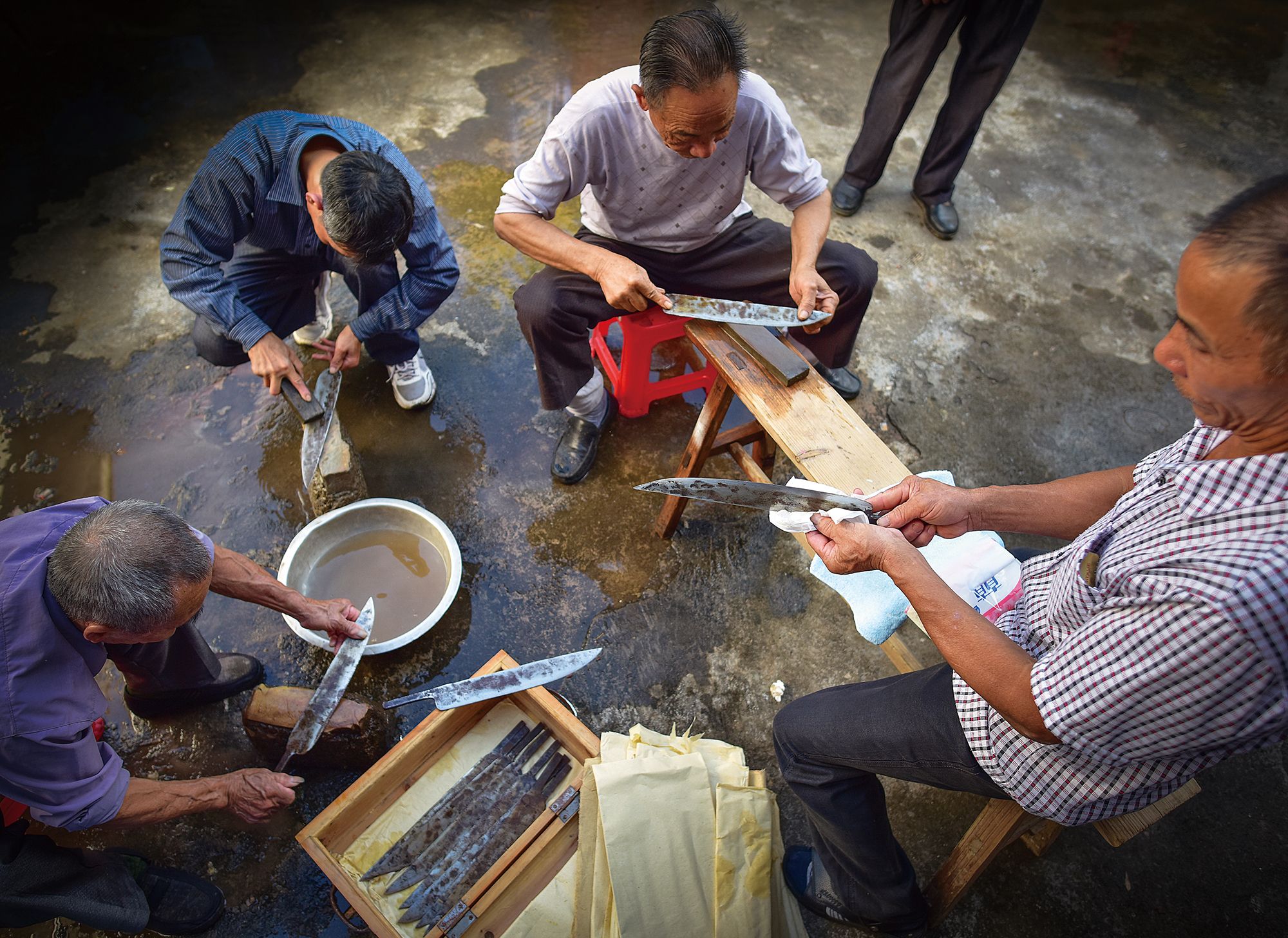
The whole village gets involved in setting up the acts

The whole village gets involved in setting up the acts

Photography by Li Guochao (李国潮)


Walking on Fire to Celebrate Harvest Season is a story from our issue, “State of The Art.” To read the entire issue, become a subscriber and receive the full magazine.

Tags:
FESTIVALS FUJIAN PROVINCE MINORITIES

Related Articles

Wedding at stadium in Guizhou
TRADITIONAL CULTURE

How China Is Celebrating Qixi This Year | Photo Story

Chinese ethnic minorities celebrating Sanyuesan and robots
TRADITIONAL CULTURE

Celebrating Sanyuesan: A Vibrant Fusion of Tradition and Myth

Chinese Horse lantern
TRADITIONAL CULTURE

A Festival of Lights: How Lanterns Illuminate the Yuanxiao Festival Across China

WZF_8877
TRADITIONAL CULTURE

Where Heroines Take the Reins

Related Articles

Wedding at stadium in Guizhou
TRADITIONAL CULTURE

How China Is Celebrating Qixi This Year | Photo Story

From traditional rituals to mass weddings and DIY drafts, the Qixi festival has blended centuries-old romance with modern ways of celebrating love

Chinese ethnic minorities celebrating Sanyuesan and robots
TRADITIONAL CULTURE

Celebrating Sanyuesan: A Vibrant Fusion of Tradition and Myth

From ancestral worship to joyous festivities, discover the rich cultural significance of Sanyuesan, or Shangsi Festival, across China

Chinese Horse lantern
TRADITIONAL CULTURE

A Festival of Lights: How Lanterns Illuminate the Yuanxiao Festival Across China

From cyberpunk horse installations to “My Little Pony”-inspired lanterns, here’s a glimpse of how the Lantern Festival is lighting up every corner of the country

WZF_8877
TRADITIONAL CULTURE

Where Heroines Take the Reins

There’s no better way to celebrate the Year of the Horse than with Xiaxi’s all-female horse-themed parade

Subscribe to our newsletter

Scan to follow us on WeChat

Or add: Theworldofchinese

Topics

  • Society
  • Life
  • Business
  • Language
  • History
  • Arts
  • Literature
  • Photo Stories

Media

  • Magazines
  • Books
  • Podcasts
  • Videos

News and Events

  • Announcements
  • Events

About TWOC

  • About Us
  • Our Team
  • Join Us
  • Pitch to Us
  • Contact Us

PARTNERS

© THE WORLD OF CHINESE | 京ICP备05007371号-7