
From quips about Team China’s outfit design to following the games with bated breath, here are the internet memes and slang inspired by the Milano-Cortina Olympics
When the 2026 Olympic Winter Games in Italy kicked off on February 6, Chinese netizens were startled into awareness: “So it’s already been four years (原来已经四年了 Yuánlái yǐjīng sì nián le)!” Like everything else that took place during the tense and blurry years of the pandemic, memories of the Beijing 2022 Winter Olympics feel both fresh and distant.
Co-hosted by Italy’s fashion center, Milan, and the Alpine city of Cortina, this year’s Winter Games may not receive the same level of attention among Chinese audiences as their home Olympics four years ago. However, the artistic opening ceremony, Team China’s star athletes, and the thrill of the world-class winter sports still prompt some to “live on Italian time in China (在中国体验意大利作息 Zài Zhōngguó tǐyàn Yìdàlì zuòxī)”—staying up way past their usual bedtime to catch the live broadcast, and debating the results online.
Read more about China’s Winter Olympics history:
- From Boycott to Host: China’s Road to the Winter Olympics
- Post-Pandemic, Can China’s Winter Olympic Town Thrive Again?
- China’s Road to Winter Paralympic Glory
The Milano-Cortina Olympics got off to a good start, with viewers in China raving about the innovative representation of Italian culture in the opening ceremony: “When it comes to art, Italy takes the crown (艺术这一块,还得看意大利 yìshù zhè yí kuài, hái děi kàn Yìdàlì).” Some went so far as to praise Italy as “the benchmark of European aesthetic (欧洲审美标杆 Ōuzhōu shěnměi biāogān).”
Netizens, especially on the social media platform Xiaohongshu (RedNote), also praised the participation of women in what they call a 女本位开幕式 (nǚběnwèi kāimùshì, female-centered opening ceremony): female flag-bearers, female athletes lighting the main torch, Italy’s first female astronaut Samantha Cristoforetti walking a young girl through the model of a solar system, and the first female president of the International Olympic Committee (IOC) giving the welcoming speech. “Maximum girl energy engaged (含女量拉满 hánnǚ liàng lā mǎn)!” cried netizens.
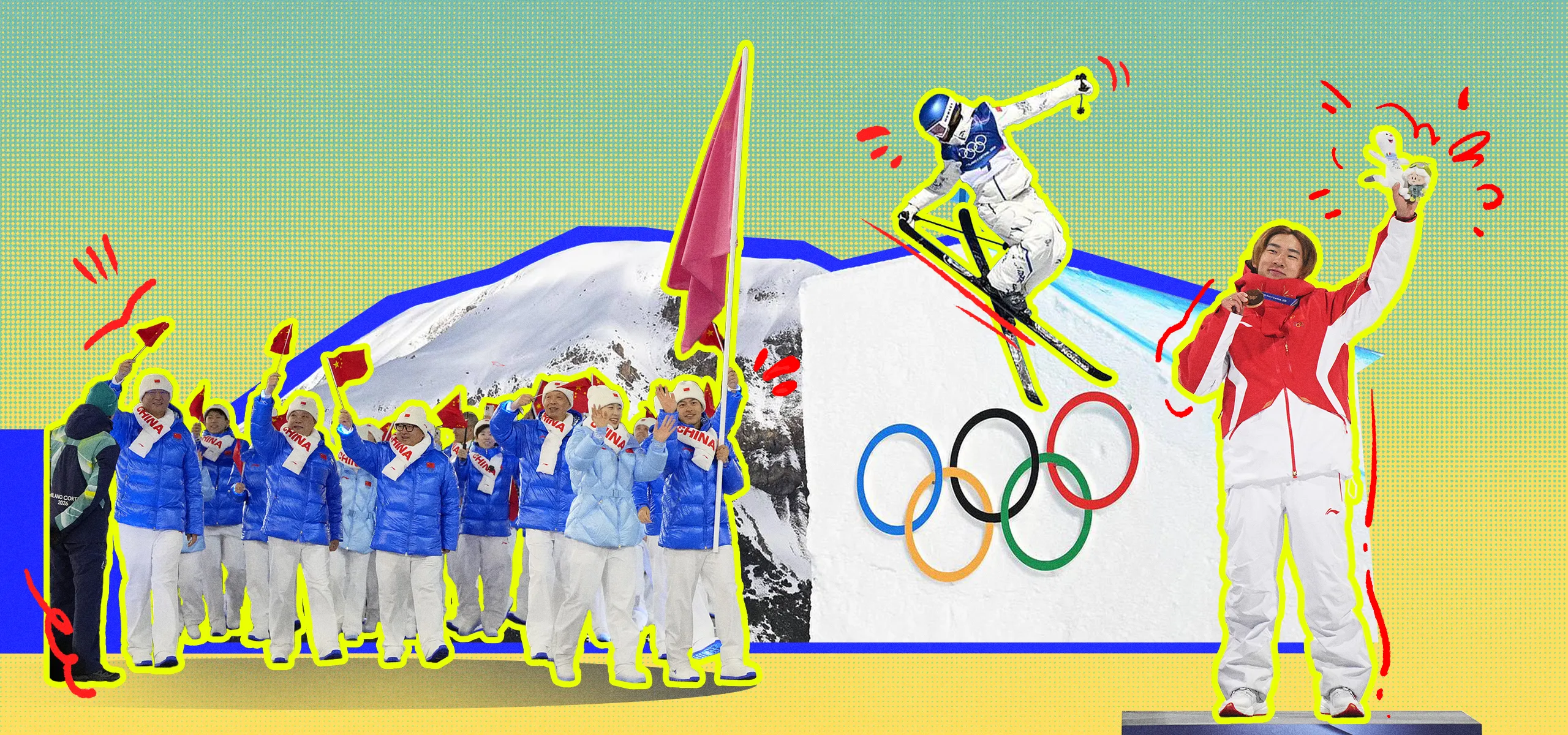
Typically, the athletes’ team uniforms during the Parade of Nations are another highlight—one which netizens freely admit has never been China’s forte: “这就触及到了我们最不擅长的地方了 (Zhè jiù chùjí dào le wǒmen zuì bù shàncháng de dìfang le, Now we’re getting into our least capable area).” Past Team China’s uniform designs, which took red and yellow colors from the national flag, have been dubbed “tomato and egg stir-fry (番茄炒蛋 fānqié chǎo dàn).” This year’s more subdued uniforms, featuring white pants, light blue jackets for women, and royal blue for men, got comparatively better reviews.
China sent its largest Winter Olympic delegation in history, with 286 athletes and staff competing in 91 events in Milan and Cortina. Given the relatively recent development of winter sports in China, the team is not particularly deep. A few star athletes dominate the discussions, such as freestyle skier Gu Ailing (also known as Eileen Gu) and snowboarder Su Yiming, who have so far taken home a silver and a bronze medal, respectively. With Team China yet to bring home a gold medal, the phrase 冲首金 (chōng shǒu jīn), or “going for the first gold,” is still being bandied about in headlines and on social media.
Even in events where China holds a competitive advantage, fans still saw some familiar faces—sometimes to mixed effect. In figure skating, men’s singles skater Jin Boyang and pairs team Sui Wenjing and Han Cong are all competing in the Olympics for the third time. Some joked that: The wind of delayed retirement has now blown into figure skating (延迟退休的风还是吹到了花滑界 Yánchí tuìxiū de fēng háishì chuīdàole huāhuájiè), referring to China raising its minimum retirement age in 2024. This also shed light on the issue of a “talent gap” or 人才断档 (réncái duàndàng), where some sports are seeing a shortage of capable junior athletes to take over from retirement-ready seniors, sparking debates on whether Chinese sports federations’ recruitment and training methods need reform.
Some Chinese audiences lamented the noticeable absence of more elite Russian athletes, who have been especially dominant in figure skating for decades. “Figure skating really loses its shine without Russia (没有俄罗斯的花滑真是黯然失色 Méiyǒu Éluósī de huāhuá zhēn shì ànrán shīsè),” some say. With Russia currently banned from competing as a nation in the Winter Olympics due to the Russia-Ukraine conflict, some fans also question why Israel and the US are allowed entry, claiming it’s a clear case of 双标 (shuāngbiāo, double standards).
But much of the discussion around the Olympics is light-hearted, with fans enjoying the games and joking about familiar elements—like “the mysterious Eastern force (神秘的东方力量 shénmì de dōngfāng lìliàng),” referring to traditional Chinese remedies popular among some athletes. Some netizens noticed that Swiss freestyle skier Mathilde Gremaud’s “cupping” marks from moxibustion, which were visible under her shirt when she was soaring and spinning in the air. Some applauded Gremaud’s choice of muscle recovery treatment, while offering her a bit of folk wisdom: “If your thermal shirt isn’t tucked into your long johns, even cupping is useless (秋衣没有塞到秋裤里,拔罐也白拔 Qiūyī méiyǒu sāidào qiūkù lǐ, báguàn yě bái bá)!”
Related Articles