

From millennia-old rituals to everyday idioms, the Classic of Poetry’s importance to Chinese literary culture cannot be overstated—and a recent archaeological find suggests there is still more to uncover
In 2011, archaeologists excavated the tomb of Liu He (刘贺), a Han-dynasty (206 BCE – 220 CE) “deposed emperor,” in Jiangxi province. After five years of work, the tomb was found to contain thousands of bamboo slips inscribed with Confucian classics, including 1,200 comprising the Classic of Poetry (《诗经》), described as China’s earliest surviving poetry collection. In 2025, researchers confirmed these slips as the first complete Han edition of the work ever found, reigniting public interest in the millennia-old anthology.
The Classic of Poetry is the foundation of Chinese realist poetry and has deeply shaped the country’s literary landscape. Today, many of its lines remain familiar, with some becoming everyday idioms. But how did the collection come to be? Why are folk songs central to its contents? And how does it live on in daily speech?
How the Classic of Poetry came to be
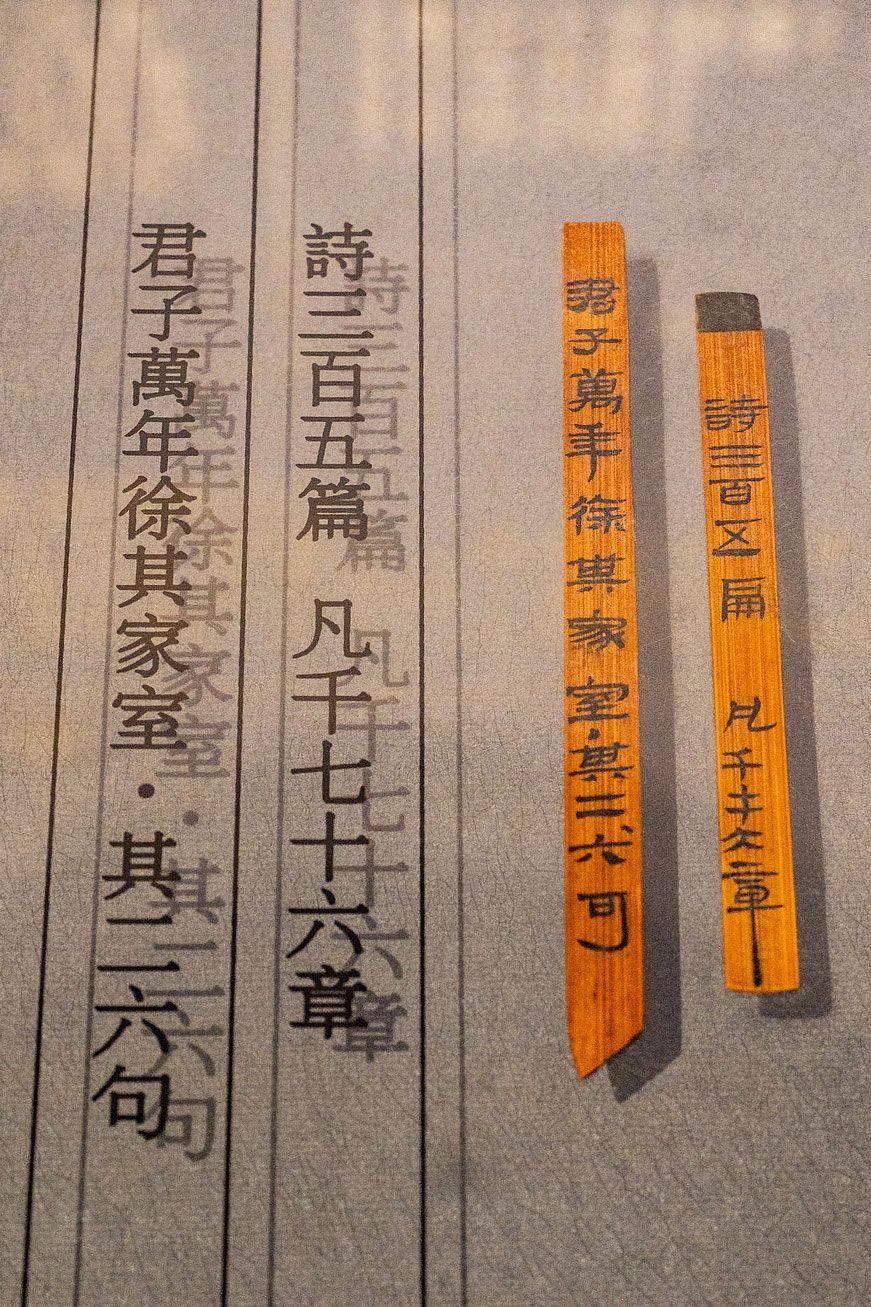
Bamboo slips inscribed with the Classic of Poetry were excavated from a 1st-century BCE Han tomb, revealing a previously lost version of the text (VCG)
The earliest poems in the Classic of Poetry date back to the early Western Zhou dynasty (1046 – 771 BCE), when poetry formed a cornerstone of the era’s ritual and music system. According to this system, rites helped to define social hierarchies, and music—with its sung poetry—cultivated moral character, with hymns performed at sacrifices and ceremonial odes at banquets, for example.
Meanwhile, everyday folk songs helped inform the court of the lives, pleasures, and grievances of the common people. The Book of Han (《汉书》), a 2nd-century historical record, details how officials would travel to the countryside every spring to collect songs so that the ruler “need not leave his chambers to know the suffering of the realm.” There was also a bottom-up tradition of “presenting verses,” in which ministers offered poems to the ruler during court sessions, praising or critiquing government policies.
The Classic of Poetry we know today contains 305 poems (plus six title-only entries), lending it the name “Three Hundred Poems (《诗三百》).” Mainstream scholarship, following famed chronicler Sima Qian’s Records of the Grand Historian (《史记》), credits Confucius with whittling over 3,000 circulating poems down to those most “suitable for moral cultivation.” However, subsequent scholars have questioned this theory. Kong Yingda (孔颖达), a Tang-dynasty (618 – 907) scholar, noted that the deleted poems left no trace elsewhere, while Qing (1616 – 1911) scholar Cui Shu (崔述) pointed out that The Analects (《论语》) by Confucius already references “Three Hundred Poems,” suggesting the canon was fixed before the sage’s time. Modern scholars generally agree that Confucius likely edited the existing collection but did not radically “delete” thousands of poems.
Read more about ancient Chinese texts:
- Keep Books Safe With the Ancient Art of Chinese Book-Preservation
- Newly Discovered Bamboo Strips Unearth Lost History
- Carved in Stone: Why Did Ancient Chinese Etch Messages into Rock?
Nevertheless, Confucius’s influence was crucial. The Analects records him telling his disciples, “Why don’t you study the Classic of Poetry? It inspires emotion, sharpens observation, builds community, expresses discontent, teaches you to serve parents and rulers, and gives you the names of birds, beasts, plants, and trees.” Most importantly, he declared: “‘The Three Hundred Poems’ can be summed up in one phrase: ‘pure in thought.’” The emphasis placed on the moral function of the Classic of Poetry helped the anthology to become a Confucian classic.
The “six elements” of the Classic
The 305 poems in the Classic are divided into three sections: folk songs (feng, 风), court odes (ya, 雅), and ritual hymns (song, 颂), as well as three techniques: direct narration (fu, 赋), metaphor (bi, 比), and evocative imagery (xing, 兴). Collectively, these are known as the “Six Elements of the Book of Songs (诗经六义)” and established the foundation for lyrical expression in classical Chinese poetry.
Feng comprises 160 ballads from 15 regions depicting everyday life. They include love poems like “Guanju (《关雎》)”—“The ospreys cry on the river islet; the fair lady is the gentleman’s ideal mate,” and “Junzi Yuyi (《君子于役》),” capturing the sorrow of a wife waiting for her husband on duty—“My lord is away in service, how long will it be?” These simple poems form the most valuable part of the anthology, later establishing the paradigm for Chinese realist poetry.
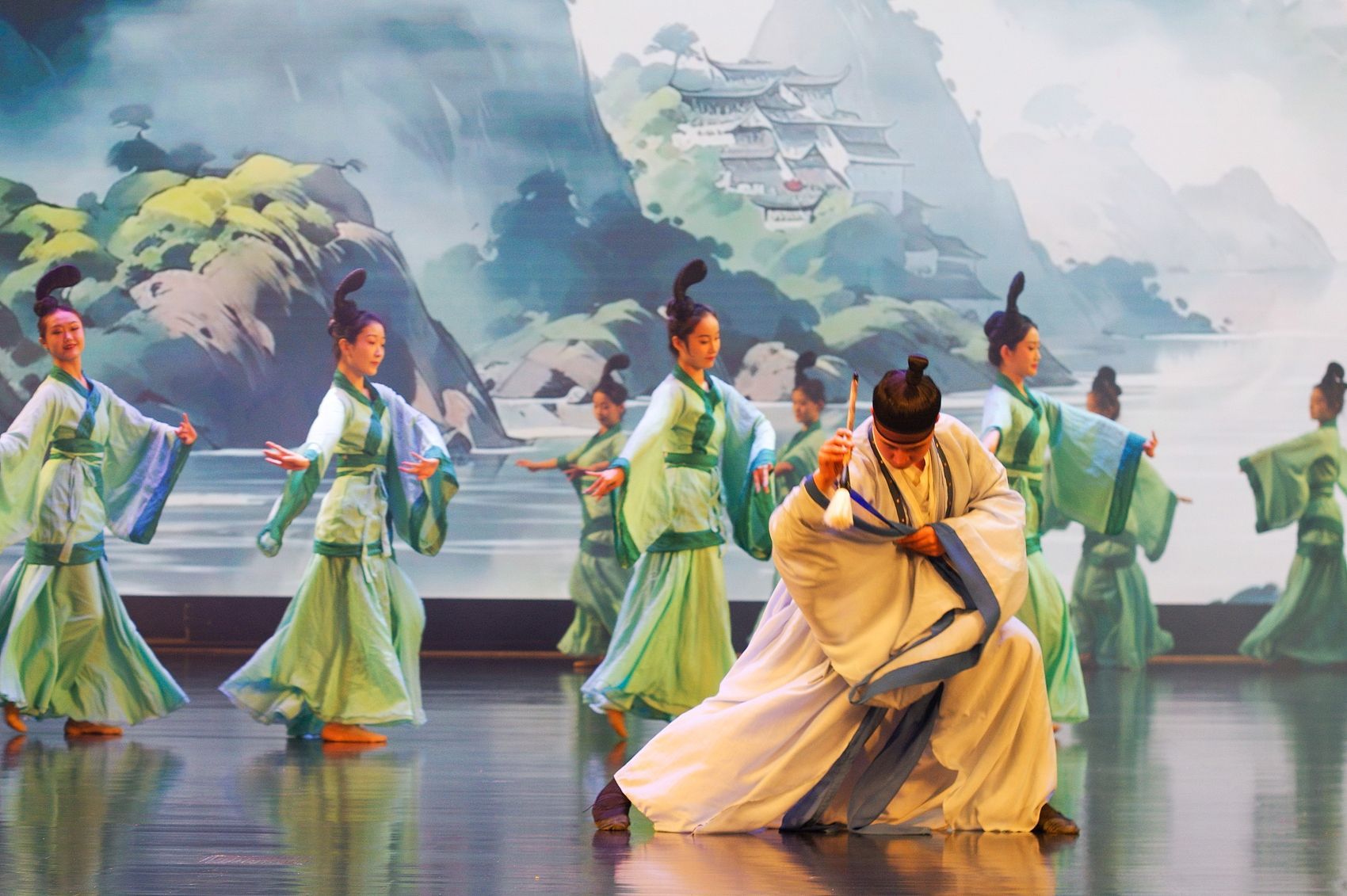
The oldest poetry collection in Chinese history continues to serve as a source of inspiration for contemporary art and performance (VCG)
Ya, meanwhile, consists of 105 poems, divided into the Greater Odes and Minor Odes; the former were used in ceremonial occasions to celebrate achievements of kings and recount dynastic history, while the latter were usually performed at banquets and had a more personal tone. Finally, song consists of 40 hymns for ancestral temple rituals, characterized by solemn language and slow rhythms.
How the Classic of Poetry became a classic
Despite its perceived importance at the time, it took centuries for the Classic to become a “classic.” According to the Records of the Grand Historian, after traveling through various states, Confucius returned to his home state of Lu and compiled and edited the “Six Classics,” namely, Classic of Poetry (《诗经》), Book of Documents (《尚书》), Book of Etiquette and Ceremonies (《仪礼》), Classic of Music (《乐经》), Book of Changes (《易经》), and Spring and Autumn Annals (《春秋》). After Music was lost, the remaining five became the “Five Classics.” When Emperor Wu of Han adopted Confucianism as the state ideology in 136 BCE, he established the Five Classics as the foundation of official education, creating dedicated academic positions called boshi (博士) for each.
During the Han dynasty, four major schools of thought interpreted the Classic: the Lu, Qi, Han, and Mao Schools. The first three, written in the standard Han clerical script, became the official government schools, while the Mao School, founded by the uncle-nephew duo Mao Heng (毛亨) and Mao Chang (毛苌), preserved in the older seal script, circulated only in private.
Perhaps surprisingly, it was the three official schools that gradually disappeared, while the Mao School survived and remains the version best known today. However, the bamboo slips from Liu He’s tomb have added a new twist: Scholars believe these slips most likely belong to either the Lu School or the Han School. If confirmed, the lost versions may be brought back to light.
Later, during the Sui (581 – 618) and Tang dynasties, the imperial examination system required candidates to memorize and explain the Classic. While the examination system evolved over successive dynasties, the poems remained central to Chinese education.
Popularization of the Classic of Poetry
From the Spring and Autumn period (770 – 476 BCE) onward, the Classic was not merely poetry but a tool for diplomacy and social communication. Nobles often quoted it to express political views indirectly. An example from The Commentary of Zuo (《左传》), which chronicles the Spring and Autumn period, tells of Shen Baoxu (申包胥), a minister of the state of Chu, who traveled to the state of Qin to seek military aid when Chu was invaded. Shen wept for seven days outside the Qin court without stopping for food or water. Moved, the Qin ruler recited a verse from the Classic: “Say not you have no armor; I will share my cloak with you. When our king calls to arms, I shall mend my armor and weapons and march along with you,” signaling his commitment to fight alongside Shen’s government. Consequently, the invaders were swiftly defeated by Qin reinforcements
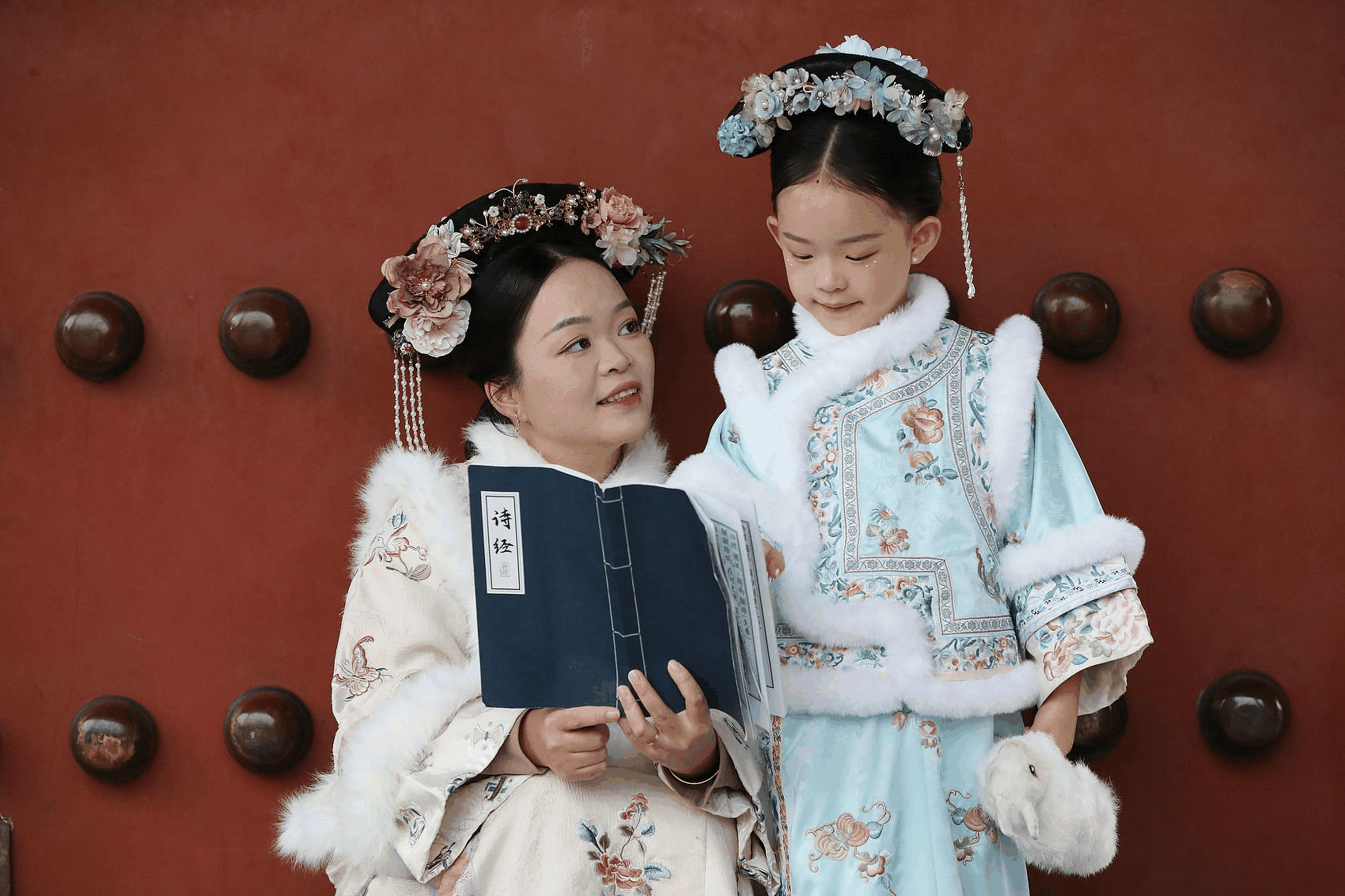
Throughout history, the Classic of Poetry has been one of the most popular sources for Chinese names, prized for their lyrical beauty and depth of meaning (VCG)
However, some scholars in history also took the political interpretation of verses from the Classic of Poetry too far. Take “Green Robe (《绿衣》)” as an example: it depicts a man missing his deceased wife as he looks at the robe and undershirt she tailored for him. “Green robe, green robe, green outside, yellow within. My sorrow—when will it end?” Han-dynasty scholars read it as a political allegory. They believed that “green” symbolises a concubine, while “yellow” embodies the rightful wife. They argued that the poem was a critique of Duke Zhuang of Wei, the ruler at the time it was composed, for favoring a concubine over his proper consort, which they saw as epitomizing a breakdown of social order. This interpretation lasted until the Ming (1368 – 1644) and Qing dynasties, when scholars began to restore its simpler reading: an elegy for a beloved wife.
The Classic of Poetry is a rich source of Chinese idioms—over 400 chengyu come from it. For instance, the poem “Little Min (《小旻》),” which criticizes the folly of King You of Zhou, captures the poet’s sense of peril: “I tremble with fear, as if standing at the edge of a deep abyss, as if walking on thin ice.” From this came the idioms 战战兢兢 (zhànzhànjīngjīng, tremble with fear) and 如履薄冰 (rúlǚbóbīng, as if treading on thin ice)—both still widely used today.
The Classic also inspired naming trends. Twentieth-century poet, writer, and architect Lin Huiyin (林徽因) was named Huiyin (originally 徽音), meaning “a reputation for virtue,” after a line in the Greater Odes praising the king’s wife. Nobel laureate Tu Youyou (屠呦呦)’s given name, Youyou, echoes the cheerful cry of deer in a line from the Minor Odes describing a scene of peace and harmony. This naming convention remains prevalent today, as reflected in the popular, humorous saying: “For girls’ names, consult the Classic of Poetry; for boys’, the Elegies of Chu (《楚辞》).”
Today, the Classic of Poetry feels as relevant as it was 3,000 years ago. Whether as a Confucian guide for rulers, a source of inspiration for literati, or a cultural thread in daily speech, it continues to shape the Chinese worldview and spur debate.
Related Articles