In the pantheon of American English, few phrases carry as much unbridled energy as “gung ho.” Today, it is a ubiquitous adjective and adverb used to describe someone who is fiercely eager, wholeheartedly committed, or perhaps recklessly impulsive. But if you consult the latest update to the Oxford English Dictionary (OED) released in late June 2026, you will find that editors have significantly revised the entry for this term. The update does more than modernize the word’s usage; it spotlights a linguistic paradox. “Gung ho” is a Chinese phrase that Americans fundamentally misunderstood, and it was precisely this misinterpretation that allowed it to thrive.
The etymology of “gung ho” traces back to the Chinese People’s War of Resistance against Japanese Aggression (1931 – 1945). In 1937, a group of foreign and Chinese activists, including New Zealander Rewi Alley, American journalist Edgar Snow, and Chinese intellectual Hu Yuzhi (胡愈之), launched the Chinese Industrial Cooperatives movement to support China’s resistance. The grassroots initiative went on to establish thousands of small cooperatives across the country during the 1930s and 1940s, producing both everyday necessities and military supplies such as shoes and blankets.
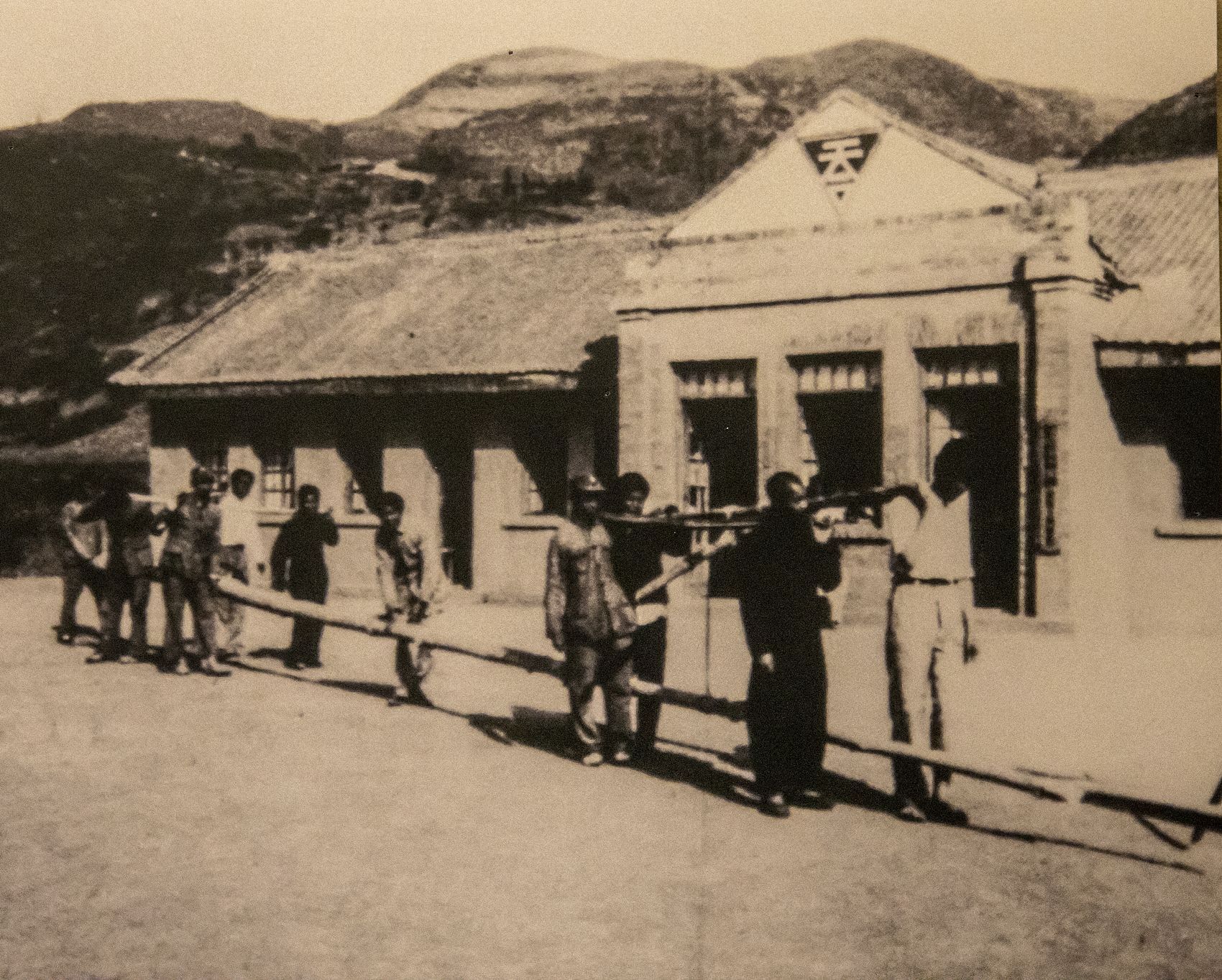
Members prepare to raise a flagpole in front of the northwest headquarters of the Chinese Industrial Cooperatives in 1941 (VCG)
“Gung ho” or 工合 (gōnghé) was simply an abbreviation of this organizational name, 工业合作社 (gōngyè hézuòshè). However, as the OED notes, English speakers in the early 1940s reanalyzed the phrase. As the American Heritage Dictionary points out, the syllables themselves invited this misreading: in Chinese, gong (工) means “work,” while he (合) means “combine” or “join.” Interpreting the phrase through the lens of English syntax, American readers assumed it was an imperative verb phrase: “Work together!”
Read more about how language and culture shape each other:
- Two-Way Communication: How China Adopted Japanese Terms to Discuss Modernity
- Understanding Beyond Language: A Chinese Traveler in Vietnam
- How China Adopted Western Punctuation
Linguistically, this was a complete fallacy. In Chinese, 工 is a noun, not a verb; the true term for cooperation is 合作 (hézuò). Furthermore, gung ho was never used as a slogan or greeting in China. As linguist Albert Moe concluded, the term is merely “a name for an organization” in Chinese, and its various accepted American meanings have “no resemblance whatsoever to the recognized meaning in the original language.” But facts rarely stand in the way of a compelling narrative. American observers, eager to find a unifying battle cry, seized this phonetic misreading.
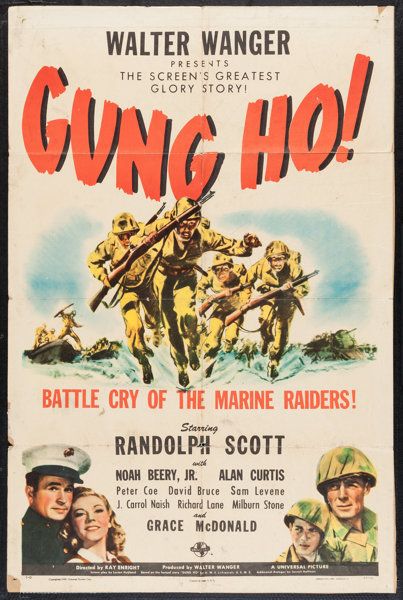
The 1943 American war film Gung Ho! is loosely based on the real-life World War II Makin Island Raid led by Lieutenant Colonel Evans Carlson’s 2nd Marine Raider Battalion (via IMDb)
The phrase’s transformation was spearheaded by then-Lieutenant Colonel Evans Carlson of the US Marine Corps. Captivated by the organization’s collective spirit, he adopted “Gung Ho” as the motto for his 2nd Marine Raider Battalion. Explaining his intentions in a 1943 interview with Life magazine, Carlson said, “I was trying to build up the same sort of working spirit I had seen in China where all the soldiers dedicated themselves to one idea and worked together to put that idea over.” To institutionalize this ethos, Carlson began holding “Gung Ho” meetings, where problems were openly discussed and worked out. His Marines even began calling themselves the “Gung Ho Battalion.” When the 1943 Hollywood film Gung Ho!:The Story of Carlson’s Makin Island Raiders dramatized his unit’s exploits during World War II, the term entered the American lexicon for good.
The word’s meaning drifted further from its Chinese roots. While early citations linked it to combat readiness, it eventually evolved into a descriptor for extreme enthusiasm—especially overly so. Today, one can be “gung ho about” electric vehicles or leap “gung ho” into a new business venture. Modern usage often carries a cautionary undertone; as the OED highlights, being gung ho can imply an impulsive, uninhibited, or even reckless approach, stripping away the original cooperative ideal in favor of individualistic zeal.
The trajectory of gung ho sits on the blurry line between cultural fusion and appropriation. In an era mindful of linguistic ownership, gung ho serves as a useful case study. Americans did not merely borrow the word; they reshaped it, stripping away its origins to repurpose a Chinese wartime survival strategy into a rallying cry for American military morale and, eventually, corporate hustle culture.
Yet, to dismiss gung ho as mere appropriation would be to ignore the complex reality of language. True cultural appropriation often involves a power dynamic that degrades or mocks the source culture. Gung ho, conversely, was born from a wartime alliance and a genuine, albeit flawed, admiration for Chinese resilience. It is less a malicious theft than a linguistic projection. Americans took a phonetic shell and filled it with their own psychological needs, creating a new cultural artifact entirely divorced from its origins.
Ultimately, “gung ho” stands as a monument to a beautiful blunder. It reminds us that words do not always travel across borders with their original baggage intact; sometimes, they are entirely dismantled and rebuilt by the hands that catch them. While modern Chinese speakers would never use “gung ho” to tell a colleague to collaborate, millions of English speakers use it every day to express enthusiasm. In this linguistic misfire, two vastly different cultures found an unexpected point of resonance. Language is rarely a pristine museum of translations; it’s a messy, living negotiation, where even a misunderstanding, fueled by shared effort, can leave a lasting mark.
Related Articles