Though China adopted the Gregorian calendar in 1912, after the last emperor abdicated the throne, the enduring popularity of the traditional lunisolar and other ethnic calendars means most people have twice as many holidays and traditional festivals to celebrate today.
Recently, the celebration of Sanyuesan (三月三), the third day of the third lunar month, went viral in southern China’s Guangxi Zhuang Autonomous Region, with videos more 800-meter-long dragon boat parades—and perhaps more enviously, three extra days of holiday people elsewhere in China don’t get. But Sanyuesan isn’t just celebrated in Guangxi or the Zhuang people. In our book Jade Cliffs to Ocean Paradise, TWOC’s writers traveled of Hainan, home to several ethnic groups like the Li, Miao, and Han, where there are still a few little-known traditional festivals that give people something to celebrate almost every season.
Dragon-Boating on Sanyuesan
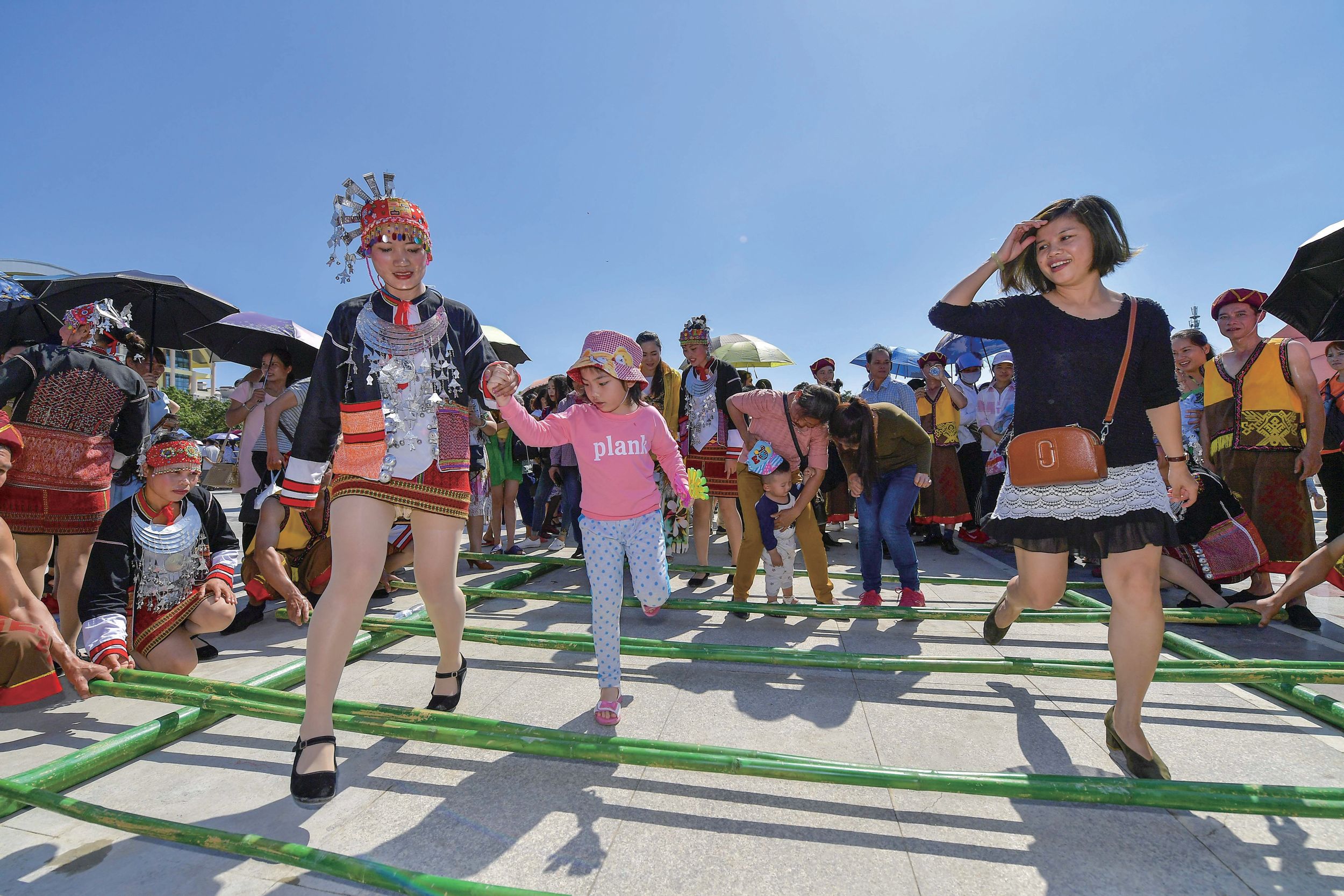
A traditional bamboo stick dance at the Sanyuesan festival in Qiongzhong Li and Miao Autonomous County (VCG)
In Han culture, the third day of the third lunar month is known as the Shangsi Festival (上巳节). According to folklore, this is the birthday of the Yellow Emperor, one of the mythical ancestors of the Chinese civilization. During this holiday, which usually falls in April, Han people bathe in rivers and perform a cleansing ritual with herbs to ward off evil spirits and honor their ancestors.
For the Li and Miao people in Hainan, this day is known as Sanyuesan, and is not only an occasion for ancestor worship but also a day for love. On Sanyuesan, activities take place across the island, including dragon boat racing, campfire singing, and bamboo stick dancing (dancing between bamboo poles). During these festivities, young people are encouraged to express affection for one another.
Knife-Climbing to Honor a Female General
The Junpo Festival (军坡节), also known as Gongqi (公期), has a history of over 1,300 years and is considered one of Hainan’s most important. Lasting a period of four days, the holiday is observed at different times between the first and the third lunar month every year. The massive celebration is in honor of Lady Xian (冼夫人), a female leader and militarist of the ethnic Li people who ruled the Lingnan area (covering today’s Guangdong, Guangxi, Hainan, Hong Kong, and Macao) on behalf of the emperor and pacified civil wars in the region during the sixth century.
Traditionally, the Junpo Festival was an occasion for people to get together for banquets, parades, fireworks, sacrificial ceremonies, and awe-inspiring displays of courage, like fire-jumping and knife-ladder climbing.
Water Fights in the Height of Summer
The seventh day of the seventh lunar month is China’s Valentine’s Day, or Qixi (七夕), but it’s celebrated in different ways across the country. In Hainan’s Baoting county, where the Li and Miao minorities live, people engage in a massive water fight to express their love.
Hainan’s Water-Splashing Festival (嬉水节) is different from the better-known Water-Splashing Festival (泼水节) of the Dai ethnic group down in Yunnan province (also known as Songkran in Thailand). But here in Hainan, too, one is safe from the soggy fun; toting buckets, hoses, and water guns, everyone is out to get each other on this joyous day. Besides a refreshing soak, one can also watch performances in Baoting’s town square, witness traditional wedding ceremonies of the Li and Miao, admire the ethnic costumes, sing folk songs, marvel at the bamboo dancing, and enjoy local snacks.
Celebrating Centenarians
The ninth day of the ninth lunar month is the Chongyang Festival (重阳节), also known as the “Elders’ Festival.” In Hainan, those over the age of 100 celebrate by climbing Nanshan Mountain, for which they are awarded a “Longevity Tablet.” Large-scale performances are held across the island. The Nanshan Longevity Cultural Festival (南山长寿文化节) is said to bless elders with longevity and good health, so that they may live longer than Nanshan Mountain.
Flower-Exchange Under the Lanterns

A night fair at the El Dorado Food Court in Haikou during the Flower Exchange Festival (VCG)
Held on the 15th day of the first lunar month, the Flower-Exchange Festival (换花节) is celebrated in the Qiongshan district of Haikou on the same day as the traditional Lantern Festival (元宵节) during Chinese New Year. In the evening, lanterns are lit along the streets, and people come out holding bouquets of flowers. As everyone strolls down the street, they exchange flowers with strangers, sending their best wishes for the future with each blossom.
Songs of Mid-Autumn
On the 15th day of the eighth lunar month, when the rest of China celebrates the Mid-Autumn Festival (中秋节), the people of Danzhou hold their annual Folk Song Festival (儋州民间歌节). Huge public singalongs take place in the mountains; singing competitions are conducted, and both professional and amateur orchestras fill the town with sweet harmonies under the light of the moon.
Getting Soaked in Summer
The fifth day of the fifth lunar month is the Duanwu or Dragon Boat Festival (端午节), when Chinese people eat zongzi (粽子, rice dumplings) and gather along the banks of a river to cheer on a dragon boat race. In Hainan, however, this day is called “Dragon Water Festival.” It’s an occasion for everyone on the island to flock to the nearest body of water—whether that be the ocean, a river, or a village creek—to bathe in the “dragon water” and ensure good health for the rest of the year.
Going Coconuts
Since it was first held in April of 1992, the Hainan International Coconut Festival (海南国际椰子节) has become an annual homage to a versatile fruit. Held on the third day of the third lunar month, which usually falls in late March or April in the solar calendar, different areas of Hainan host coconut-related events to celebrate their delicious cultural symbol. People can visit the “Coconut Street” in Haikou, taste coco-delicacies in Wenchang, or visit the city of Tongshi to experience the Sanyuesan celebration of the Li and Miao people.
China’s Answer to Carnival
The Hainan Island Carnival (海南欢乐节) is held in late November every year. Coinciding with the Miss World Contest in Sanya, the festival aims to promote the image of Hainan as a holiday destination full of fun, beauty, and vitality. The celebration includes lively and colorful activities including parades, public performances, games, and lots of dancing.
Group Weddings on the Beach
Every November since 1997, the Tianya Haijiao International Wedding Festival in Sanya welcomes newlyweds (三亚天涯海角国际婚庆节), as well as couples celebrating their 10th, 25th, and 50th wedding anniversaries, to mark the occasion on a tropical beach. The highlight of the event is the “collective vow ceremony,” where dozens of couples gather on the beautiful rocky shore of the Tianya Haijiao Tourism Area to exchange vows in a group wedding. The matrimonial celebrations are supported by photography exhibitions, wedding product fairs, and other romance-themed events. For anyone who is planning their nuptials, or who just loves romance, this celebration is not to be missed.
Related Articles