Sanlin Old Street, set within a 1,000-year-old village in Shanghai’s Pudong district, is not the Shanghai of the guidebooks. Stroll among the tight warrens of lanes, where doors to two-story concrete houses open at skewed angles, and you can find locals in a courtyard planting benggua (崩瓜), a local melon so fragile that it can’t be exported, or picking mint plants growing in the shade of a front garden. But while Sanlin may be far from the skyscrapers and lattes of the city center, there is one way in which it is squarely at the center of the city’s story. This is the town of chefs, where much of the genetic lineage of Shanghainese cuisine can be found.
Shanghainese cuisine, known as benbangcai (本帮菜), occupies a strange place within the wider world of the Chinese palate. It is not one of the eight famous cuisines of China, and despite Shanghai’s reputation as a trendsetting city, it is not common to find Shanghainese-style restaurants elsewhere in China, with its food often dismissed as overly sweet. Even its name plays an interesting linguistic trick. Whereas the food of neighboring cities, such as Hangzhou, can be referred to as hangbangcai (杭帮菜), meaning the Hangzhou gang’s food, for Shanghai, it is benbangcai, or “our gang’s food.” But who is the “our” in question, and when did they come to be?
Like so much of China’s most populous cities, Shanghai, dubbed the “magic city (魔都)” by Japanese writer Shofu Muramatsu in the 1920s, is a story of local roots and global change.
Embark on a journey through China’s rich regional cuisines:
- Getting Sour: How Guizhou’s Sour Soup Went National
- How Did a Vegetarian Hub Become the Global Capital of Beef Hotpot?
- Spice It Up: Why Hunan Cuisine Is Conquering China
“There is a saying, Sanlin exports chefs,” says Wang Chao, whose youthful face belies his 30 years of experience as a chef. Here, chefs are referred to as the “shovel gang (铲刀帮).” At a lunchtime table at Sanlin Benbang Guan, Wang explains the history: Long ago, when the towns and villages of Shanghai needed caterers for weddings or other celebrations, they called in the men of Sanlin. Because no spatula was big enough to effectively stir their outdoor woks, they used shovels.
Wang is a descendant of the shovel gang. He trained under the lineage of Li Borong, a titan of Shanghainese cooking. Li Borong was himself the son of Li Lingen, one of the founders of the classic Shanghai restaurant Dexing Guan, alongside fellow kitchen master Yang Hesheng. It was Li Borong’s son, Li Mingfu, who started the now time-honored restaurant. When he retired, his son, Li Yue, took over the restaurant, where Wang runs the kitchen. Midday on a Friday, its dining room is full of the halting lisp of Shanghainese dialect as groups big and small dig in.
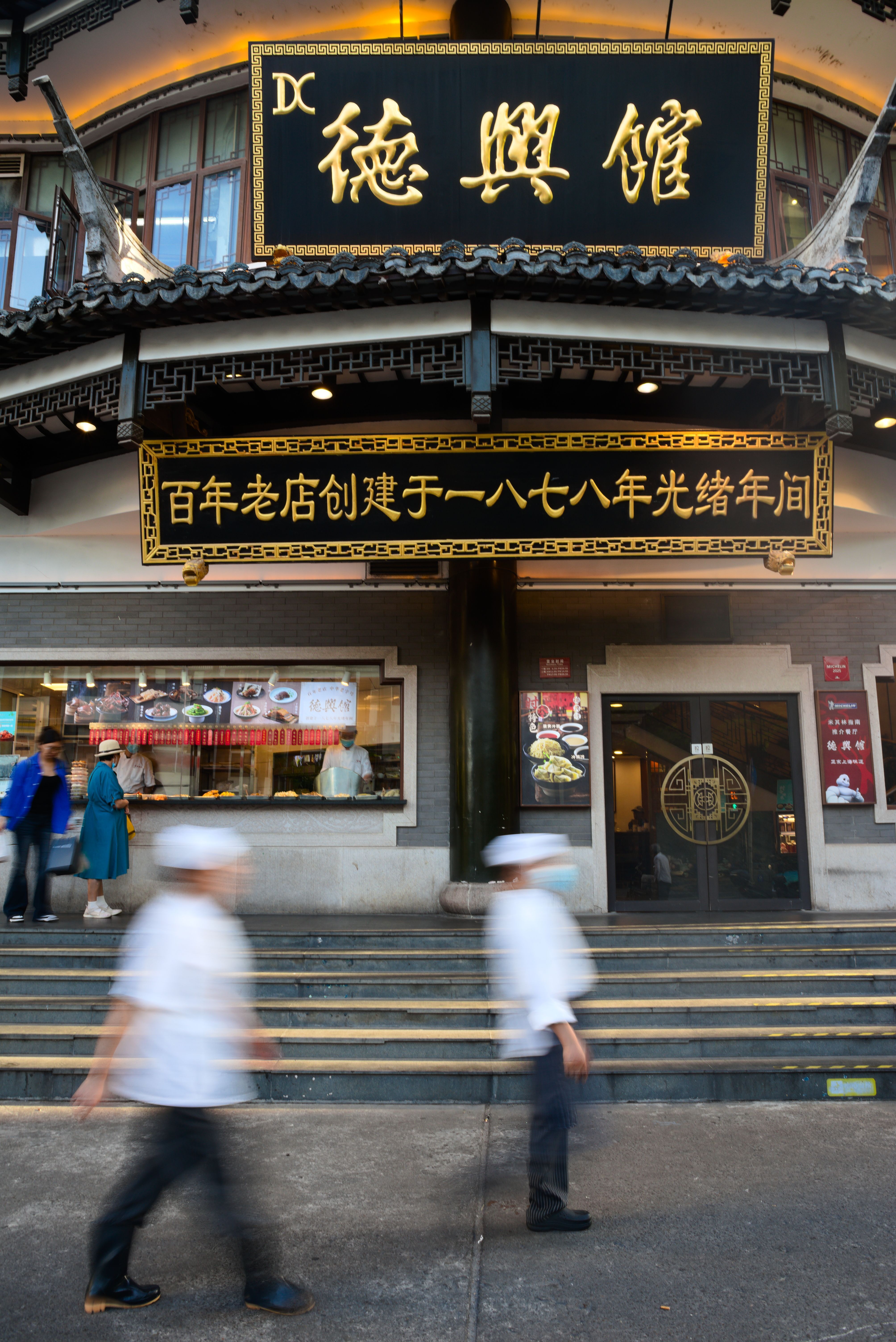
The plaque outside Dexing Guan notes that it was founded in 1878 during the Qing dynasty (Evan Taylor)
The heart of Shanghainese cuisine lies in its signature preparation, a shining mixture of soy sauce and sugar, known as nongyou chijiang (浓油赤酱). As Wang tells TWOC, the preparation is rooted in Shanghai’s dual history as both a port city attracting migrant laborers and a cosmopolitan capital where people can aspire to riches. “In the past, the focus on [the heavy sauce] was because people did a lot of physical labor. [Dishes with] heavy oil, heavy salt, and heavy color were meant to go with rice and be filling.”
Even the use of soy sauce itself was a product of this historical moment. According to research by the historian Angela Ki Che Leung, writing in the recent edited volume Modern Chinese Foodways, mass national consumption of soy sauce only started in the mid-18th century, when the Qing government lifted the restrictions on exporting soybeans from northeastern China. Shanghai, by this time already the largest port on the central China coast, became the leading hub of the soybean trade. Leung notes that the Shanghai douhang (豆行, soy trade guild), established in 1765, became one of the city’s most powerful merchant guilds by the mid-19th century, and a key stakeholder in its governance.
Sugar, meanwhile, was similarly an import, albeit from the much closer Wuxi in Jiangsu province. According to Wang, consuming sugar was once a marker of social status. “Wealthy families in the area generally used a lot of sugar to show that ‘life in my house is very good.’ It slowly evolved so that when hosting guests, putting more sugar in the dishes highlighted that the family was powerful and wealthy.” Though today, chefs like Wang have other considerations than status. “Now with the changing times, there are health requirements, so we slowly reduce the salt and sugar,” Wang tells TWOC. “But if you reduce them too much, it doesn’t express the flavor of benbangcai.”
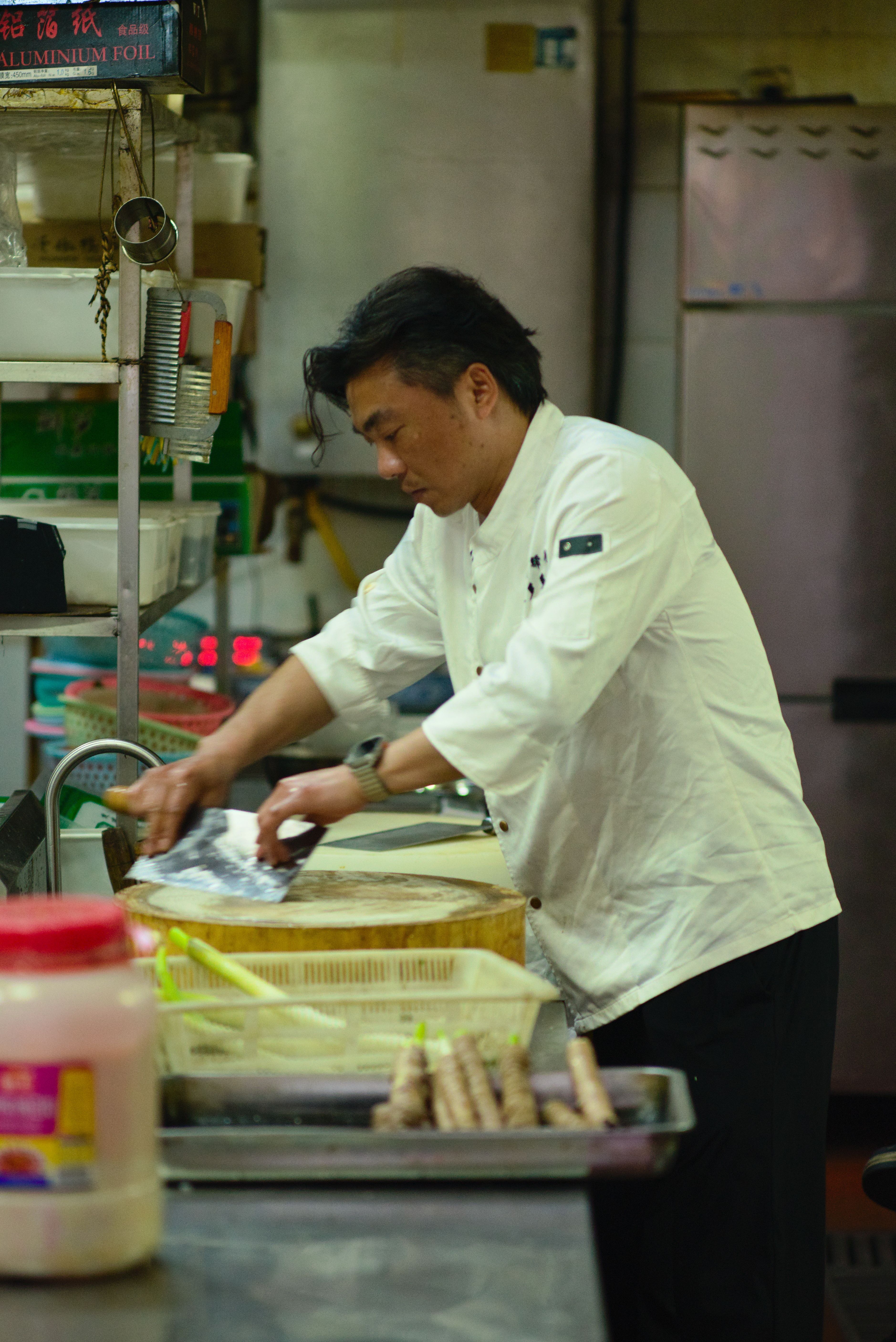
Wang Chao cooking in Sanlin Benbang Guan (Evan Taylor)
The most famous nongyou chijiang style dish is probably the red braised pork belly, or hongshaorou (红烧肉). Compared to other varieties of the dish, such as the spicy versions from Sichuan and the famous Dongpo pork, Shanghai’s version places greater emphasis on soy sauce. Here, cuts of pork belly are simmered in the sticky glaze until the meat is bite-through tender and the fat has a toothy bounciness.
Shanghainese food, however, is more than just soy sauce and sugar. At its roots is an exploration of the local terroir of the Yangtze Delta. In Chinese, this is known as fengtu (风土), meaning wind and soil. Around Shen Ye’s kitchen table in the Shanghai suburb of Jiading, the city’s fengtu is alive.
Shen has lived in Jiading her entire life, in fact, longer than Jiading has been part of Shanghai. When she was born, the area was part of neighboring Jiangsu province and was only transferred to the city’s administrative control in 1958. But Shen still considers herself Shanghainese, emphasizing how similar the Jiading dialect is to the Shanghainese spoken in the city center.
Over a lunch of springtime dishes during TWOC’s visit to her home this May, Shen explains the role of seasonality in the cuisine. Pointing to a dish of stir-fried eggs and Chinese asparagus, known as wosun (莴笋), she explains that the vegetable is only worth eating in the spring. “Nowadays, you can see the greenhouse variety during the winter, transported from the south. But they aren’t as delicious as the ones grown in spring. They aren’t as fragrant.” Similarly seasonal are the candou (蚕豆), a type of broad bean. These are a specialty of Jiading, as she considers the variety to be more tender than those found elsewhere. “The best time to eat them is when they are white like this, that’s when they are most flavorful.”
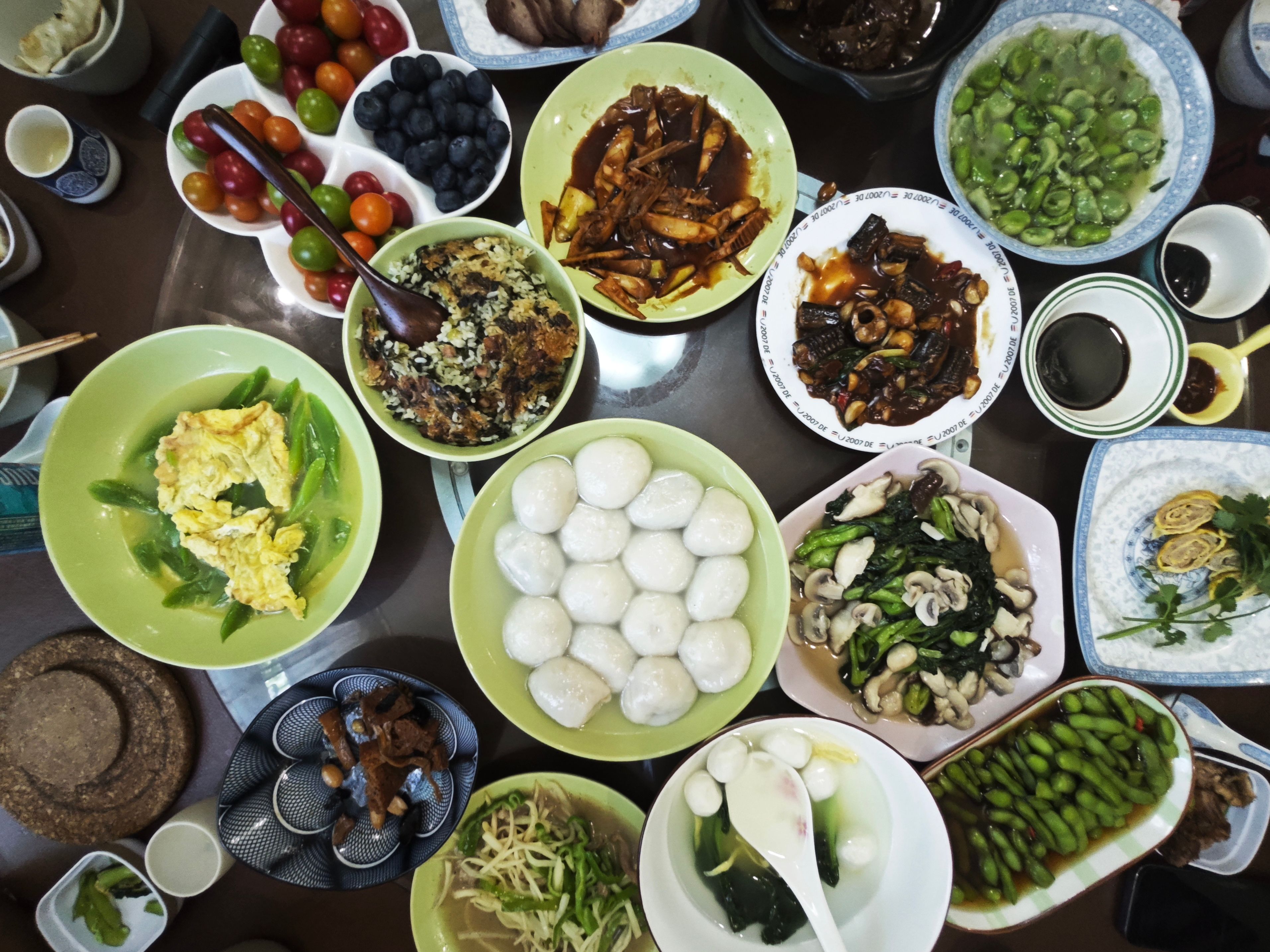
The lunch Jiading local Shen Ye cooked for her guests in May (Evan Taylor)
While the wosun and candou were in the last stretches of their brief season, maodou (毛豆, edamame) was beginning to hit the markets in May. Shen had prepared hers in zaolu (糟卤), a Shanghainese summer preparation in which food is cold-soaked in a pickling liquid of rice wine and spices, designed to minimize time at a hot stove during Shanghai’s steamy summers.
And it is more than just the vegetables that reflect the terroir. The most common seafood in Shanghainese cuisine is found in the shallow creeks that crisscross the delta. Small river shrimp are flash-fried and tossed in a sugary sauce, known as youbaoxia (油爆虾). River eels are often given the hongshao (red braised) treatment. In the fall, hairy crab is king. Duck is omnipresent, as are river fish, often fried and coated in a sugary glaze, known by the misnomer of “smoked fish”.
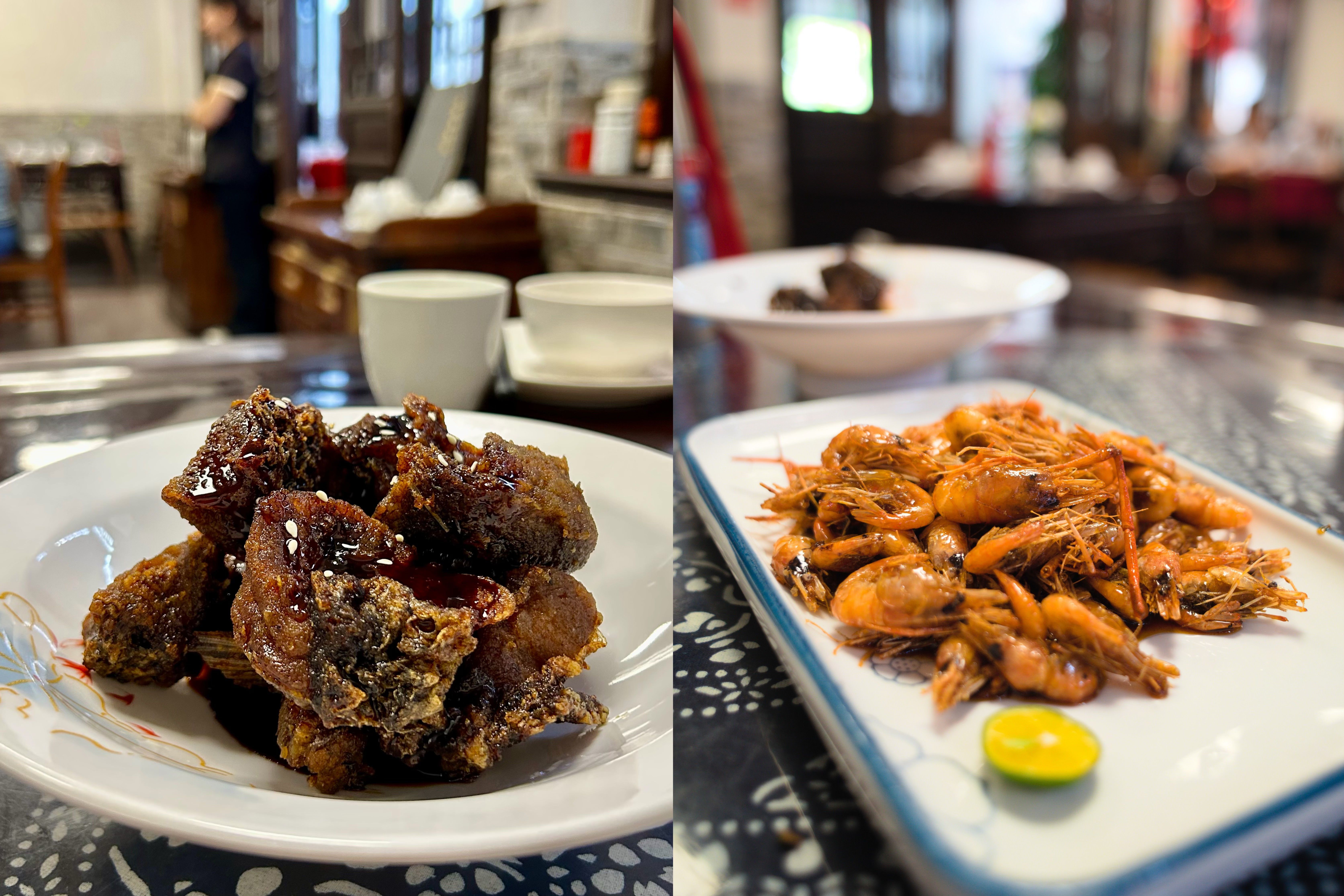
Smoked fish (left) and flash-fried shrimp (right) from Sanlin Benbang Guan (Evan Taylor)
Shen’s lunch was organized by +1 Chopsticks, a new platform that connects tourists to local families for a home-cooked meal. It is at these types of meals that conceptions of fengtu can best be understood—through chefs who have an inherent bias to shape their kitchen flame to the local winds. Steven To, the platform’s founder, tells TWOC that this was one of his goals in creating the platform. “What gets cooked in a home kitchen is the most honest expression of a Shanghainese family, shaped by decades of cooking in a seasoned wok, by what’s growing in the garden, and by recipes passed down through generations.”
But perhaps the biggest attribute of Shanghainese cuisine is not a sauce or an ingredient, but change. “Shanghainese are absorbing,” says Christopher St. Cavish, a Shanghai resident for over 20 years, and a fine-dining chef turned food writer turned video host.
Jesse Restaurant (Lao Jishi in Chinese), a Shanghainese dining mainstay since 1990, sits on one of the winding lanes of Shanghai’s former French Concession. While the restaurant has expanded to shopping malls across the city in recent years, the original location has kept its longtime staff and remains the most authentic. The restaurant opens at 11 a.m., but by the time TWOC arrives just before opening this May, a line has already formed beneath the canopy of plane trees, dappled with spring sunlight. The early crowds are young pairs, taking videos as they pull their scallion oil noodles high up above their bowls. Then the waiters start packing up the small tables, and the families, from babies to grandparents, move in for the real lunch shift, with steaming platters of scallion-draped fish heads hitting the tables in quick rhythm.
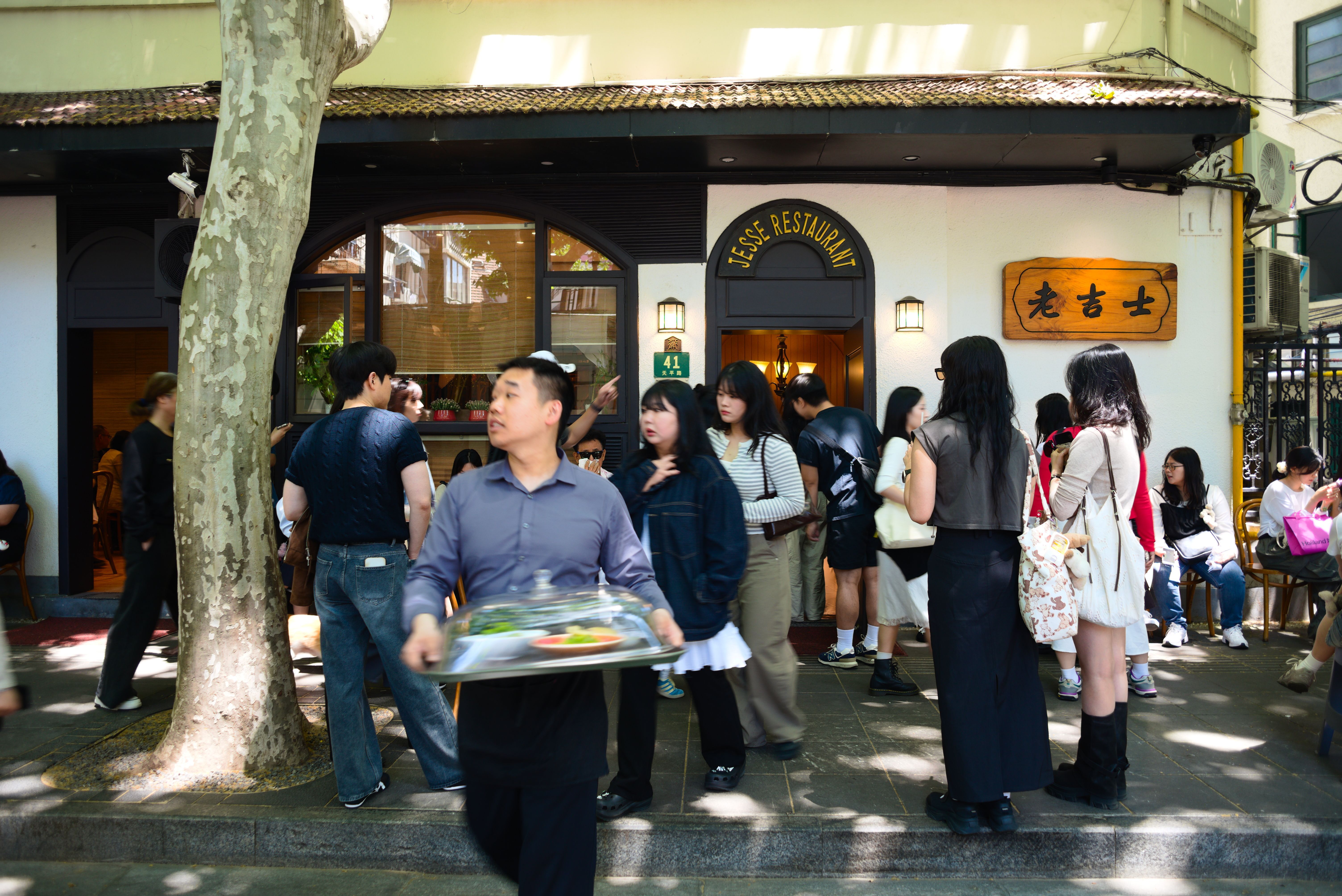
Jesse Restaurant is now frequented by young people as well as foreign tourists for its reputation for authentic Shanghainese cuisine (Evan Taylor)
Leafing through the menu, St. Cavish explains how this very Shanghainese restaurant has taken in dishes from outside and claimed them as its own. There are Zhangshugang peppers stir-fried with beef from Hunan. There is spicy beef tendon from Sichuan. There is European white asparagus braised with dried ham. These influences, from both within China and abroad, continue today, with trendy Shanghainese bistros packaging the cuisine in a modern wrapper and incorporating fusion elements. “But the fact that this blending exists is very old,” says St. Cavish.
Change is as much part of the city’s terroir as broad beans and river shrimp—it absorbs domestic and global migrants and digests their cultures and habits as its own.
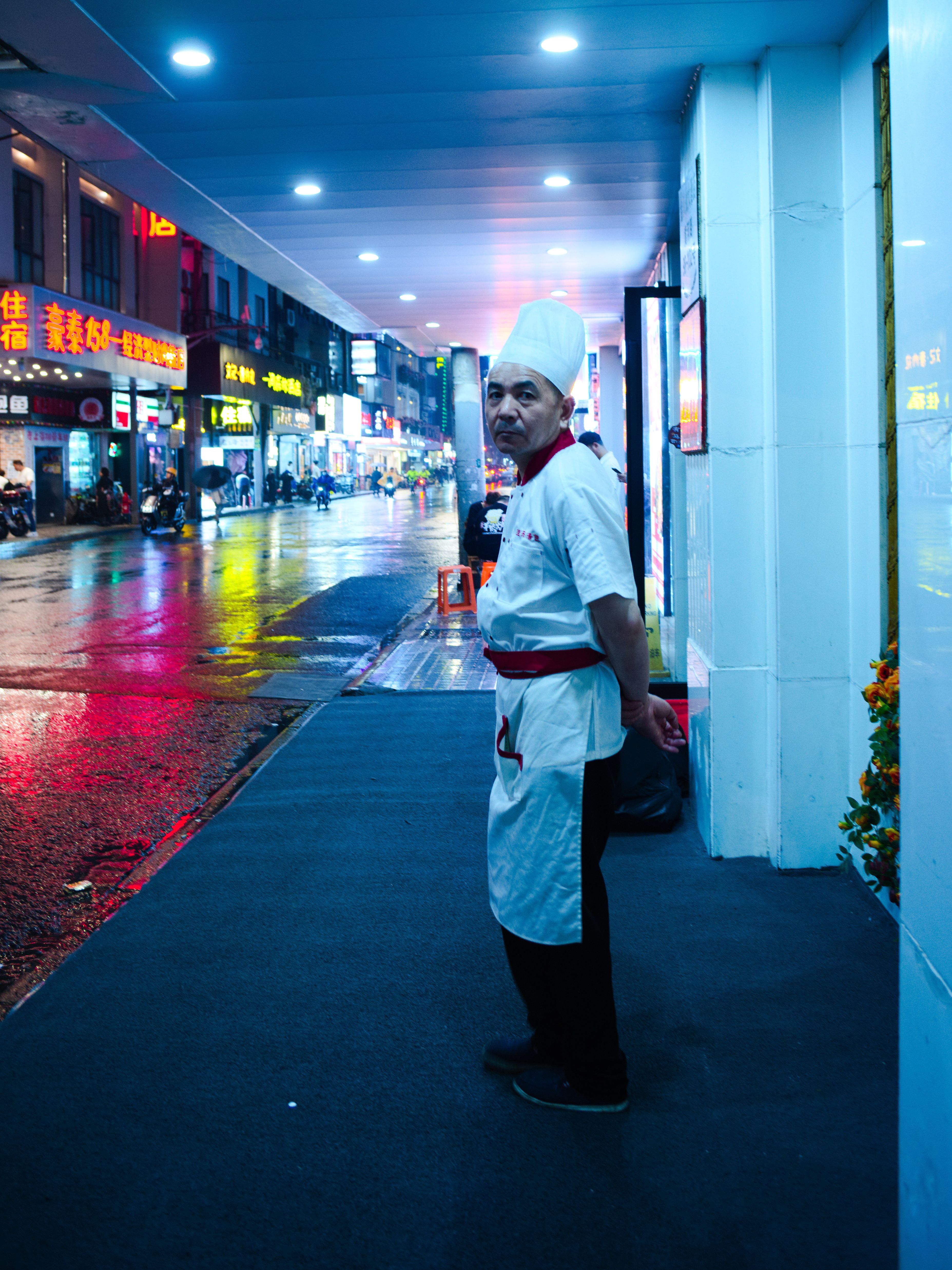
A chef on his break on Huanghe Road, before the show Blossom turned it into a tourist attraction (Evan Taylor)
In late 2023, the Shanghai-born director Wong Kar-wai released the TV series Blossoms, his ruminations on the dynamism of early-1990s Shanghai. Its popularity triggered a mini-boom in Shanghainese food among tourist locations in the city. One of the biggest beneficiaries of this was Huanghe Road, famous in the show for its many restaurants, and still today a prime street for snacking. Walk along the road, and signs for mildly overpriced Shanghai classics dot the storefronts. Most popular was fried pork cutlets with rice cakes(排骨年糕), served with a sweet and tangy sauce known as lajiangyou (辣酱油). Of course, the pork was originally German schnitzel, the rice cakes are from nearby Ningbo, and the sauce is an adaptation of British Worcestershire sauce. But today it is all unmistakably Shanghai.
This comfort with adaptation feels almost innate among Shanghainese chefs. Back in Sanlin, Wang reflects that people’s tastes today are increasingly diverse. “We can’t be limited to only these old traditional things,” says Wang. “People will get tired of traditions one day.”
Our Gang’s Food: The Mixed-Up Cuisine of the Magic City is a story from our issue, “I, Humanoid.” To read the entire issue, become a subscriber and receive the full magazine.
Related Articles