“As the boat sailed into the night, a bright moon rose over the river, round as a jade pendant. It felt as though I were back in our homeland, standing beside you and admiring it together,” recites Ye Shurou in the slow, rhythmic Chaoshan dialect. Now a grandmother in her 80s, Ye revisits these lines time and again from a letter sent by her husband during the long years they lived apart while he worked overseas. Ye’s husband never returned, but continued sending letters along with money, food, and necessities to support the family.
The poetic image of the moon as a symbol of longing for reunion is not lost on Chinese audiences. Yet the recent low-budget Chaoshan-dialect hit film, Dear You, opens with a comic premise: Ye’s grandson, burdened by debt from a failed business venture, decides to seek help from his supposedly wealthy grandfather in Thailand. His journey, dotted with amusing, unexpected encounters, soon leads him to the tearful truth of a family history of love, friendship, and sacrifice.
Explore recent Chinese cinema:
- Chaoshan-Dialect Indie Tearjerker Tops China’s May Box Office and More
- Fate of the Moonlight: Three Generations of Women in the Crack Between City and Countryside
- Like a Rolling Stone: A Stirring Meditation on Womanhood and Defiance
After quietly hitting screens during the Labor Day holiday in May, Dear You has become one of the most successful domestic films in recent years. At the time of writing, the film had grossed over 1.6 billion yuan on a budget of just 14 million yuan and received a rating of 9.2 out of 10 on the review platform Douban, based on over 810,000 users.
Without existing IP, A-list stars, a big-name director, or eye-catching visual effects, the film’s opening screen share was a mere 1.6 percent across cinemas nationwide. However, word-of-mouth momentum soon built up, leading to its current phenomenal success. How did such a niche film manage to win both critical acclaim and commercial success, especially in a slow film market? That question has become one of the most debated topics in the Chinese film industry this year.
Breaking the formula
For commercial Chinese films today, marketing can often take priority over the script. Experienced viewers can easily spot such signs on the big screen: certain scenes exist because they would make good short-form video clips, or certain lines are written to become trending catchphrases. However, Dear You actively defies tried-and-tested formulas and audience expectations with its fresh, sincere storytelling.
The film, which spans half a century, traces back to the 1940s, when Ye Shurou (played by Wang Xiaohui) and Zheng Musheng (Wang Yantong) fall in love and marry against their families’ wishes. Later, to escape forced military conscription, Musheng flees to Southeast Asia, leaving Shurou and their three young children behind. Enduring hard labor and life in Thailand’s dangerous underworld, Musheng sends money and letters home to support his family.

The ongoing popularity of Dear You has fueled a tourism boom in one of its filming locations in Jieyang, Guangdong (VCG)
While in Thailand, Musheng bravely saves a hotel owner and his daughter, Xie Nanzhi (Li Sitong), from a fire. A less nuanced film might have used the situation to introduce a love triangle. Musheng and Nanzhi’s initial interactions even seem to set up expectations of an enemies-to-lovers romance, a well-worn trope in Chinese dramas. Yet the filmmakers resolutely steer their relationship in another direction. Nanzhi may feel gratitude, admiration, and compassion for Musheng, but there is not a trace of romantic attraction between them. It is also this power of genuine connection and shared humanity that leads Nanzhi to make an important life decision: after Musheng dies in an accident while helping to fight off robbers, she continues to send letters and money to his family in his name.
The film’s anti-cliché approach is also evident in various subplots. When Musheng’s friend offers him a chance to earn money at sea, viewers who are used to melodrama may brace for him to be cheated; when an elderly Shurou flies to Thailand to meet Nanzhi and finds her courtyard empty, they worry the two women will miss their chance to finally meet. Yet none of these predictions pan out.
Dear You excels in its bold, unadorned storytelling. After all, not every director who sticks to formulaic storytelling necessarily lacks taste; they may simply be uncertain about the market and choose to play it safe. Dear You’s gamble, or rather, its confidence in its audience, pays off.
The art of restraint
Prior to filming, Dear You’s director, Chaoshan native Lan Hongchun, spent seven years developing the project, drawing heavily on his own family history. He and his team also interviewed more than 300 overseas Chinese families, auditioned 300 women for the role of the elderly Shurou, and screened more than 1,000 non-professional actors before casting the lead for the young Nanzhi.
This painstaking preparation did not lead to undue ambition or self-indulgence. Instead, the team’s commitment to the project is evident in the final product, as is their expressive restraint—a rare and commendable quality when telling such an expansive story.
When Shurou finally goes to meet Nanzhi, the profound changes of half a century are distilled into a simple line: sitting on a plane bound for Thailand, the elderly Shurou remarks, “It used to take a month by boat.”
Director Lan explained his thinking behind the approach at a roadshow event in May. “Life itself is already full of turbulence,” he said. “As storytellers, we should look back with as much restraint as possible.”
In addition, the film resists the “girls help girls” label, a trendy phrase that’s often used to frame female friendship as a familiar plot device in films and TV series targeting a feminism-savvy younger audience. Despite telling the story of two women sustaining two families while being each other’s emotional support over 18 years through letters and remittances—a more traditional, old-fashioned theme—qingyi (情义) lies at its core: a sense of emotional commitment and moral obligation rooted in genuine human connection. Opening with striking white characters on a black screen—“Grandma said: A person must have qingyi; those without it are not worth knowing”—the film never departs from this message.
Ordinary people in an extraordinary era
Chinese audiences may be familiar with the links between local histories, geographies, and literary and cinematic genres: works from the Northwest often focus on the struggles and resilience of life on the highlands, while those from the Northeast tend to feature crime stories and nostalgic narratives set against the backdrop of industrial decline in the 1990s.
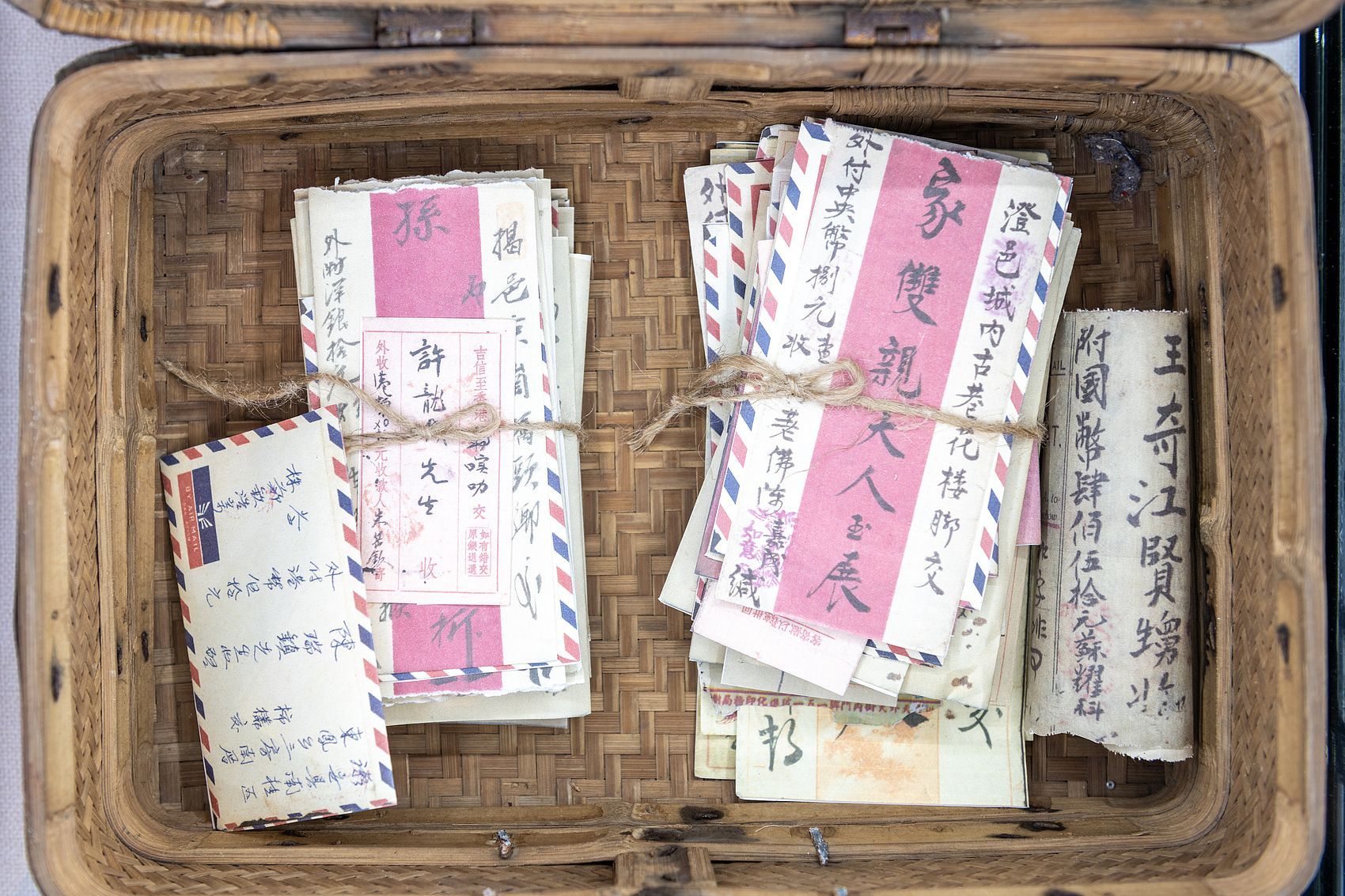
An exhibition in Shenzhen this June, themed around qiaopi and related historical records, brings personal histories and shared memory into the spotlight (VCG)
Dear You, in a rare move, turns its camera toward the migration from China’s southeastern coastal regions known as the “journey south to the Southern Seas,” or xia Nanyang (下南洋). Since the mid-19th century, millions of people from the Chaoshan region, driven by social unrest and famine, left their homes and crossed the South China Sea to settle in Thailand, Singapore, Malaysia, Vietnam, and elsewhere, where they strived to put down roots. Statistics show that between 1922 and 1939 alone, more than five million migrants sailed from ports in Fujian, leaving behind countless stories of departure and reunion.
What tied them to home was a special kind of keepsake: qiaopi (侨批), letters and remittances sent by Chinese migrants to their families. Providing a vivid record of Chinese migration history and the lives of overseas Chinese communities, qiaopi and related documents were inscribed on UNESCO’s Memory of the World Register in 2013.
In the film, qiaopi is another central thread. Director Lan read through a significant number of them during the creative process, with the film’s four screenwriters then reshaping these real-life stories for the screen. When the end credits roll, they are accompanied by real qiaopi—handwritten and yellowed with age—inviting audiences to read family stories that would otherwise have been buried in time.
It is exactly the earnest portrayal of the grand history behind these stories that gives Dear You its authenticity. Yet its appeal is not limited by the specific history it depicts. Though the director and most of the lead actors are Chaoshan natives, this is not a film made only for Chaoshan audiences. Although many viewers may never have heard of qiaopi, they are still moved because they can empathize with those who yearn for a home left behind and for loved ones they hold dear. This broad resonance makes it more than just a Chaoshan story—it is a Chinese story, and ultimately a human story, one that has always been told and will always be told as long as people know what it means to miss someone or somewhere.
“Dear You”: A Dark Horse’s Quiet Revolution Against Movie Formula is a story from our issue, “I, Humanoid.” To read the entire issue, become a subscriber and receive the full magazine.
Related Articles