It’s been called “the caviar of the East” by Vogue China, and is widely considered one of the most exquisite additives in the world. Almost every Hong Kong eatery worth its salt boasts its own homemade version, with a packaged brand produced by Central’s Lee Kum Kee an international bestseller.
Yet XO sauce, the Cadillac of condiments, remains little known on the Chinese mainland, far less found in any regular restaurant. And even though it was invented only a few years ago in one of the world’s most beloved food capitals, the origins of the sauce remain somewhat of a mystery, with varying chefs laying claim to competing recipes.
“I suspect XO sauce originated in Hong Kong in the late 1980s and early 1990s, which is when I first experienced it,” Ken Hom, the celebrated Cantonese chef and TV presenter, tells TWOC from Thailand. During that period, Hom was one of several pioneering chefs who helped introduce quality Chinese cuisine to mainstream Western audiences. Thanks to his BBC TV series, Hom’s 1987 book East Meets West was practically the bible of British Asian fusion.
Even so, the book scarcely mentions XO; as Hom admits, “for a long time, you could only find it in Hong Kong.” Unlike “gateway” Asian condiments like sriracha, or even fashionable ingredients like Sichuanese peppercorn oil, it has taken the city’s best-kept saucy secret nearly three decades to start catching fire among diners, critics, and trend-setters beyond the Asian diaspora.
Despite the name, few, if any, recipes for the sauce include premium “extra old” cognac, which is abbreviated as XO. Instead, the first varieties were made by “enterprising restaurant owners who wanted to put a premium offering on traditional Cantonese dipping sauces,” explains Hom—it’s believed the “XO” was simply bestowed to lend the upstart sauce the kind of class and prestige that Hong Kong elites in the late 80s craved.
Not that XO needed fine liquor to qualify as luxurious. The main ingredients—dried scallops, shrimp, and air-cured aged ham (usually Jinhua or Yunnan varieties, similar to Spanish jamon)—are already pricy enough.
“Dried scallops alone cost about 600 [AUD] per kilo,” says Tony Tan, author of Hong Kong Food City, referring to the cost of just one of XO’s ingredients in Australia, where he runs a pan-Asian cookery school.
Other ingredients include chilies (essential), but one can also add soy sauce, ginger, brown sugar, chicken stock, or lop cheong sausages, depending on taste. The New York Times described the finished product as “a near-perfect example and explanation of the concept of umami, a fifth taste beyond sweet, sour, salty and bitter [with] faint pork-smokiness and a whisper of allium…It is a flavor enhancer, a riot of glutamates.”
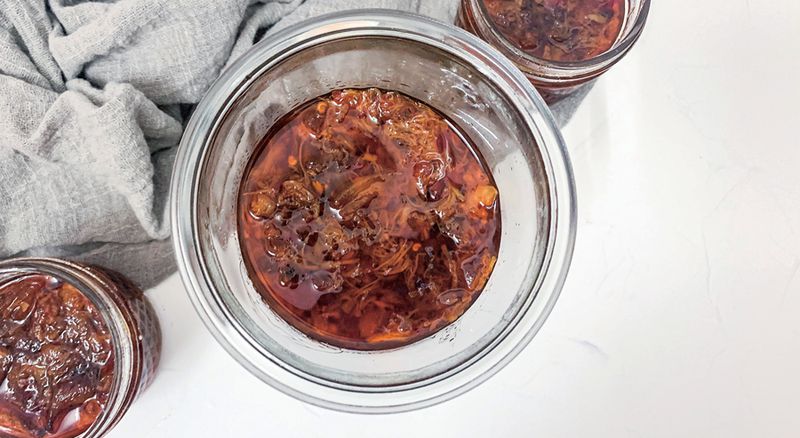
XO sauce can be either used for dipping or mixed into the dish
Tan believes he first tried XO around 1992 at the Peninsula Hotel in Kowloon, whose Spring Moon restaurant is one of the claimants to the XO crown (others argue that it was Kowloon’s Tsim Sha Tsui seafood eateries that perfected the sauce). The hotel insists that Spring Moon’s chef was the first to dub XO after the bottles of Rémy Martin that Tan recalls were ubiquitous at practically “every upmarket banquet in Hong Kong” in the 90s.
From Hong Kong, XO spread to other nearby international cities like Singapore and Kuala Lumpur, then onto Australia, where Tan says the Asian culinary scene tends to be more diverse and authentic than in places like the UK, due to geography. In Europe, Chinese food still slightly suffers from the stigma of “stodge,” in no small part due to the proliferation of low-budget all-you-can-eat buffets in many Chinatowns that serve sweet-and-sour chicken, chow mein, and other MSG-heavy dishes.
It’s partly for this reason that XO is still relatively obscure in Europe and the US, at least outside culinary circles—in the UK, precious few supermarkets stock the stuff. Online, the most popular variant is Lee Kum Kee, at around 17 USD a pop. The South China Morning Post dismisses the brand as a “rather dry sauce…looks more like dried scallops tossed in some oil than an actual condiment [and] lacks richness and balance.”
Nevertheless, adding even the most ordinary XO to a dish will work culinary wonders. The reviews on Amazon for LKK are almost entirely five-star. Adding LKK to a simple beef stir fry is like topping-up an empty glass of Lambrusco with aged Dom Perignon—just one spoonful in a bowl of plain rice turns a simple staple into a taste sensation; or you can have it straight from the jar, accompanied with an ice-cold beer.
As a further experiment, add it to some Peking-style roast duck with pancakes and scallions. Those who find the usual plum or hoi sin sauce rather cloying will marvel at the difference.
So why hasn’t this remarkably versatile sauce achieved mainstream popularity in China, where mealtimes are practically religion? In part, it may be the sauce’s relatively recent vintage, compared to soy or vinegar.
But Tan thinks it’s mostly down to cost. Certainly, wealthy mainlanders are not averse to indulging in overpriced luxuries like Louis Vuitton bags, and there’s still huge demand for controversial delicacies like bird’s nest and shark’s fin soup, which confer status on the consumer.
On the other hand, even the most spoiled fu’erdai (rich scion) is happy to enjoy a simple dish of dumplings, or late-night skewer session at a streetside stall. You can find vinegar and dried chilies on the table of practically any hole-in the-wall or four-star restaurant in China. While XO is a “prohibitively expensive” item, Tan points out, it’s not necessarily perceived as a flashy one to mainland diners. Meanwhile, among the suburban Chinese-American restaurants that dominate the US market, there’s simply not much demand for 17-dollar dip.
For now, XO’s main consumers are mainly a broad but enthusiastic coalition of Hong Kongers, diaspora chefs, Western hipsters, and food bloggers. That fan club is only likely to grow over time, though: It may no longer be young, but XO never seems to get old.
Love, XO is a story from our issue, “High Steaks.” To read the entire issue, become a subscriber and receive the full magazine.
Related Articles