Fumes billow from a hulking tower—an odd architectural hybrid of traditional sloping eaves and factory furnaces that form an imposing fortress in the snowbound landscape. The image sets a grim tone for the martial arts odyssey about to unfold, in which lighthearted adventure and schoolboy heroics are off the menu. This is the world of Phantom Blade Zero, the latest action RPG from studio S-Game, now available on PS5 and PC.
The game’s dark mood reflects the “kung fu punk” vision of director Liang Qiwei and owes much to the work of Hong Kong novelist Gu Long, one of the so-called “three musketeers” of wuxia fiction, whose martial-arts stories are infused with the same ominous themes of vengeance and betrayal that permeate Liang’s world. A line from Gu’s writing lends the series from which Phantom emerges its original name, Rainblood, a game series Liang began working on back in the 2000s while still an architecture student at Tsinghua and, later, Yale.
Two decades on, Phantom reimagines Liang’s early works as a major studio production backed by four years of active development. With 4 million copies sold in its first three days and a peak of 830,000 concurrent players on Steam, the game is already a major win for its makers and has strengthened the case for China’s domestic investment in AAA games, or big-budget, high-production-value games with a large distribution.
Read more on China’s gaming industry:
- Spoiled for Choice: Can Live-Action Games Become More than Drama with Buttons?
- The Rise of China’s Mini-Game Industry
- The Fear Within: Can China’s Horror Game Developers Overcome Genre Malaise?
The story follows Soul, an elite assassin for the secret organization Order. Framed for the murder of Order’s leader, Soul is mortally wounded by the blade of his sworn brother and fellow orphan, Zuo Shang. Left for dead, Soul makes a grim bargain that gives him only 66 days to live, during which he must navigate the Wulin (武林), a sprawling martial arts network of different fighters, sects, and clans, to find answers, clear his name, and save his own life.
Beyond the obvious inheritances from wuxia fiction is the concept of Sha-Chi (杀气) —an oppressive, sinister aura or “killing intent”—which serves as a primary force guiding both combat and narrative in Phantom. As the game itself explains, “Sha-Chi is the foundation of all martial arts. It is born from the countless bonds and grudges, loves and hatreds, joys and angers of human life.”
A forbidden form of technology-assisted Sha-Chi augmentation threatens the Wulin: it can make fighters more powerful, but doing so comes at the risk of their sanity. Though convoluted at times—motivations and conspiracies abound—the plot’s through-line remains Soul’s connection to Zuo Shang.
Proof of concept
Comparisons between Phantom and the 2024 smash hit Black Myth: Wukong, a watershed for China’s AAA (big-budget, high-production-value) games, are inevitable. Yet the points of departure between the two titles are arguably more instructive.
Phantom lacks both the name recognition of the Monkey King, famed troublemaker of the 16th-century novel Journey to the West, and the cultural momentum of being a milestone first. Black Myth became a global phenomenon, selling more than 30 million copies by June 2026, and while the ultimate sales arc of Phantom remains to be seen, it has already succeeded on its own merits as an original work of fiction. It even edged out its predecessor with critics—Black Myth’s PC Metacritic score stands at 81, while Phantom’s stands at 88.
More importantly, Phantom rebuts the idea that Black Myth was an exception. Dr. Liu Mengfei, a professor of game studies at Beijing Normal University, explains to TWOC that Phantom demonstrates that “China’s game industry has gained the capacity to consistently deliver industrially polished games with meaningful artistic expression.”
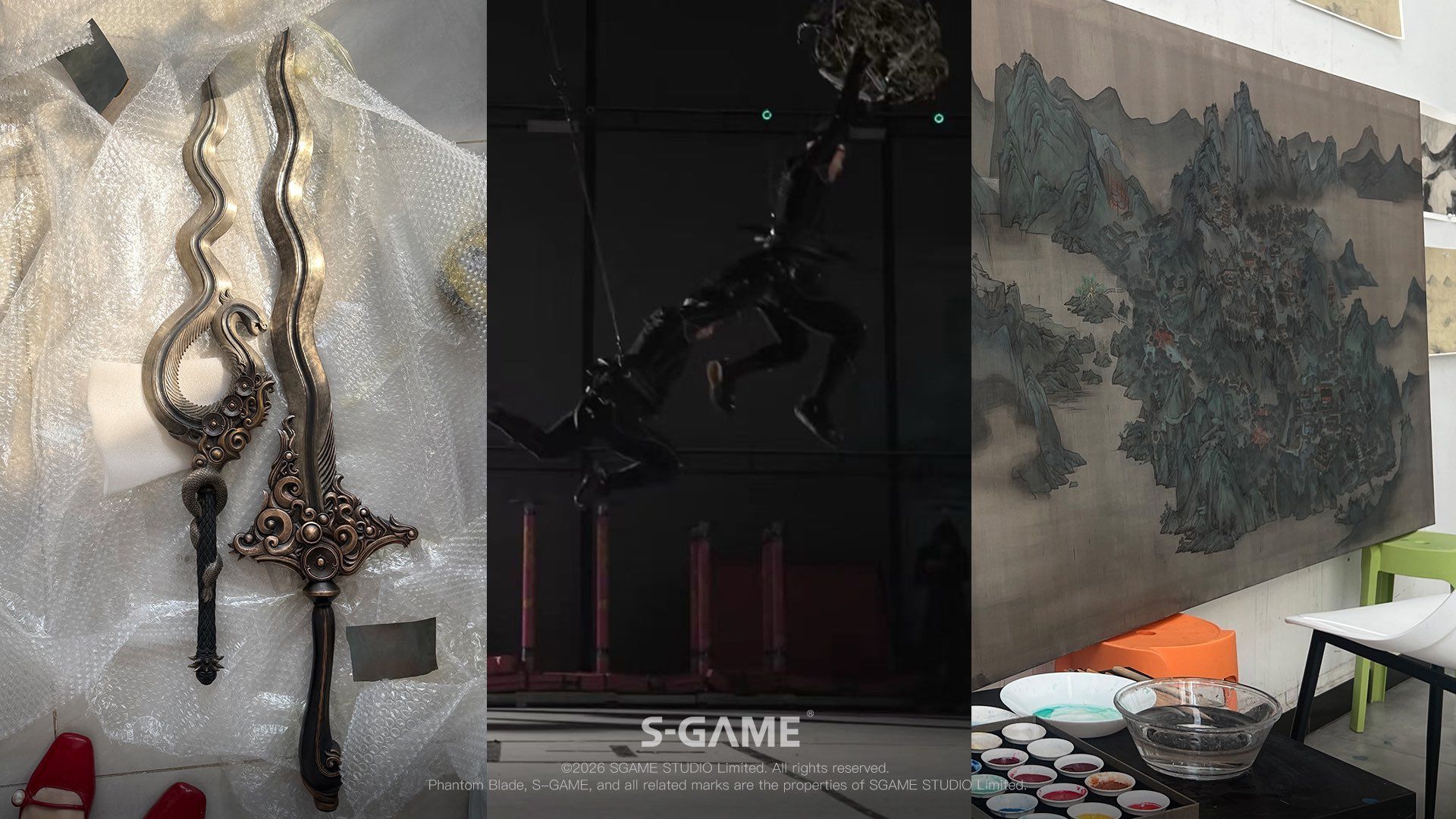
In this AI age, every part of Phantom Blade Zero is still crafted by real artists, from character and architectural models to the voice performances. To understand how a weapon’s weight and length affect movement, the developers even made steel replicas. (X)
Commercial success is only one measure of Liang’s creative ambition. In an interview with Beijing Daily, he explained how his vision of kung fu punk blends wuxia with “modern popular culture, visual elements, sci-fi elements, and musical elements such as rock music, as well as steampunk and cyberpunk, ultimately creating a new form of expression.” In other interviews, Liang has stressed the importance of adopting an innate Chinese action logic rather than merely attaching outwardly Chinese symbols to fundamentally Japanese or Western frameworks. “Relying solely on national pride cannot make a game better,” he says.
Composer Bo Caisheng embraced the same approach while creating the game’s eclectic score, in which a two-stringed Chinese erhu sometimes faces off against an electric guitar. Some Chinese players have criticized his unconventional use of traditional instruments, but Bo was quick to defend his creative process. “The best way to defend your culture is by innovation,” he told the British newspaper Metro. “You have to constantly innovate.”
The nonconformist approach of its creators bleeds into Phantom’s gameplay, which Liang has consciously differentiated from the “soulslike” action of games such as Elden Ring and the Dark Souls trilogy, where combat rewards precise timing and mistakes are heavily punished. Progression isn’t lost upon dying, most enemies don’t respawn, and players can choose from a range of difficulty options. In multi-stage boss battles, which require players to defeat several forms of the same powerful enemy in succession, beating one form means they won’t have to repeat it if they die later. The idea, it seems, is to minimize repeating the same content while maintaining the challenge. Difficulty is subjective—the easiest setting will likely still frustrate novice players, while even the hardest may not satisfy the most hardcore contingent—but the game seems to strike a welcome middle ground.
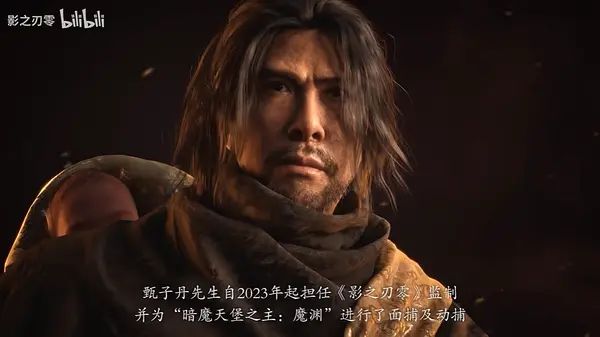
Hong Kong action star Donnie Yen serves as the game’s creative consultant and the facial and motion-capture actor for the character, Mo Yuan, a formidable masked warrior (screenshot via Bilibili)
With eight extensive maps that reward curiosity, Phantom’s semi-open world is geared toward exploration. Scattered story fragments piece together the game’s lore, while scavenged materials and loot help level up its 30 primary bladed weapons. These are supplemented by 25 “Phantom Edges,” secondary weapons that double as a means of accessing new areas, such as a giant axe that can cleave through obstructive vines. New weapons are primarily obtained from besting one of more than 50 bosses, while defeated enemies also drop unique plot-based “souls” that can be used to level up both skills and weapons.
The central philosophy of Phantom’s combat mechanics is “attacking while defending,” a balance that requires carefully timed moves and combos to overcome enemies. Combat relies on health and Sha-Chi, which accumulates like a power bar, allowing players to unleash powerful attacks and is replenished by switching weapons. If Soul’s Sha-Chi reserves run low, he is defenseless, but so too are enemies who have their own visible meters. The challenge is to apply pressure, attacking to drain an opponent’s energy or baiting them into expending it themselves. This is the dance: a back-and-forth that proceeds with the unbroken flow of 1990s Hong Kong action-movie choreography. That martial-arts star Donnie Yen served as a creative consultant only reinforces the connection.
This satisfying interplay forms the backbone of the game’s appeal. Controls are responsive—the crunch of a heavy blow is palpable—and each weapon has entirely unique motion-captured animations. Players can take down regular enemies with ambush attacks or combine button prompts to take out a field of enemies in a single devastating assault. These moments make playing Phantom magic.
Style and substance
Yet, despite the success of its combat, the story has been singled out as the game’s weak spot. GameSpot’s headline was unsparing in its assessment: “Phantom Blade Zero’s Combat Is So Good, You Won’t Care The Story Makes No Sense.” There’s no denying that the machinations of the Wulin’s competing sects and their various esoteric techniques are complex and difficult to keep track of—but the real issue is less that the story makes no sense, and more that, for many players, it isn’t worth the effort. For all Phantom’s world-building, it’s hard to care beyond a few key characters.
While the game’s polished visuals have also attracted praise, others lament the departure from the lo-fi charm of Liang’s earlier work. For Professor Liu, the transition to 3D has “resulted in a certain loss of flavor” in comparison to their previous 2D installments, with their “unique and beautiful graphics and narratives” and an “aura of indie games.”
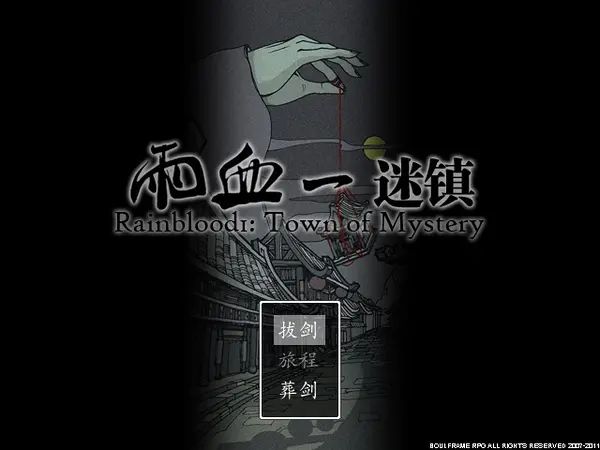
Rainblood: Town of Death, Liang Qiwei’s debut game, was released independently in 2010. It is known for its Gu Long–inspired wuxia style and dark, cold atmosphere (Douban)
Phantom’s clear ambition may not be enough to excuse a less-than-groundbreaking story and a vibe that never coheres into a fully realized identity. There are interesting touches of folk horror in the puppets and Maskwalkers, which recall the ancient exorcism rituals of Nuo opera, alongside more familiar examples from China’s folk repertoire like lion dances and the drunken fist style of fighting.
Yet Phantom offers more than just cultural signifiers. Its techno-dystopian vision of Sha-Chi augmentation is genuinely novel and perhaps the best expression of creator Liang’s kung fu punk philosophy. As one user on the question-and-answer platform Zhihu observed, in Phantom, “martial arts itself is rewritten as a ‘technology’ that can be extracted, infused, and used as energy.” Like its precursors, cyberpunk and steampunk, kung fu punk deals in the same relation of technology to power.
The intersection of these two elements is literally baked into the game’s world. S-Game has an office near Shougang, the Beijing steelworks that once defined Chinese heavy industry. The team even scanned mechanical parts from the blast furnaces as they sought to construct their ideal. The game they forged is a fine weapon, but its essence remains a phantom.
Related Articles