

Extreme fan culture can emerge around anything in China, whether music idols or Olympic athletes. But nowhere have the hopes and fears of devotees been more keenly concentrated than in video games, where the fate of an industry has seemingly been entrusted to one hero—Sun Wukong—in the form of the hottest video game of the year, Black Myth: Wukong.
The so-called “Monkey King” has been a cultural touchstone ever since he appeared in Wu Cheng’en’s (吴承恩) 16th-century novel Journey to the West. Sun Wukong played cheeky companion to a monk based on the historic Xuanzang on his pilgrimage to India in search of Buddhist scriptures, encountering “murderous Buddhists, perfidious Taoists, expanses of rotten persimmons, and monsters of all shapes and sizes (femmes fatales, rhinoceroses, iguanas, scorpions),” as Julia Lovell put it in the foreword to her 2021 translation. Now, a darker take on this mythology, picking up with the Monkey King rejecting a position in the Celestial Court after his return from India.
Black Myth is a passion project from Hangzhou developer Game Science, led by a team of ex-Tencent employees. Four years to the day after an August 20, 2020 announcement, the game was released to massive fanfare and critical acclaim. It exceeded 10 million sales in just three days and broke player count records. At one point, 2.2 million people were simultaneously playing.

People lined up to check out the Black Myth: Wukong booth at the Gamescon Game Fair in Cologne in 2023 (VCG)
For a game to achieve these milestones, much hype is necessary. Black Myth is China’s first AAA game, a designation given to large-budget, high-profile video game projects. At the same time, there was rampant skepticism over whether a relatively small (40 to 50 people), independent studio could deliver on the sweeping action-RPG vision presented on initial demos. Female gaming professionals have highlighted Game Science’s long history of sexist advertising and recruitment.
Read more about the Monkey King
- How many Journeys to the West have you seen?
- The Business of Being Monkey
- A Look Back at the Golden Age of Chinese Animation Through the Monkey King Movie
Such tensions have not dampened gamers’ enthusiasm, though. If anything, they’ve only increased the game’s popularity. We gathered a half-dozen gamers and asked for their thoughts on Black Myth and the Sun Wukong phenomenon. Their responses have been edited for length and clarity.
Zed (Zuozhen), 32, game concept artist
As a creator myself, with 10 years of experience, I’m in a somewhat unique position. I don’t play games a lot in my spare time, but I do dabble in a bit of everything, mainly as a Steam user. I first became aware of Black Myth’s development team in university, before I entered the industry, mainly due to the “Asura” project, which got me interested in [art director] Yang Qi and [lead producer] Feng Ji.
I’ve always looked forward to the day when a domestic game could reach this level of production quality. I’ve also dreamed of developing such a game. For me, being able to work on the design of such a project would be incredibly enjoyable.
Of course, this means that in the future, investors and developers might be more willing to fund such projects. I believe the management at Game Science has an idealistic spirit, which is especially valuable today. To use a metaphor for the current investment environment, people need to lift their heads to stand up, and I feel like maybe we’re finally lifting our heads.
Wan, 29, legal professional
The games I usually play don’t involve many action or combat elements, so I specifically played Elden Ring before Black Myth to get used to a similar gameplay feel. After playing, I felt that the graphics were quite good, but there are too many invisible walls, and I would prefer to explore the maps more…though the richness of the map improves after the first chapter.
What makes me happiest is that people abroad are finally seeing our mythological stories. Chinese mythology is truly amazing, no less than Norse mythology. It’s really exciting that such stories can be shared with the world through this medium.
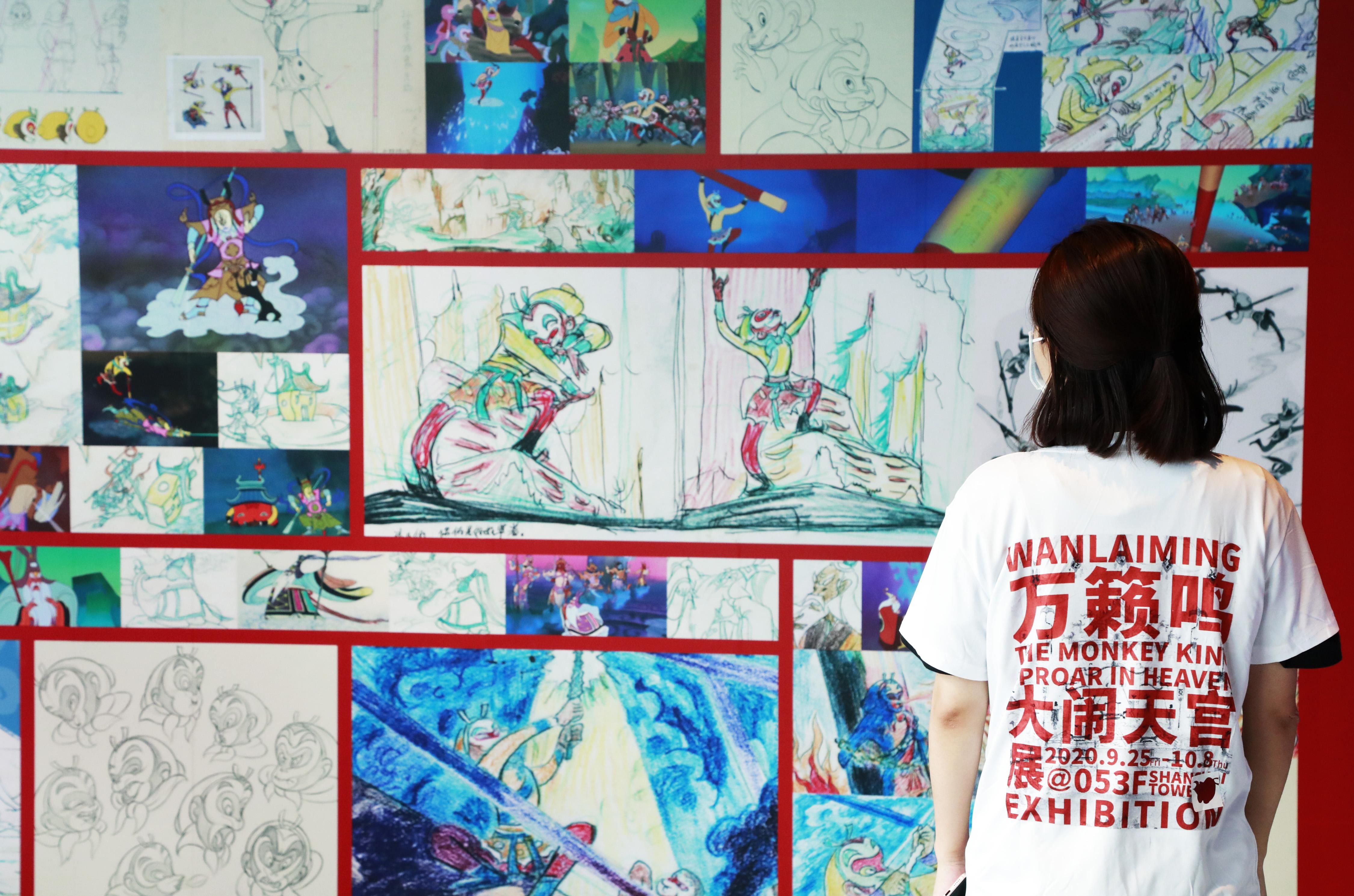
Original artwork from the classic Chinese animation Havoc in Heaven was exhibited in Shanghai in 2020. (VCG)
Duanduan, 28, visual artist
Because I’m quite concerned about gender issues, I find it regrettable that while this game is excellent in many aspects, it lacks depth in gender awareness. I’ve noticed that on platforms like Bilibili, most of the videos and reviews are still dominated by a male perspective. There’s little room for discussion on gender. The core team has very few women, if any, and they likely wouldn’t have much influence. So I think this is a missed opportunity.
But I support this kind of adaptation. Before Black Myth, we had the [1986] Journey to the West TV series, and the Hong Kong film adaptations like A Chinese Odyssey. They all explored different themes from different angles. Western literature, including the Bible, has many stories that have been adapted over time. For instance, the word yokai [yaoguai in Mandarin] from Japan has become familiar even in English when referring to monsters. Originally, these ideas came from China, but Japan did a better job of exporting its culture, so now people associate these terms with Japan.
Jin Chaocheng, 32, film director
It’s well known that the Chinese gaming market has long been dominated by mobile games. From a capital investment perspective, quick-turnaround mobile games are obviously more profitable than time-consuming and labor-intensive single-player games with a smaller market, which makes Black Myth all the more commendable.
I’ve currently reached the fourth chapter, and from my personal experience, the game’s difficulty level is not that high. I’ve been a console player. I bought a PS3 in high school. What shocked me is that many of my friends who don’t usually play games have shown a keen interest in Black Myth. On the day of the game’s release, they came to my house to experience it, and some even considered buying a PS5 just for this game.
Black Myth has truly broken through its niche, capturing the attention of society at large. I’ve also been paying attention to the negative rhetoric abroad. The accusations of gender discrimination against Game Science are, in my opinion, utterly baseless. What’s the point of being politically correct just for the sake of it? Shouldn’t a game just be fun?
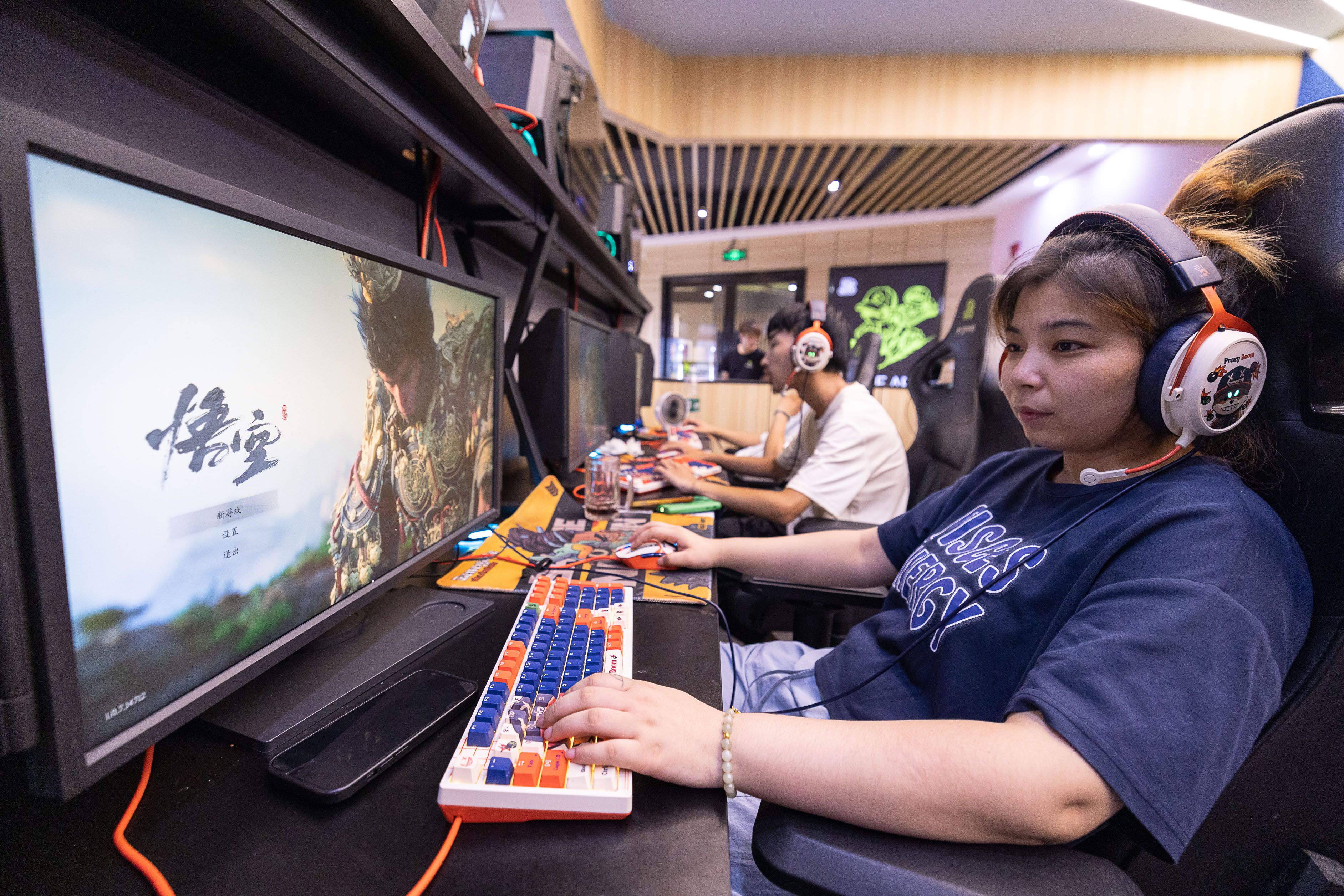
A female gamer in Zhejiang province playing Black Myth: Wukong at a gaming studio the day after the game's release (VCG)
Chen Tiantian, 23, English teacher in Hubei
Honestly, this game totally exceeded my expectations. What makes this game special for me is its distinctly Chinese culture. As a Chinese player, I find the names of some characters familiar, like Zhu Bajie and Yellow Wind Sage. I’ve seen some feedback from foreign players who struggle with these names. It reminds me of the time I played games like Olden and Assassin’s Creed. I wasn’t familiar with the culture and background, so there were some bosses’ names that I didn’t know at all.
Although the plots in the game are basic, Black Myth still captures a strong sense of cultural identity. For Chinese players, Journey to the West is a classic that we’ve all read in our childhood. Even though it has been 10 or 20 years, and I’ve almost forgotten some of the plotlines, I think it’s a great opportunity for us to rediscover its rich story. If I find some free time, I’d like to revisit the classic novel to better understand this game.
Playing this game makes me feel like an annoying Chinese parent, always hoping their child will succeed and believing there is room for improvement. Every time I explore, I find small flaws, like the lack of a map and massive invisible walls, and I want the game to make up for little imperfections. But when I look back, I see that the game has done quite well already. Why do I still feel compelled to criticize it? Why do I have so much dissatisfaction and want to complain about it? Who are we doing this for?
Xiong Tuoni, vice president of Indie Light (a support foundation for independent game developers in China) with 20 years in the industry
Not only has it continuously set records for a Chinese single-player game in terms of sales, but in the realm of social attention, Black Myth has also broken records. Local TV stations across the country, which usually never mention single-player games, broadcast live coverage of this one for several days in a row. Local tourism boards also leveraged the famous landmarks featured in the game to promote cultural and historical sites nationwide. Even people in their 40s and 50s, who never discuss video games, were sharing articles and videos related to Black Myth in their WeChat groups and Moments—something entirely unprecedented. PlayStation 5 consoles became a hot commodity nationwide from the day of [Black Myth’s] release.
This game heralds the arrival of a new era in the Chinese gaming industry, where the focus has shifted from “channel is king” in the free-to-play and pay-to-win dominated market to a “content is king” era. The new era for Chinese single-player games is just beginning.
Related Articles