As China expands visa-free travel, more visitors are venturing beyond the usual megacity destinations and finding their way to Chengdu—Sichuan’s provincial capital, a UNESCO City of Gastronomy, and the world-famous home of the giant panda. Recently named by National Geographic as one of the “Best Places in the World to Travel to in 2027,” the city offers visitors another reason to explore: archaeological discoveries revealing a Bronze Age civilization dating back some 3,000 years. Chengdu’s historical significance, however, goes far beyond these ancient remains. It has served as the seat of power for seven kingdoms and states, leaving behind a rich cultural legacy. Its appeal has also long extended to the literary world, with generations of poets and writers finding inspiration in its natural beauty, particularly its profusion of flowers.
Chengdu is also known as Rongcheng (蓉城, “the city of cotton roses”), a nickname said to date back to the Five Dynasties period (907 – 960), when the city served as the capital of the Later Shu state. Its last ruler, Meng Chang (孟昶), was known for his patronage of poets and painters, as well as his romance with his consort, Lady Huarui (花蕊夫人, literarily, ”Lady Pistil”), an accomplished poet. According to legend, Meng had cotton rose trees planted throughout the city because the flowers were the lady’s favorites. The nickname has endured to this day.
Cotton rose is considered auspicious in traditional Chinese culture, as its Chinese name, furong (芙蓉), has the same pronunciation as 福 (fú, fortune) and 荣 (róng, prosperity). Another of Chengdu’s celebrated resident poets, Xue Tao (薛涛) of the Tang dynasty (618 – 907), is credited with developing small sheets of paper made from cotton rose bark, which were ideal for writing short poems. She also used cotton rose petals to dye the paper a distinctive crimson. Through further experimentation with different colors and the brush-coating technique, an elegant writing paper was born: Xue Tao paper (薛涛笺). It is said to have come in 10 colors, ranging from apricot red to bronze green. Xue’s poems are among the most extensively preserved works by a female poet of her time, while her ingenuity also earned her a place in the history of papermaking.
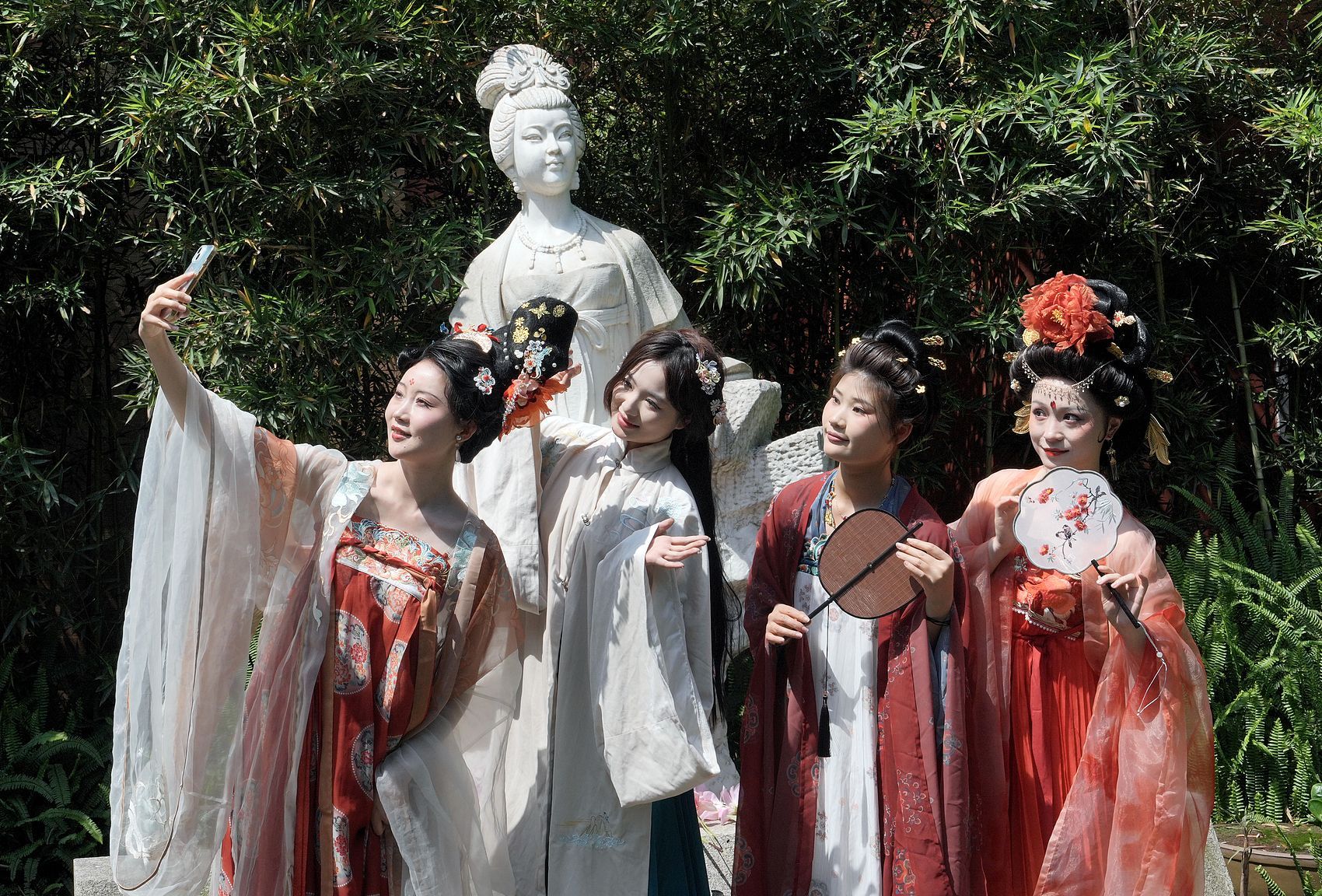
Tourists dressed in hanfu pose for selfies beside a statue of Tang-dynasty poet Xue Tao in Chengdu (VCG)
Besides cotton roses, crabapple blossoms are also among Xue’s favorite local flowers. Known as haitang (海棠) in Chinese, they were so beloved by Xue that she had many trees planted around her residences in Chengdu and often celebrated their beauty in verse. One of her best-known poems, “Haitang Creek” (《海棠溪》), evokes a flower-strewn stream in spring:
Spring lingers in a haze of rosy light; Fish shimmer with blossoms in the stream.
Three hundred years later, Xue’s beloved crabapple blossoms became a poetic emblem, celebrated by Song-dynasty (960 – 1279) poet Lu You (陆游) in his poem “Ode to Crabapple Blossoms” (《海棠歌》):
The Biji crabapple is peerless beneath heaven; each branch red as blood.
“Biji” in this verse refers to Biji Fang, Xue’s residence in Chengdu during her later years. During his six-year posting as an adviser to the Chengdu regional commissioner, Lu fell deeply in love with the local culture and its celebrated flowers. So enamored was he of the crabapple blossoms that he even went so far as to disparage another flower long cherished in Chinese culture: the peony, or mudan (牡丹).
If only the crabapple could be transplanted, Yangzhou’s peonies would die of shame.
While in Chengdu, Lu traveled all around the city to appreciate its flowers, proclaiming: “The ten thousand crabapple trees in Chengdu are so magnificently beautiful that you can find nowhere else (成都海棠十万株,繁华盛丽天下无).” Whenever he spotted crabapple trees in someone’s garden, Lu would walk right in to admire them, even if he didn’t know the owner. Lu had thus earned himself the nickname of a “haitang nuts (海棠颠).”
Read more about flower in traditional Chinese culture:
- Crowning Glory: China’s Floral Headdress Tradition
- How a Tiny Flower Becomes the Scent of Autumn in China
- Poetic Blooms: Discover the Beauty of Classic Chinese Spring Poems About Blossoms
Aside from haitang, Chengdu is also known for its osmanthus blossoms. Ming dynasty (1368 – 1644) politician, scholar, and poet Yang Shen (杨慎), a Chengdu native, planted osmanthus trees at his residence. Yang and his wife would stroll along these trees while reciting:
In the jeweled grove, jade-green coolness lingers;
Autumn winds bring the golden osmanthus into bloom.
Plucked, each branch glitters with golden grains;
tucked into dark hair, each sprig spills its fragrance.
A few of these ancient trees still stand today, greeting visitors from around the world in Yang’s hometown of Xindu, known as “the city of fragrance (香城),” now a district in northern Chengdu.
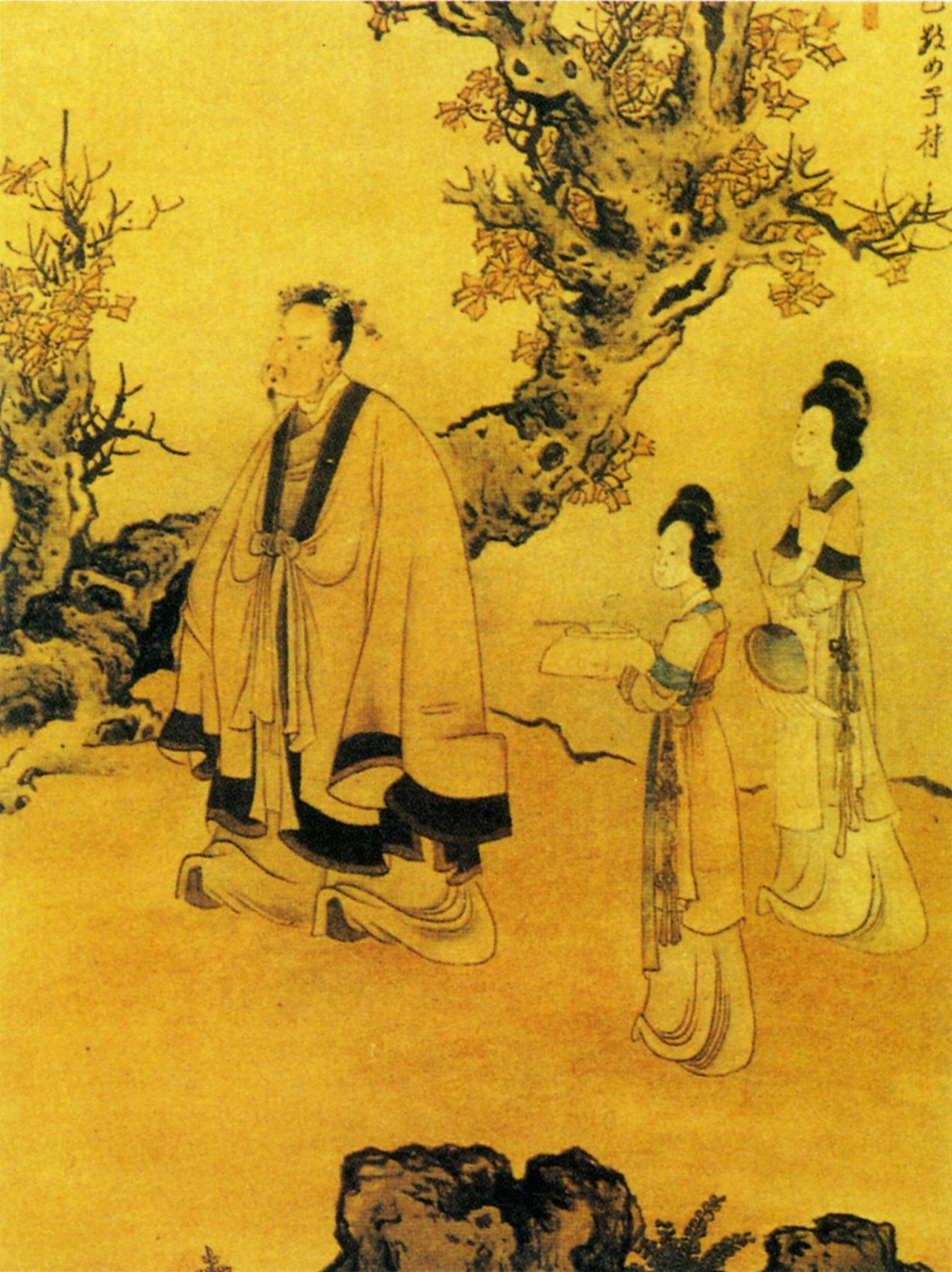
In Ming dynasty painter Chen Hongshou’s (陈洪绶) “Yang Shen Adorned with Flowers,” Yang is depicted wearing blossoms as he roams the countryside, a gesture that may have offered an oblique outlet for the frustrations of his turbulent official career (VCG)
The literary figure who really put Chengdu’s flowers on the map is Tang dynasty poet Du Fu (杜甫). Considered one of the greatest Chinese poets of all time, Du lived in Chengdu for nearly four years, arriving as a refugee following the An Lushan Rebellion, which caused extensive destruction in the north. Some historians argue that Chengdu’s beautiful flowers helped heal him psychologically, allowing him to spend the happiest years of his life there. Generations of Chinese students have recited Du’s writings about Chengdu’s flowers in school, “Pleased with Rain on a Spring Night (《春夜喜雨》)”:
A nice rain knows when to fall,
Coming as a natural product of the spring.
Following the wind, it smoothly occupies the night
And moistens everything with soft and silent blessings.
Dark are the clouds above every country road;
There is only one light coming from a slowly moving boat.
In the morning I shall see many red and wet patches
Of full and heavy flowers everywhere in the City of Brocade [a nickname for Chengdu].
(Translated by Hong Ye)
Du Fu’s former home, the Thatched Cottage, is now a popular stop for visitors to Chengdu. There, he famously wrote of the blossoms in his neighbor Huang Siniang’s garden:
At the home of Miss Huang Four, flowers fill the lane; a thousand buds, ten thousand buds press the branches low.
Lingering there, sporting butterflies dance now and again. Lingering there, sporting butterflies dance now and again.
(Translated by Stephen Owen)
The flower culture remains prominent in Chengdu today, with flower fairs across the city’s parks in the spring and a particularly grand chrysanthemum fair in the famous People’s Park every fall. One of the most popular pandas at the Chengdu Research Base of Giant Panda Breeding is even named Huahua (花花, flowerie).
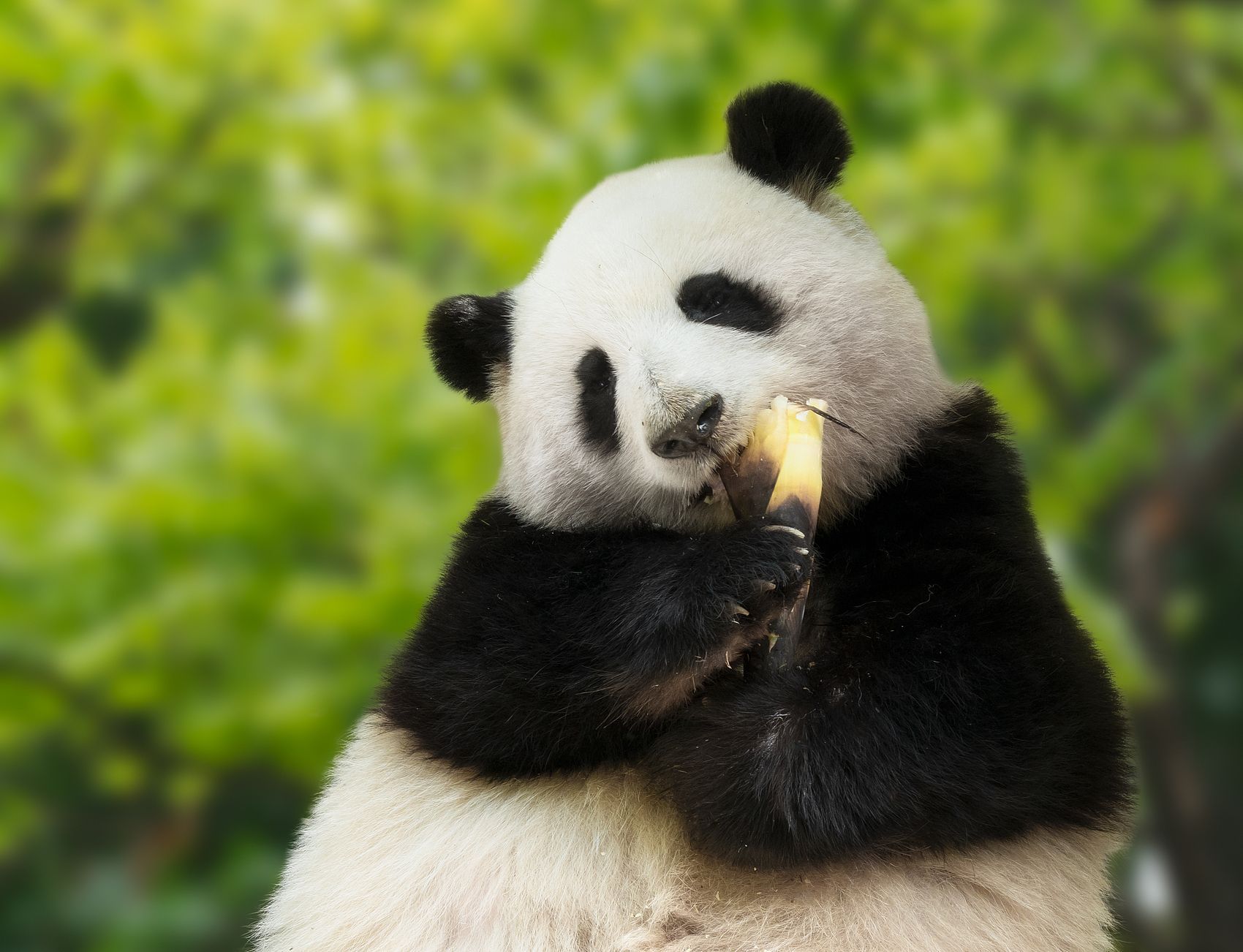
Giant panda Huahua was titled the honorable director of the Bureau of Culture and Tourism in Chengdu in 2024 (VCG)
If you’re planning on visiting Chengdu in the coming year, leave time to wander among its blossoms. Perhaps you’ll glimpse what captivated generations of poets and feel an echo of the city that has endured for thousands of years.
Related Articles