


During peak tourist season, long lines of restless visitors form inside the Palace Museum’s Treasure Gallery in Beijing, eager to snap photos of the stunning exhibits for social media. A sapphire-blue empress’s crown, one of the biggest draws, rests in a well-lit glass case. Adorned with gold dragons and phoenixes and cascading strands of pearls, the crown is a striking blue on account of diancui—literally “dotting with kingfisher”—a highly skilled traditional jewelry craft in which the majestic bird’s iridescent feathers are meticulously cut and inlaid onto a gold or silver base, giving a luminous, enduring quality.
After the style fell out of fashion around the 1930s, diancui was on the brink of disappearing, leaving antique pieces to gather dust in museums for decades after. Over the past 25 years, however, a nationwide revival of interest in traditional arts and crafts has brought it back to life. Artisans have since adapted the style to incorporate eco-friendly materials and expanded designs from classic motifs to modern looks, even incorporating internet memes to appeal to younger audiences.

First added to UNESCO’s Intangible Cultural Heritage in Need of Urgent Safeguarding in 2011, the Yimakan storytelling tradition of the Hezhe ethnic group in northeastern China was moved to the Representative List last year following successful preservation efforts (VCG)
A pivot to traditional crafts in China has unfolded alongside a broader global shift toward a more expansive understanding of culture and heritage. For much of the 20th century, international heritage protection focused primarily on physical monuments and historic sites, as exemplified by the 1972 World Heritage Convention, which established the World Heritage List. But opponents of these Eurocentric heritage models drew attention to how, in most of the world, culture is expressed through oral traditions, performance, and social practices. This shift led to UNESCO’s 1982 redefinition of culture at the World Conference on Cultural Policies in Mexico City. The conference redefined culture as encompassing the full range of cultural values embedded in everyday life, and marked the first official use of the term “intangible heritage.”
Learn more about traditional culture in contemporary China:
- Old Techniques, New Vibes: How China’s Inheritors Are Reshaping Ancient Arts
- How China Turns Intangible Heritage Into Tangible Returns
- The Uncertain Future of Grassroots Chinese Opera
China has a long tradition of preserving folk culture. As early as the 11th and 7th centuries BCE, officials gathered songs to gauge public sentiment. This practice gave rise to the Classic of Poetry (《诗经》), China’s earliest poetry collection, whose entries are still echoed in idioms used today. Nearly three millennia later, in the 1950s, the newly established PRC launched a nationwide initiative to collect and document folk arts and culture, gathering materials ranging from folktales and ballads to music. This effort proved crucial, as it preserved works that might otherwise have been lost. One example is the canonical erhu piece “The Moon Over a Fountain,” famously performed by the blind street musician A Bing, who died shortly after the recording was made.
A major turning point in preserving living culture in China came in 2001, when Kunqu opera, a 600-year-old art form originating in Kunshan, Jiangsu, was inscribed on UNESCO’s list of Masterpieces of the Oral and Intangible Heritage of Humanity (renamed the Representative List of the Intangible Cultural Heritage of Humanity in 2003). This recognition helped popularize the term “intangible cultural heritage (ICH),” or feiyi (非遗), among the country’s policymakers, practitioners, and the wider public, and shape the country’s future preservation efforts. Today, feiyi has become a cultural buzzword across disciplines from academia and legislation to commerce.
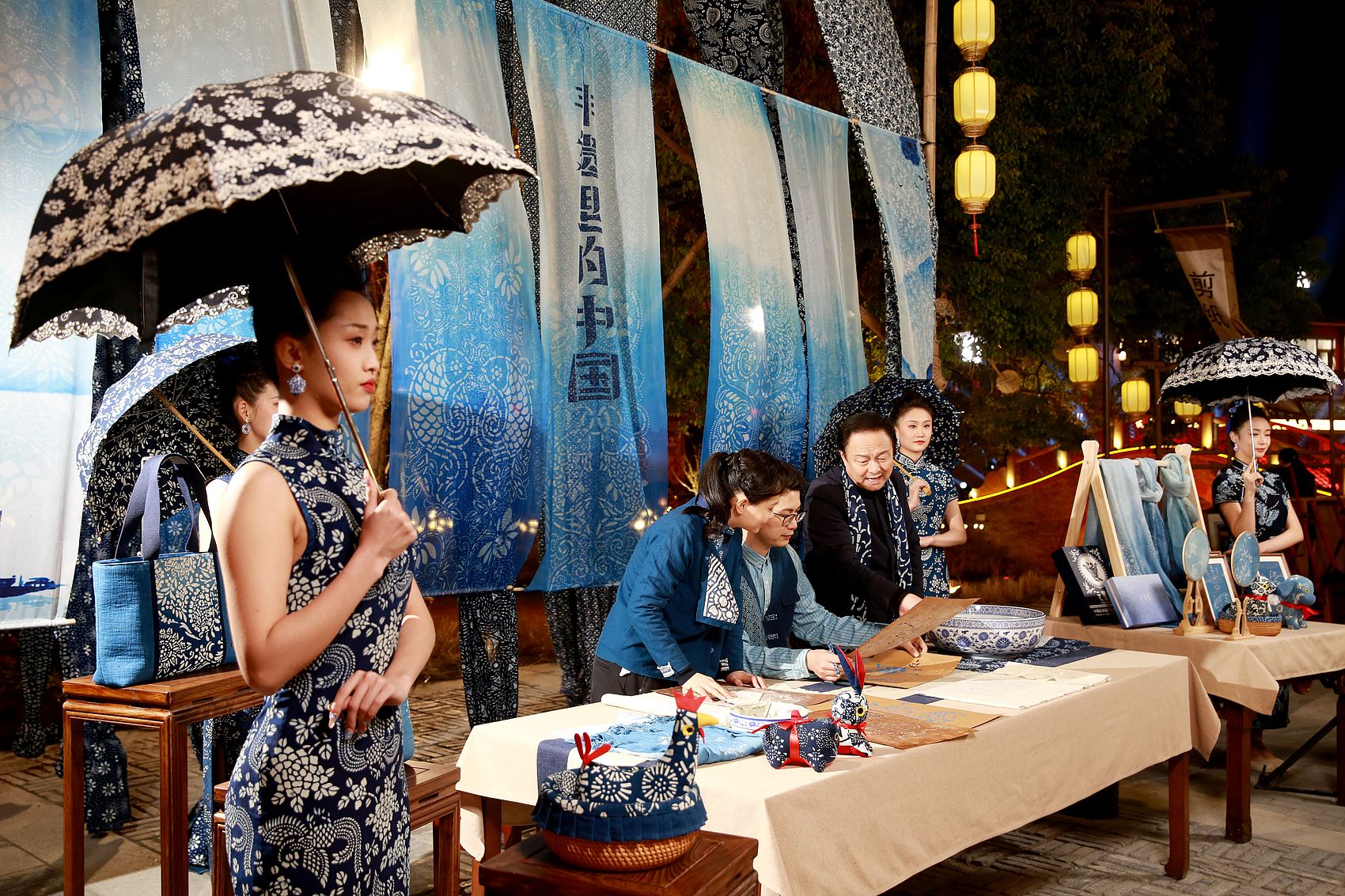
Inheritors of blue fabric printing and dyeing showcase the technique in a promotional event in Jiangsu (VCG)
In the following decade, China developed a nationwide system that mobilized four levels of government, from county to national, each responsible for identifying, preserving, and promoting cultural heritage. A system of “inheritors,” inspired by Japan and South Korea’s “Living National Treasure” designation, was also introduced to recognize expert practitioners committed to promoting regional culture and passing down local knowledge. In 2011, these efforts were codified in the Intangible Cultural Heritage Law of the PRC, marking a major step in institutionalizing cultural preservation at the national level.
Efforts to safeguard ICH have yielded significant results, sparking widespread public enthusiasm that has translated into innovation and economic benefits. However, challenges remain, including the persistent issue of aging inheritors and rapid social transformation. Ma Shengde, former deputy director-general of the Department of ICH at the Ministry of Culture and Tourism, notes in his work Ten Lectures on the Safeguarding of China’s ICH that an imbalance also exists in preservation across different categories. For example, some regional governments tend to prioritize forms of ICH with commercial potential, often overlooking other traditions such as oral literature, which arguably require the greatest preservation efforts.
With ICH becoming a marketing label applied to everything from street snacks to traditional medicine, an underground market for issuing fake ICH certificates has since emerged. In February, China Central Television reported on the trade, noting that for a few hundred to a few thousand yuan, individuals can claim to be ICH practitioners with official-looking certificates bearing their portraits. Some don’t involve real individuals at all. Journalists from Voice of China, China’s central radio news channel, found cases in which a so-called “inheritor” featured in promotions for ethnic medical plaster products was entirely AI-generated.

Since 2006, every second Saturday in June has been designated as Cultural and Natural Heritage Day in China, with ICH events held across the country (VCG)
Su Junjie, director of the Intangible Cultural Heritage Research Base in Yunnan and associate professor at Yunnan University, told Voice of China that the black market surrounding ICH not only undermines the credibility of legitimate practices but also threatens the livelihoods of real inheritors. Su also emphasized that the core of ICH protection should be people and skills, not products on industrial assembly lines.
While much remains to be improved, from building a unified database of ICH credentials to engaging a changing audience, preservation shouldn’t be about placing living culture behind glass. Rather, it should be about sustaining its vitality in the hands of the people who practice it, so that, like the lasting enchantment of diancui, it can entice new advocates through shared experience—an effect unlikely to be achieved through drab, formal labels.
What’s Driving China’s Intangible Cultural Heritage Boom? is a story from our issue, “When Heritage Goes Viral.” To read the entire issue, become a subscriber and receive the full magazine.
Related Articles



