

The summer is barbecue season for much of China, with patrons at popular restaurants spilling onto stools and tables on the streets to eat their fill (and wash it down with ice cold beers). But the art of the barbecue (烧烤) varies significantly across the country, from the oysters of coastal Guangzhou, to the famous lamb skewers of China’s northwest, and the banana leaf-wrapped morsels of Yunnan province.
In Northeast China (known as Dongbei), for example, barbecue is so loved that people jokingly refer to the Dongbei diet as “three barbecues a day.” The government of Jinzhou, Liaoning province, even designated barbecue an “intangible cultural heritage” in 2010. From crabs to silkworm pupae, Jinzhou barbecue menus can have over a hundred choices. Some dishes are seasoned with herbs such as licorice root (甘草) and dried tangerine peel (陈皮) to bring out the delicate flavors.
No Jinzhou barbecue menu is complete without tofu-skin rolls. The dried tofu is stuffed with cilantro and grilled on skewers until soft and tender. The chef completes their offering by brushing chili sauce on the rolls and sprinkling over cumin and sesame seeds. The crunchy fragrance of the cilantro and the rich flavor of the seasoned tofu skin soothes the stomach in between sizzling meat kebabs.
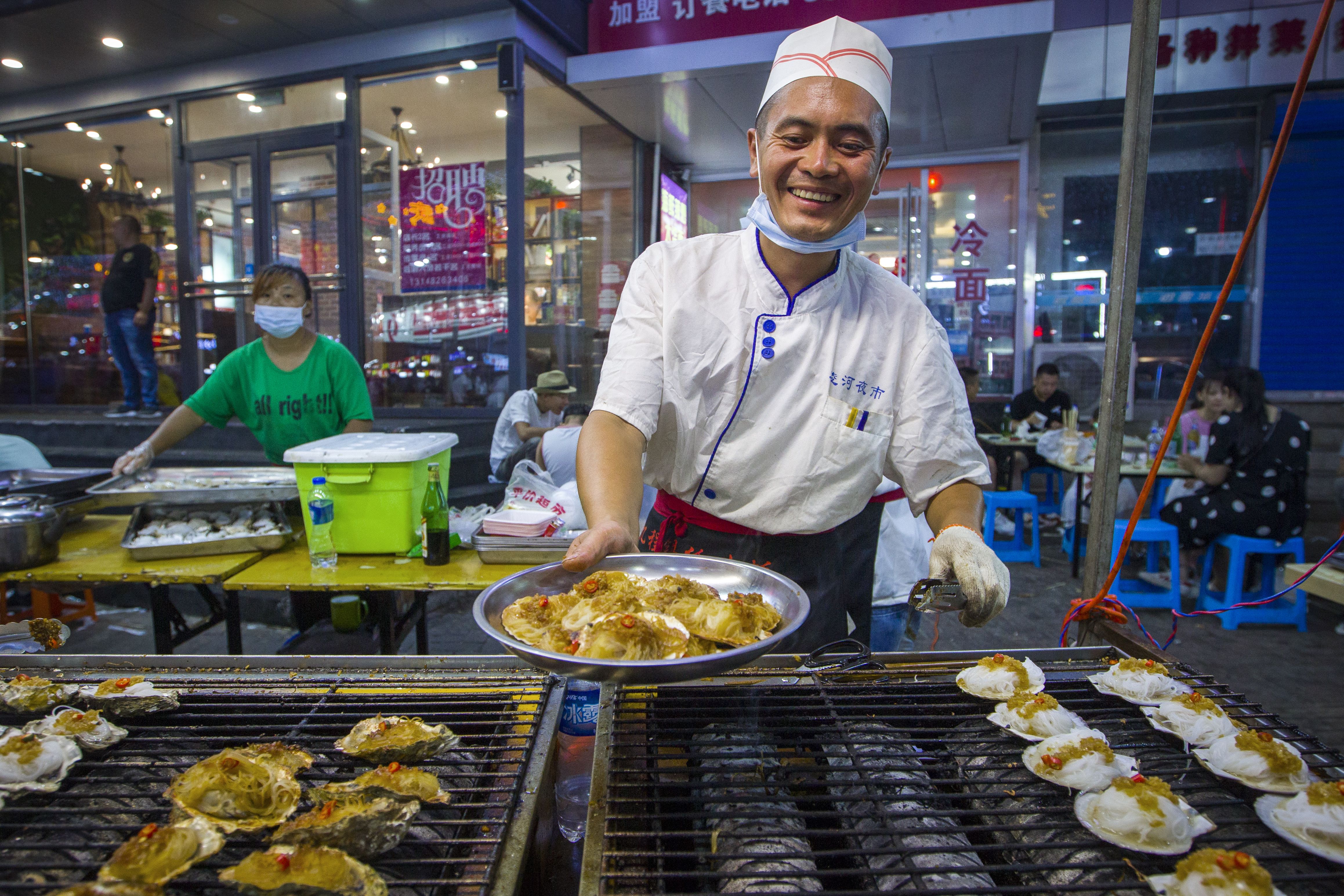
Seafood barbecue in Jinzhou, Liaoning province (VCG)
In Zibo, Shandong province, locals assert the “soul” of any barbecue comes from spring onions, pancakes, and sweet bean sauce (甜面酱). Pancakes are the vehicle for enjoying barbecue in Zibo. Take a sheet of pancake, add some grilled pork and local Shandong onions in the middle, then spread the sweet bean sauce on top for a sharp flavor. The onions in Shandong are prized for their crisp, sweet taste.
But in Qingdao, the beer and seafood king of Shandong, a late-night barbecue feast ends with a surprising twist—“wild wontons (野馄饨).” While wontons are served for breakfast in most other parts of China, they have morphed into a midnight comfort food in Qingdao. Local street stalls only open for business after 11 p.m., when law enforcement is scant, earning them the “wild” monicker.
The name also captures the carefree spirit of Qingdao locals who sit on seaside benches enjoying the evening breeze, seafood barbecue, and draft beer freshly brewed in Qingdao. After an evening of chomping down meat kebabs and slugging ice cold beer, nothing is more comforting than a warm bowl of wontons with seaweed and shrimp, before patrons head home for a satisfying sleep.

Lamb skewers are common in Xinjiang (VCG)
In northwestern China, landlocked and often arid, barbecues become wilder still. In Xinjiang, chefs use branches from the salt cedar tree (known as 红柳 or “red willow” in Chinese) to skewer fresh tender lamb chunks, alternating with one piece of fatty meat between two lean ones. Traditional roasting ovens are made from stone, with the lamb slow-roasted over charcoal fire until the juice from the willow branch gives the lamb a natural fragrance. The lamb is seasoned using only salt and cumin—more than enough for the perfect taste.
In southern China’s Guangzhou, Guangdong province, where seafood reigns supreme, fresh grilled oyster is one of the most popular barbecue dishes at the city’s night markets. Cooks grill the oyster slowly until juice fills the shell. The finishing touch is garlic paste, made with fresh garlic, lemon juice, salt, sugar, and other secret ingredients depending on the store.
Take a sip of the oyster juice while it's hot, then swallow the delicate and smooth oyster meat in one bite, and let your taste buds enjoy the flavor of the South China Sea.

Barbecue in Xishuangbanna often includes grilling meat wrapped in banana leaves (VCG)
Finally, in tropical Yunnan province, in China’s southwest, banana tree leaves are the best companion for barbecue fare. In Xishuangbanna, an autonomous prefecture of the Dai people bordering Myanmar and Laos, people wrap all kinds of meat in the leaves, then tie them together with fresh lemongrass and grill them over an open fire. It’s fresh, appetizing, and handy to eat. Banana leaves are also said to reduce internal heat and help detoxify the body—perfect for Xishuangbanna’s steamy summer climate.
Related Articles