

“Eat hot tofu slowly (心急吃不了热豆腐),” a Chinese saying warns of the danger of impatience. Hot tofu takes time to cool down, and even when it stops steaming on the outside, the inside might still burn your tongue. But one “tofu” dish—almond tofu (杏仁豆腐)—is enjoyed cold, and is a popular refreshing dessert for summer.
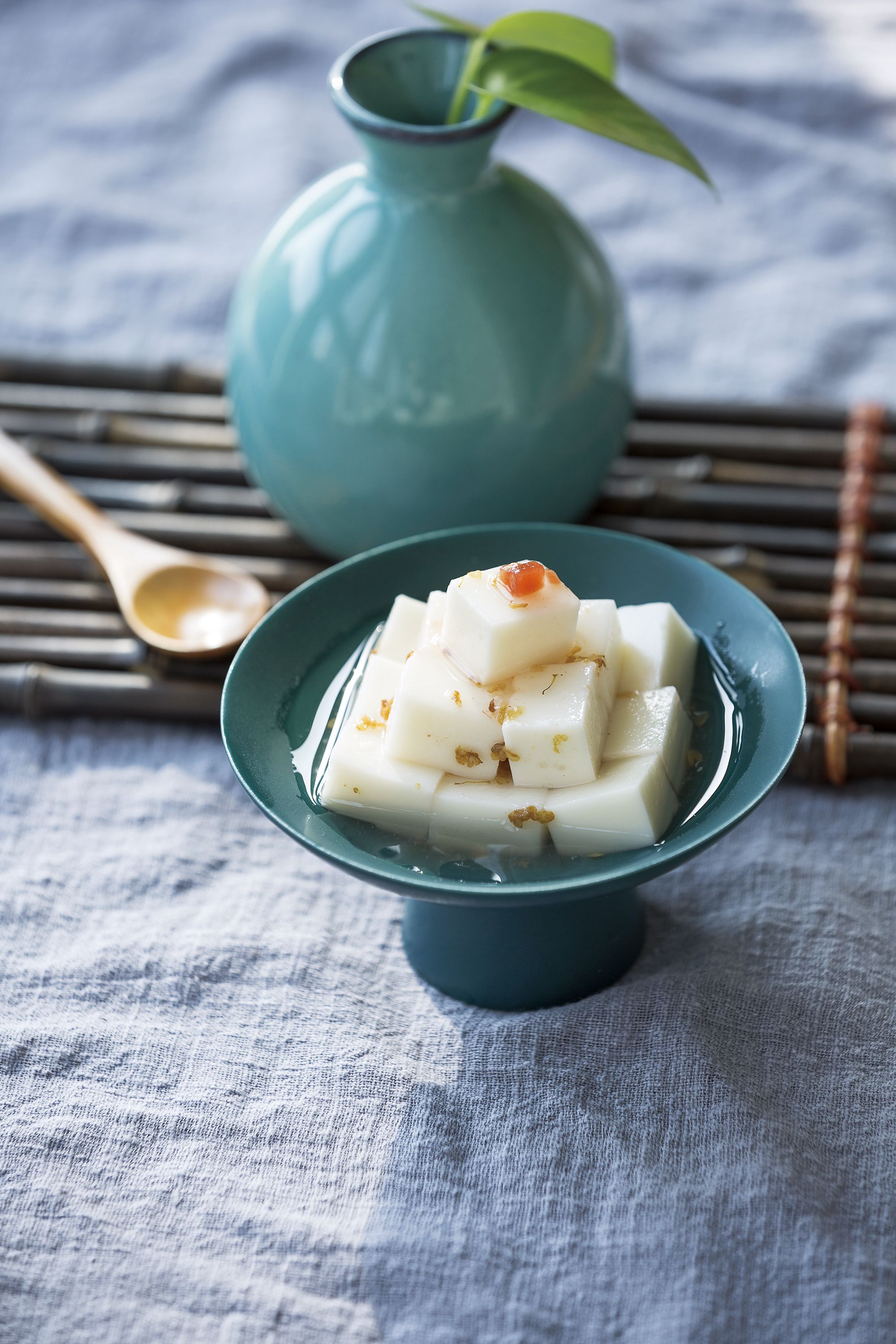
Don’t be fooled by the word “tofu” in its name: This chilled dessert has little to do with soy bean curds. What it has in common with tofu is the processing and appearance—soft, pale, jiggly, and vulnerable. Yet almond tofu is even more refreshing and smooth than the regular type, melting at the tip of your tongue and soothing your senses with its subtle sweetness and nutty fragrance.
The creation of almond tofu is commonly associated with Dong Feng (董奉), one of the most famous “miracle-working physicians (神医)” at the end of the Eastern Han dynasty (25 – 220). Instead of money, Dong asked his cured patients to pay him by planting almond trees on the mountain behind his village in Houguan county (present-day Fuzhou of Fujian province): one for a mild ailment, and up to five trees for treating a severe disease. As the trees multiplied into a forest over the years, Dong welcomed people to harvest the fruits in exchange for their grains, which he then donated to the poor. The story goes that locals then created almond tofu with the kernel from the fruit.
The tale gave rise to the idiom 杏林春暖 (“an almond forest flourishes in the spring”), used to praise medical professionals ever since, though the origin of the dessert remains unverified. In any case, the dish later made it into high society, adding a refreshing touch to the imperial Manchu-Han Banquet of the Qing dynasty (1616 – 1911) and allegedly winning the favor of big shots such as Empress Dowager Cixi.
(VCG)
The Secret Recipes to be Followed and Promoted (《食宪鸿秘》), a wellness and recipe book by the Qing dynasty scholar and foodie Zhu Yizun (朱彝尊), recorded a version of almond tofu, then known as “杏酪 (almond cheese).” The process includes soaking almonds with a pinch of stove ash, blending and grinding with water “as if making tofu”—as Zhu wrote—filtering with cloth, and boiling with sugar or water.
Modern-day almond tofu makers still more or less follow the traditional recipe, while adding creative touches like osmanthus syrup, goji berries, cherries, or raisins. You might want to experiment with your own preferred ingredients, but some old Beijingers will tell you one more secret: Using a ratio of nine parts sweet almonds and one part bitter almonds can bring back the true imperial recipe.
Steps:
- Wash the almonds and soak them in 250ml of water for at least 4 hours.
- Pour the almonds and water into a blender and grind them into a milky liquid.
- Filter the liquid with a piece of gauze into a pan.
- Add the milk, rock sugar, and agar powder. Stir the mixture over a low heat until it boils.
- Filter the liquid into a bowl, remove the skin on top, and leave it to cool and solidify at room temperature or put it into the refrigerator.
- Peel the pear and cut it into small cubes.
- Cut the jelly-like curd into small cubes and serve with the osmanthus syrup and pear cubes.
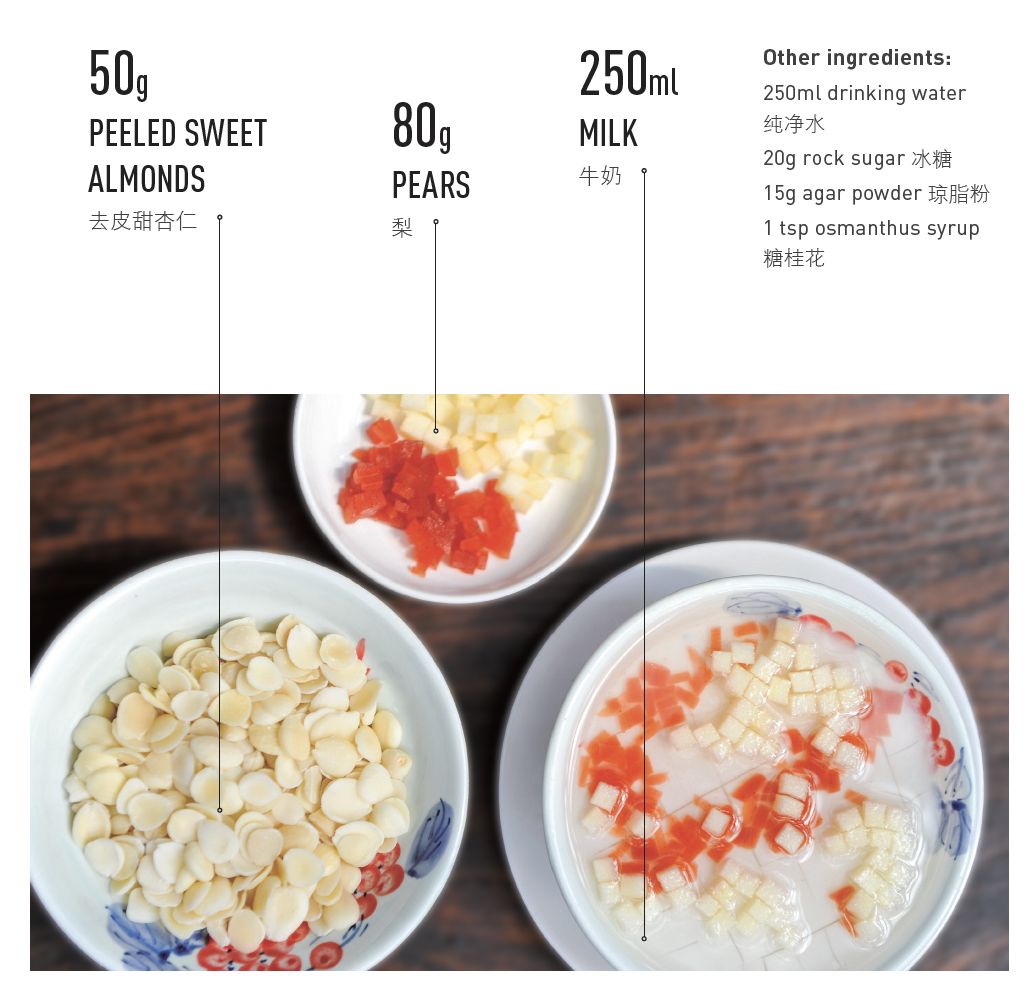
Chinese almond tofu ingredients (VCG)
Bean Curd Without Beans is a story from our issue, “Public Affairs.” To read the entire issue, become a subscriber and receive the full magazine.
Related Articles