

Tick, tick, tick … ring! The timer next to a clay hot pot suddenly springs to life, indicating that 15 minutes have passed and that the wild mushrooms, or junzi (菌子), boiling inside are cooked through and ready to eat. Every June through August, this scene can be found throughout Yunnan—and increasingly elsewhere across China—as wild mushrooms become a sought-after summer dish.
While Yunnan’s locals post vibrant photos on social media boasting about their fresh fungi hauls, especially after thunderstorms, the season also ushers in tales of strange hallucinations—from floating jellyfish and enchanting fairies to encounters with “little people”—due to the uninitiated accidentally ingesting hallucinogenic varieties. Every year, the local food safety office sends residents a text warning that “mushrooms may be delicious, but do not try wild and unfamiliar varieties.” But for many veteran mushroom hunters, the message serves less as a warning than as an official signal that the province’s lush, dense forests are ripe for foraging.
A mushrooming taste for the wild
Known as the “kingdom of wild mushrooms,” Yunnan is a paradise for fungi, with more than 900 mushroom species thriving in its biodiversity-rich landscapes. The province is the source of over 90 percent of China’s wild edible varieties.
In recent years, the region’s fungi-eating culture has also been harnessed to promote its unique, laid-back lifestyle. Images of the Amanita mushroom, with its white-flecked red cap familiar to Super Mario fans, are plastered throughout the subways of Kunming, the provincial capital. The city’s Mushuihua Wild Mushroom Market is China’s largest wholesale mushroom trading center and one of the largest in Asia. It sells 273 registered variants of edible wild mushrooms and handles around 450 tons of sales daily during the peak July to August season. The province’s mushroom industry generated more than 100 billion yuan in combined value in 2024 alone, according to the state broadcaster China Central Television.

Operating around the clock, Kunming’s Mushuihua Wild Mushroom Market employs more than 5,000 people and serves as the country’s largest hub for wild mushroom trading (Anson Zong-Liscum)
The demand for Yunnan’s wild mushrooms has grown alongside the rising popularity of the province’s cuisine, especially in China’s major cities. Xu Haoning, a Beijing native, had already dined at many of the capital’s top Yunnan restaurants, including Meowmeow, Yunteng Shifu, and In & Out Lijiang Theme Restaurant, before making his first trip to Yunnan in March 2025 to experience the regional cuisine firsthand—and, more importantly, at a much lower price than in the city.
“Niuganjun [bolete] is really popular in Beijing, but it’s too expensive—around 158 yuan just for a small plate,” he complains.
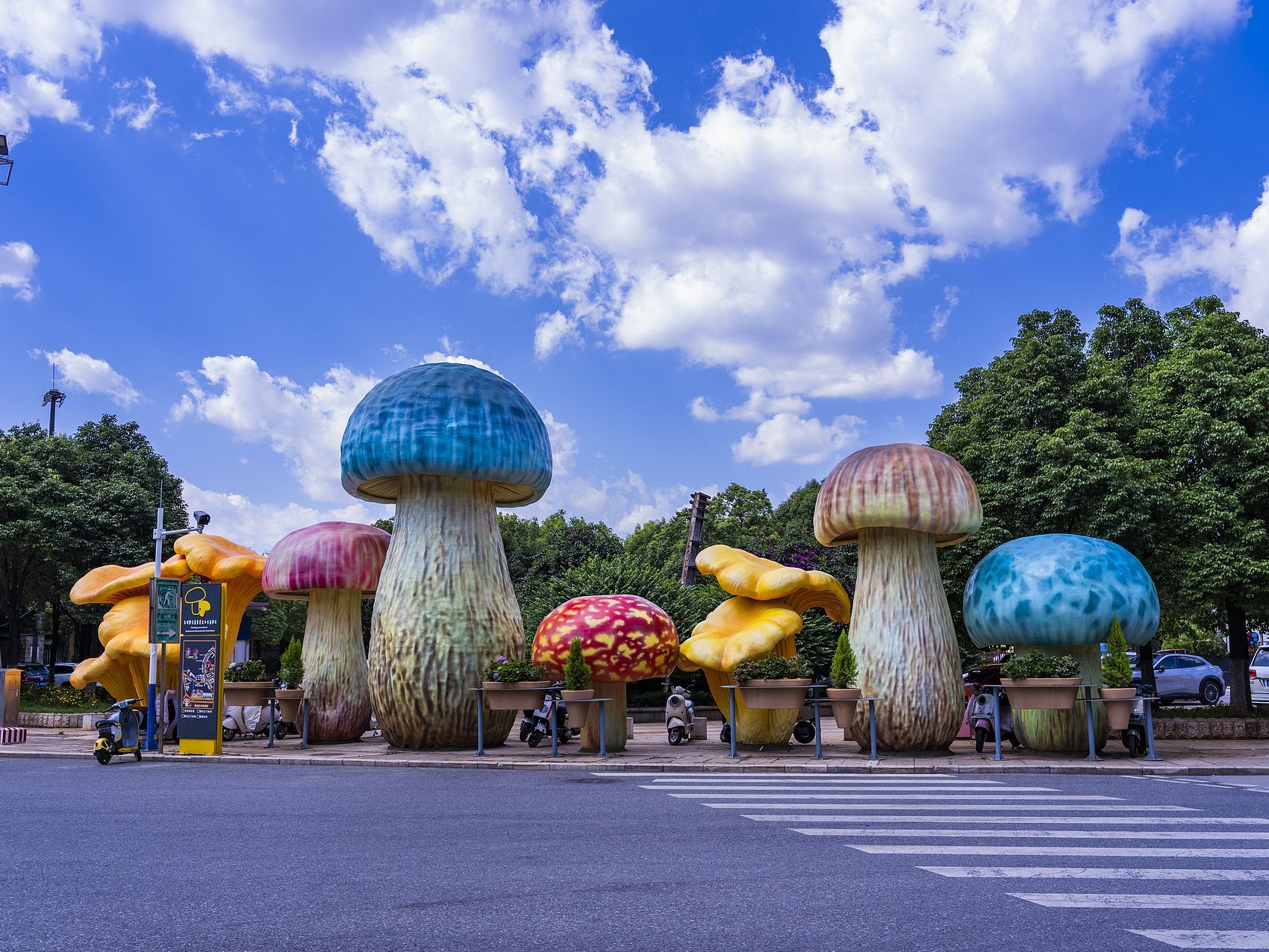
Colorful wild mushroom sculptures line a street in Kunming, highlighting the city’s bid to become a cultural and tourism destination celebrating its unique mushroom culture (VCG)
Visitors, even those who had frequented Yunnan restaurants like Xu, can feel overwhelmed by the vast assortment of edible wild mushrooms available. Among the more commonly found variants are the stout, dirt-red niuganjun (牛肝菌, bolete), the thin, lightish-gray jizongjun (鸡纵菌, Chinese parasol), the black-and-white, pinecone-like ganbajun (干巴菌, ganba fungus), and the bulb-shaped, greenish-blue qingtoujun (青头菌, green-cracking russula).
Different varieties of wild mushrooms emerge at different points throughout the summer. Huang Jianliang, a former restaurant owner now living in Mingjiu, a small town a three-hour drive south of Kunming, explains that qingtoujun are plentiful in June, while naijiangjun (奶浆菌, saffron milk-cap) appear later in July. Local conditions—including soil, altitude, and ecology—also shape the flavor and texture of these mushrooms, giving each region’s junzi its own distinct character.

A display of some of the most popular local mushroom varieties in the Mushuihua Wild Mushroom Market (Anson Zong-Liscum)
According to him, some of China’s best mushrooms are in Laochang, a small town outside Gejiu, China’s tin capital. “They have a [bolete] mushroom called baicong (白葱, “white scallion”), which tastes the best,” he says. “It has to do with all the minerals over there.” The best specimens can sell for 300 yuan to over 600 yuan per 500 grams.
“You can tell the quality of wild mushrooms used in hot pot restaurants by the soup color,” Huang adds. “Yellow broth comes from cheaper wild mushrooms; white broth signals a higher-quality mushroom. However, when red-capped mushrooms with a white stem—poisonous mushrooms—are used, the soup turns a purplish-red. It’s delicious.”
A case of the “dancing Lilliputians”
“Before I came to Yunnan, I thought locals ate wild mushrooms raw, like salmon,” says Xu. But that couldn’t be further from the truth. In fact, many wild mushrooms require careful preparation.
In Yunnan, it’s said that first-timer mushroom eaters should be familiar with the three principles of “shou (熟),” a word that means both “cooked” or “ripe” and “familiar.” The first recommendation is “to be familiar with the different types of mushrooms,” especially when foraging for edible wild mushrooms. The second is that “mushrooms must be fully cooked before consumption,” ideally with the help of an experienced chef. Some mushroom hotpot restaurants even physically lock the pot with a padlock and remove diners’ chopsticks for 20 minutes to prevent curious eaters from accidentally consuming undercooked mushrooms. The third, which locals consider the most important if the first two suggestions are ignored, is that “one must know the way to the nearest hospital by heart.”

In 2025, the red jianshouqing variety was removed from official poisonous mushroom guides and reclassified as a conditionally edible mushroom, meaning it is safe to eat only when properly prepared (Anson Zong-Liscum)
Despite all the warnings, new victims of poisonous junzi continue to capture local headlines each year, offering equal parts entertainment and cautionary tales. Among the most common reports are sightings of “little people (小人人).”
Scientifically known as “Lilliputian hallucinations”—after the fictional Lilliputian race from the classic 18th-century novel Gulliver’s Travels—the phenomenon often entails small, elf-like people emerging from the surrounding environment and performing entertaining activities for the patient. Lilliputian hallucinations can last for hours, or in more extreme cases, span multiple days.
Unlike magic mushrooms, or “shrooms,” whose psychoactive compound psilocybin acts on the brain’s serotonin receptors, the “lilliputian hallucinations” associated with Lanmaoa asiatica, or jianshouqing (见手青) mushrooms, are unique to this species, and their underlying cause remains unknown. A type of reddish-orange bolete commonly found around the bases of Yunnan pines, jianshouqing emits a light green tint when sliced and is extensively used throughout Yunnan cuisine for its umami flavor. But when undercooked, the delicacy can take unsuspecting diners to a different realm.
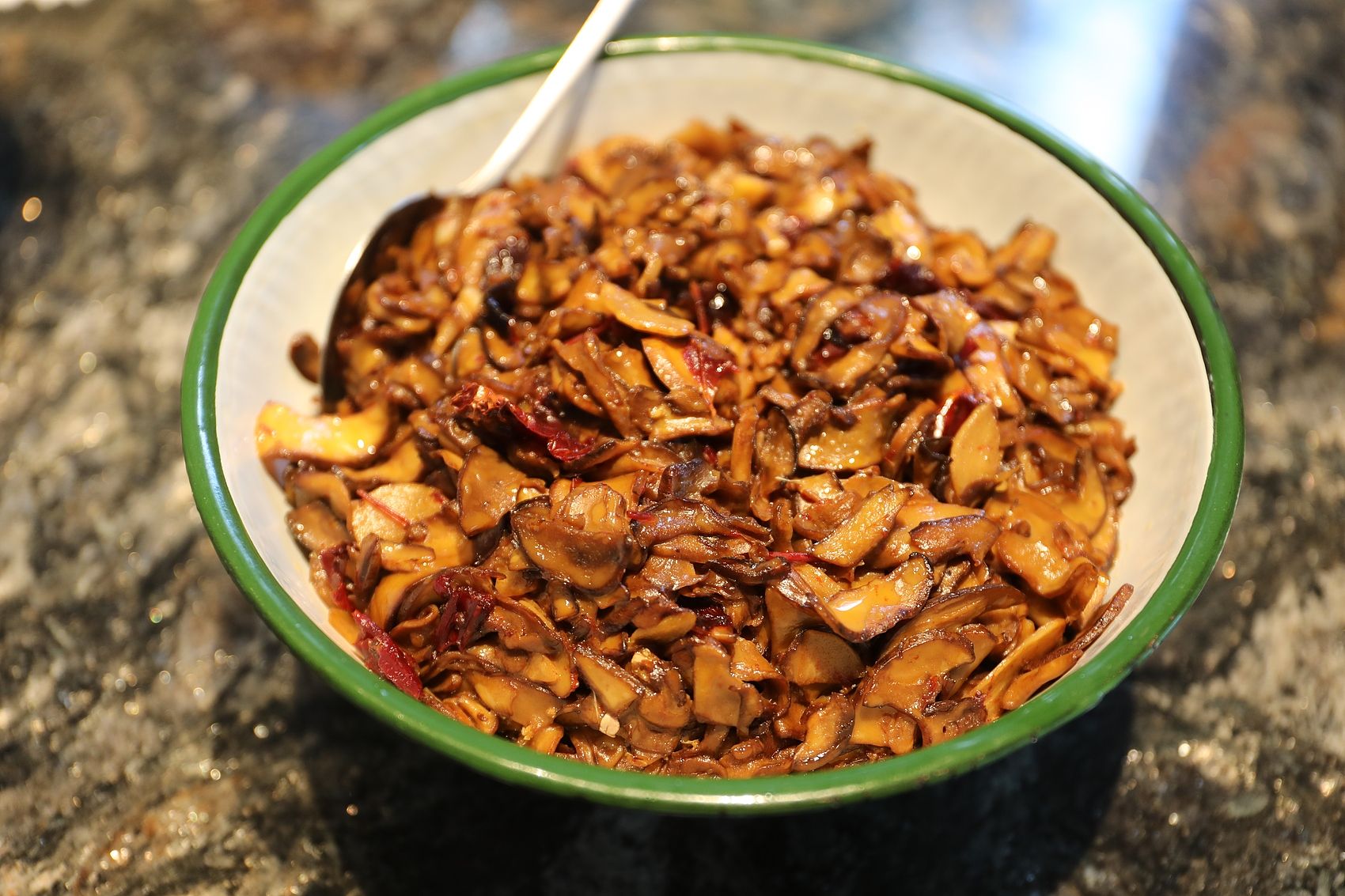
It is recommended to boil or steam jianshouqing before stir-frying it over high heat. The knife and cutting board used to prepare the mushrooms should also be thoroughly cleaned before being used for other foods. (VCG)
“I saw smoke coming out of everyone’s heads. When I arrived at my office, I thought the entire room was filled with smoke,” Niu Yuehong, a native of Pingbian county in Yunnan, tells TWOC. Over the course of two days, she had eaten nearly two kilograms of jianshouqing mushrooms prepared by her husband. When she complained about the smoke to a colleague, she was rushed to the hospital.
However, Niu’s otherworldly adventure was only just beginning. “At the hospital, I saw pretty Grecian women dancing, forests, soldiers, and ice-capped mountains. There was another young girl in the same treatment room with me who saw small angels flying everywhere. She kept trying to catch them.” Niu says it wasn’t until three days later, after continually drinking salt water and receiving IV infusions, that the hallucinations began to fade.
While the experience may seem funny in retrospect, mushroom poisoning is no laughing matter—it can have serious, even fatal, consequences. According to the Chinese Center for Disease Control and Prevention, in 2025, Yunnan ranked third highest in China with 109 reported mushroom poisoning incidents, including two deaths across provincial-level administrative regions. A study done by Lanzhou University reported that Yunnan province alone reported over 9,686 cases of wild mushroom poisoning from 2010 to 2018, with Chuxiong and Lijiang consistently ranking among the top regions. Although increased awareness has led to a decrease in deaths and reported cases overall, unreported community cases and challenges in documentation suggest that the actual numbers may be much higher.
In a creative effort to warn the public about deadly mushroom poisoning in 2021, several police stations in Yunnan have turned a local children’s rhyme into catchy safety videos on social media platforms, using comical performances to reenact its grim storyline. The lyrics go: “Red caps, white stems—eat them, and we’ll all end up lying on the slab.” The rhyme has since gone viral nationwide.
A growing global appetite
Today, China dominates the global mushroom industry, producing more than 40 million metric tons of edible mushrooms annually and accounting for over 70 percent of the world’s output for several years running. Yunnan alone, meanwhile, is home to nearly half of the world’s wild edible mushroom resources.

Mushroom hotpot remains a popular dish even outside of Yunnan (VCG)
In & Out Lijiang Theme Restaurant, a Yunnan restaurant chain, has even won praise from international government officials and delegates for its wild mushroom dishes during their visits to Beijing. Patrons include former UK Prime Minister Keir Starmer earlier this year and the former US Treasury Secretary Janet Yellen in 2023, who, after eating jianshouqing mushrooms, told CNN, “There was a delicious mushroom dish. I was not aware that these mushrooms had hallucinogenic properties. I learned that later.” Following each visit, Chinese netizens clamored to know exactly which officials ate which junzi dishes, and pondered how Yunnan cuisine came to be their first meal in Beijing.
These politicians’ patronage has only deepened the mystique over Yunnan mushrooms. Whether drawn by perceived health benefits, the allure of one of China’s most prized culinary treasures, or the chance to encounter “little elves,” visitors are increasingly seeking out Yunnan’s wild mushroom culture—no longer merely a seasonal delicacy, but a defining thread of the region’s cultural identity. Whatever the motivation, Yunnan’s mushroom kingdom is ripe for exploration, as long as travelers know the risks—and where to find the nearest hospital.
Related Articles