This summer’s box office has been anything but predictable. Low-budget horror films like Obsession and Backrooms seem to have brought back the glory days of the niche genre, inspiring memes and discussion online. The classic Hollywood heavyweights aren’t missing out either, with Christopher Nolan’s The Odyssey and the superhero franchise Spider-Man: Brand New Day rolling out full promotional campaigns, including cast visits to China and fan events. Yet it’s domestic films that are leading at the box office, with Stephen Chow’s Kung Fu Soccer and All Wishes Come True!, a fresh twist on a classic Chinese folk tale, ruling the charts. And what’s gone most viral is a terribly made 86-minute animation that has netizens around the world calling out “Mama.”
With a total box office of 11.6 billion yuan and counting at the time of writing, and over 100 titles hitting the big screen, here are eight of TWOC’s top picks:
V 空枪
Set in early 1990s Hong Kong, V, whose Chinese title literally translates to “Empty Gun,” is not just another Infernal Affairs-like crime thriller about gang violence, police corruption, and retribution. The protagonist, Wan Ziqiang (Zhu Yilong), an undocumented migrant, tries to survive Hong Kong’s dangerous underworld, desperate to change his fate in the seemingly prosperous city. Working with a crime gang, he robs a gold shop and later a cash truck, until he crosses paths with a bigger fish: real estate tycoon Chen Huiyan (Tony Leung).
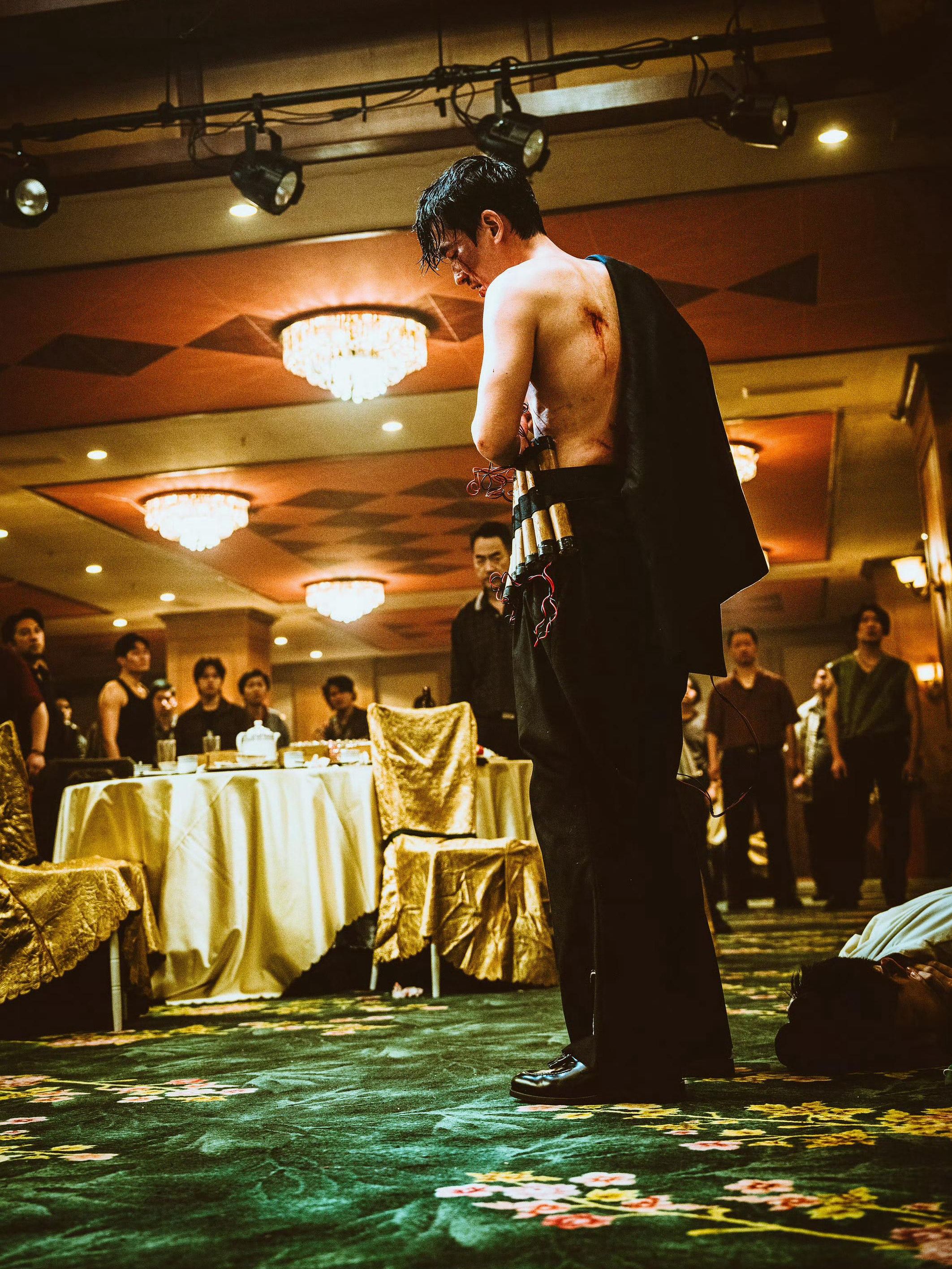
At the same time, Wan’s sudden wealth and a high-profile wedding back in his hometown caught the attention of Guangdong detective Qi Honggang (Tan Jianci). While similar Hong Kong crime thrillers might stop at the cat-and-mouse chase, V digs deeper, exploring the systemic roots of Hong Kong’s extreme concentration of wealth in the hands of a few.
Although a note at the beginning of the film reminds viewers that the story is fictional, many still see Wan as being based on real-life criminal Zhang Ziqiang, who in 1996 abducted the eldest son of Li Ka-shing, Hong Kong’s richest man. Li helped shape Hong Kong’s modern property market and its model of high-density, large-scale development. In reality, Li reportedly paid more than 1 billion Hong Kong dollars in ransom to secure his son’s release.
In the film, Wan makes an audacious visit to Chen to discuss his son’s ransom. After witnessing Chen’s luxurious lifestyle behind a carefully cultivated image of modesty, Wan accuses the tycoon of having “abducted” all of Hong Kong through his exploitative real estate empire, in which ordinary people spend their entire lives saving just to put a roof over their heads.
Coincidentally, on August 20, the second day after the film’s release, news broke that Hui Ka Yan, founder of Evergrande Group, had been sentenced to life in prison for fraud, bribery, and embezzlement. Saddled with 2.4 trillion yuan in debt, the bankrupt Evergrande Group was once China’s largest real estate developer.
The 160-minute film brings together three generations of accomplished actors, including Hong Kong actors Michelle Wai, Hui Ying Hung, and Tony Leung. One of the Chinese mainland’s leading male actors, Zhu Yilong delivers a nuanced performance as an audacious criminal torn between a sense of inferiority and arrogance.
Once Upon a Time in the Middle East 欢迎来龙餐馆
Chef Xu Fu (played by Shen Teng) is a typical northeastern Chinese man—humorous, optimistic, yet a little timid. With an aging mother and teenage daughter depending on him and debts piling up, he makes the difficult decision to seek work in the Middle East in the early 2000s. In the fictional city of Bahata, he and his floor manager Ma Junsheng (Jiang Qiming) run a Chinese restaurant called “Loong Restaurant,” opened by local government official Zayd (Sherif Sobhy).

When war breaks out, Xu initially plans to return home. But after Zayd promises him half of the restaurant, he sees a business opportunity amid the chaos and decides to stay. As one of the few restaurants still operating, Loong Restaurant becomes a gold mine, serving everyone from locals and foreign embassy staff to American soldiers. Xu makes even more money turning the place into a bar at night in a country where alcohol is banned. However, as the conflict escalates, Xu and his friends’ haven is shattered. They are repeatedly taken hostage and forced to witness the brutality of war. He gradually transforms from a man seeking only survival and a way home into someone willing to risk everything to save local children.
Though never explicitly stated, the film is set against the backdrop of the Iraq War. Directed by Wen Muye, this anti-war drama has become the most critically acclaimed film of the summer, earning an 8.7 rating on Douban and an 8.3 on IMDb. Inspired by the real stories of a group of Chinese entrepreneurs in the Middle East, the film weaves food throughout its narrative, conveying a message deeply rooted in Chinese culture: to “eat well (好好吃饭)” even in the most difficult times. The film portrays no character as simply good or evil, but rather as ordinary people caught up in atrocities beyond their control.
To Your Island 去你的岛

Bakery owner Wang Jiexiang (Yang Xiyun) finds a paper crane on her bed with a note written on its neck that reads, “Come to my island.” After she falls asleep, the crane appears in her dream and leads her to a mysterious island, where she finds only a rabbit, who turns out to be her ex-boyfriend. To save the man she once loved, who has lost his memories and is trapped on the island, Wang must open one dusty door after another, piecing together echoes of a past that has long faded away.
Adapted from the online novel of the same name, the animated film has been highly anticipated by fans, as the original story gained a large following after being published on the female-oriented web fiction platform Jinjiang in 2021. Many readers praised its poignant portrayal of a love story between two people who ultimately do not end up together. As they experience mutual healing and come to terms with their pasts, the two ultimately move on to better lives. With the novel’s author on board as screenwriter, the film stays largely faithful to the original story, recreating many of its most memorable scenes. Some have criticized the plot for being trite, but if you’re looking for a tearjerker, To Your Island sure promises a good cry. The film currently stands at 7.6 on Douban.
Niu Lai 牛来
Nobody expected the crudely made animation to attract much attention, let alone become a national or even global craze. Nevertheless, millions of viewers have flocked to cinemas to see this “so bad it’s good” production, laughing harder than they do at many actual comedies.
Niu Lai, one of the year’s biggest dark horses, has become among the strangest success stories in Chinese film history. Reportedly taking five years to produce and costing around 160,000 yuan, the animated film follows Niu Lai, a timid young calf who embarks on a dreamlike journey of friendship, migration, conflict, and loss, ultimately growing into his braver self.

The film’s initial box office sales struggled with a few thousand yuan, but it soon became infamous for its confusing plot and clumsy visuals. The mockery, however, quickly turned the little-known film into a sensation on social media platforms. Despite its gloomy rating of 6 on the review platform Douban, its box office revenue has surpassed 48 million yuan at the time of writing. “You may regret spending 80 minutes watching it, but if you don’t, you’ll regret missing it for life,” read one of the most-liked comments online.
The online fad has since grown into a real-life craze. Some cinemas introduced a rare refund policy, allowing audiences to leave if they dislike the film within the first 10 minutes; others joked that all people with money in the stock market should watch Niu Lai as the title sounds similar to “bull coming” in Chinese.
But despited all the tease, many appreciated Niu Lai’s existance, seeing it as an antidote to the AI-slop that takes over social media. Some even call the film a piece of “national-level performance art,” while others describe it as “sincere trash.” Whether loved or mocked, the film’s most iconic scene perhaps best captures its bizarre charm: when the orange calf cries out “Mama,” his mother instantly calls back his name, “Niu Lai!”
Make Zhonghe Great Again 年会不能停!2

When ambitious newcomer Liu Ben (Zhang Ruoyun) meets veteran office worker Ma Jie (Bai Ke), who was demoted to his current position due to office politics, the mismatched duo teams up to navigate a toxic workplace after repeatedly failing to secure promotions.
A sequel to the highly successful Johnny Keep Walking!, the office comedy returns this August with a new fantasy twist: a time loop. While the 2023 film won audiences over with its sharp satire of workplace absurdities, the sequel turns familiar office frustrations into an opportunity to rewrite past mistakes.
Each failed attempt or resignation resets the timeline to the moment when the duo first meet, giving them endless chances to try new ways to win over their bosses. Their later promotions, however, rarely come from capability or strategy, but from a series of misunderstandings. The loop creates countless coincidences and hilarious moments. When HR rejects Ma’s promotion request, Ma finally loses his temper and slaps the man. Instead of punishing him, the deputy director interprets his outburst as proof that Ma has powerful connections with their boss and immediately approves the request.
Beyond laughter, many viewers find resonance with the film’s parody of modern workplace frustrations, from repetitive routines to relentless pressure. Some, however, argue that the time loop gimmick pushes the story too far from reality. As a result, the film earned a modest 6.6 on Douban, far lower than its predecessor’s impressive 8.1. But as a lighthearted comedy about surviving the daily grind, it’s still an entertaining watch.
All Wishes Come True! 八仙

Following the wild success of the Ne Zha series (2019, 2025), All Wishes Come True!—the latest summer box-office animation hit—is also inspired by Daoist mythology. The film is based on the household story of the “Eight Immortals Crossing the Sea,” in which the eight legendary figures showcase their unique powers, from dividing the water to riding a paper donkey, to cross the ocean in a friendly competition. But unlike Ne Zha, which largely preserves the original storyline, All Wishes turns that competition into a heist, with eight mortal beings plotting to steal the deities’ treasure by posing as immortals.
Rated a respectable 8.2 on Douban, the film has grossed more than 1.7 billion yuan at the box office, ranking among the top 10 highest-grossing animated films in Chinese film history. Director Mu Zhengyang finds creative inspiration in the Eight Immortals, whose origins remain shrouded in mystery. Rather than being based on a single historical source, the figures gradually emerged from centuries of folklore. They represent people from all walks of life—different ages, genders, and social backgrounds, from the wealthy to the poor, the young to the old, and even those with disabilities—making them relatable figures for ordinary people. In the film, Penglai, the celestial realm, is reimagined as a highly bureaucratic workplace for deities: they have to clock in, compete for incense rankings, squeeze onto crowded cloud trains for their daily commute, and even apply for approval to operate their temples. This workplace satire gives the mythical world a distinctly modern twist, making the gods’ celestial existence surprisingly familiar to urban audiences.
Kung Fu Soccer 功夫女足

Commonly regarded as a sequel to Stephen Chow’s 2001 Hong Kong box-office winner Shaolin Soccer, Kung Fu Soccer tells the story of how a grassroots female soccer team braves all obstacles to win an important competition and prove themselves. The movie is currently the highest-grossing film of the summer, with over 2.3 billion yuan in box office receipts at the time of writing. Many attribute its commercial success to nostalgia, as audiences who grew up watching Chow’s comedies in the 1990s and early 2000s feel they “owe him a ticket.” At the time, Chow’s films were not officially released in Chinese mainland cinemas and were instead watched through TV broadcasts, pirated DVDs, or later on streaming platforms.
However, the film currently holds a mediocre 6.3 rating on Douban, reflecting its less-than-satisfactory critical reception. Some enjoyed Chow’s signature wulitou (无厘头, literally “nonsense”) comedy style, including characters’ exaggerated expressions and moves. Familiar scenes and lines also remind fans of his previous classics like King of Comedy (1999) and Shaolin Soccer. But others feel it lacked the depth of its predecessor, particularly its portrayal of ordinary people’s struggles and perseverance in the face of absurd realities. Instead, it played up conflicts with sudden twists while lacking the necessary backstory to explain, for example, why the women players were so determined to play and win the game.
Since Chow stopped starring in his own films in the 2010s, they have struggled to match the acclaim of his earlier works, mirroring the broader decline of Hong Kong cinema. His last two releases, The Mermaid (2016) and The New King of Comedy (2019), received Douban ratings of 6.7 and 5.7, respectively. Yet Chow’s long and impressive career has long solidified his status as the “King of Comedy.” Despite the less-than-satisfactory ratings, audiences are still willing to go to the cinema for him.
I Know Who You Are 抓特务

On October 1, 1949, Beijing was immersed in celebrations marking the founding of the PRC. While patrolling the capital, young policeman Xiao Dali (Lei Jiayin) overheard elementary school teacher Feng Jingbo (Hu Ge) discussing weapons with others. Suspecting Feng of being a Kuomintang spy, Xiao decides to keep a close eye on him to look for evidence, even moved into the same courtyard Feng lives. What Xiao didn’t expect was that the pursuit would tear his own family apart over the next three decades.
Adapted from writer Zhang Ce’s novella No Regrets, whose 1995 TV adaptation received a 9.4 rating on Douban, the film, directed by Feng Xiaogang, has grossed only around 120 million yuan in the two months since its June 19 release—less than half its reported production cost of nearly 300 million yuan.
The Chinese title, 抓特务 (literally “hunting for spies”), carries a distinctly period-specific connotation, evoking the early years of the PRC, when suspicion of enemy agents was deeply embedded in everyday life. Unfortunately, this historical association is largely lost on younger audiences. The film has also faced controversy over its soundtrack producer Han Hong’s appeal to Beijing residents after a public screening. She called on them to “do her a favor (走个面儿)” by watching the film and boosting its box office, a move many criticized as a form of moral pressure that may have further dampened audience interest.
With a rating of 7.4 on Douban, the film ranks above 83 percent of drama films on the platform, but its reception remains polarized. Some criticized the film for its poorly developed characters and weak plot, especially compared with the highly praised TV adaptation. Many said they could even sympathize more with the spy Feng than with the film’s hero, Xiao. Others appreciated its effort to portray everyday life in Beijing’s hutongs and the social changes from 1949 to 1984.
Related Articles