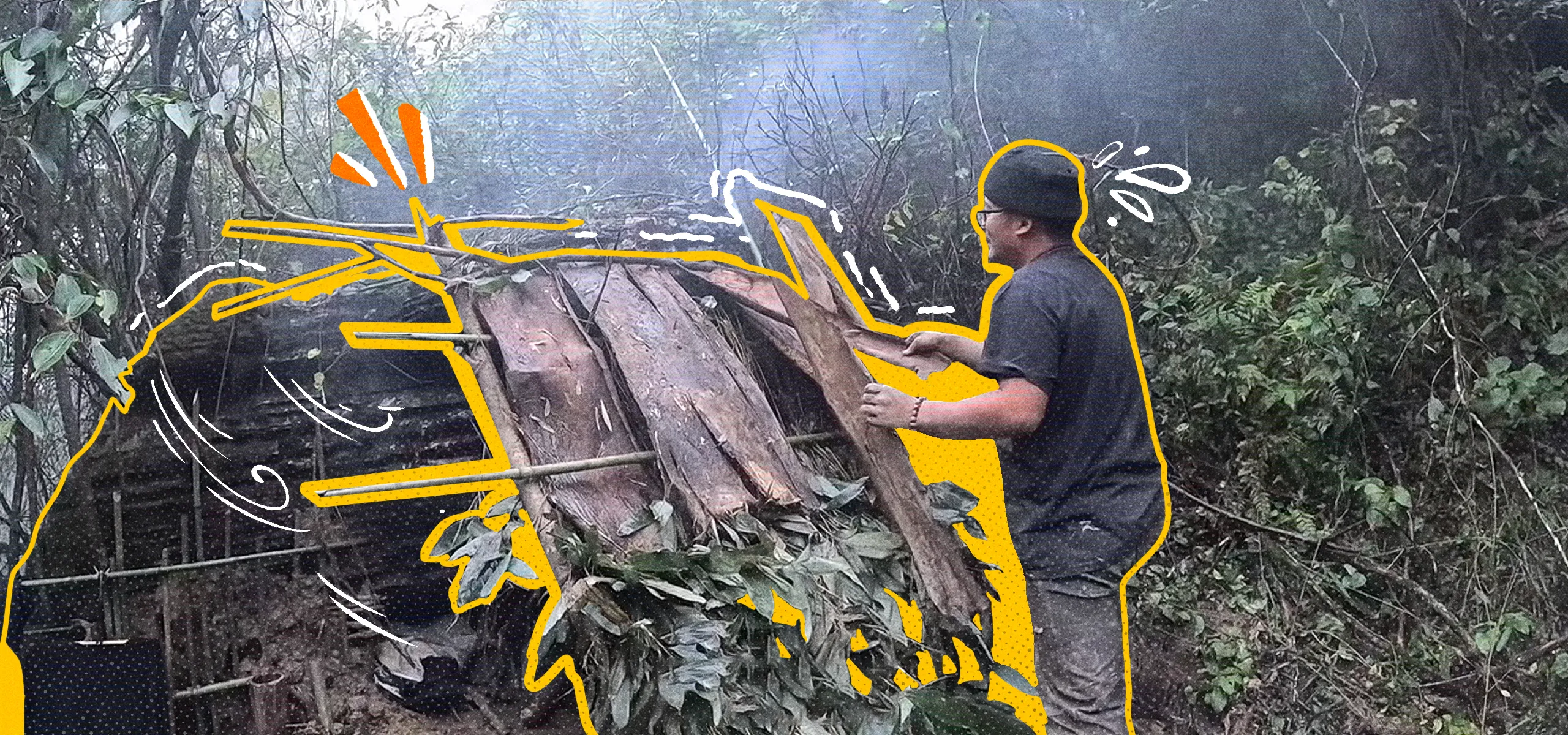

As a local wilderness survival contest goes viral, young people are rediscovering the allure of nature, both in their free time or via livestreams
Swinging from a tree in the rain and letting out playful monkey calls, Zhang Bolin—better known online as Lin Bei—looks entirely at home in what netizens jokingly call his “natural habitat.” A pharmacy graduate from Sichuan, he flashes a grin before admitting, “I kind of want to be a vagabond now. I feel like I’ve even put on weight [in the wild].”
It is day 36 of the second “Qixing Mountain·Camel Cup” wilderness survival contest, yet Zhang looks less like a contestant on the edge of exhaustion than a man rediscovering a long-buried version of himself. Behind him stretches the untamed forests of Hunan province’s Qixing Mountain, where Zhang spends days gathering mushrooms, digging for wild yams, and sleeping in makeshift cave shelters. Clips of the 25-year-old’s mountain life have gone viral on the short video platform Douyin, China’s version of TikTok, drawing as many as 30 million views in a single day with his smarts, courage, and humor. Viewers have dubbed his attitude—a combination of ease, intuition, and playfulness—“ancestral-style (返祖),” helping him to become a spiritual icon for young, homebound audiences.
Zhang is one of 13 remaining contestants, fueling the challenge’s popularity since it began in early October. Viral clips of participants gnawing on raw pork or swallowing slugs have pushed peak livestream viewership to 18 million, with related hashtags surpassing 1 billion views on Douyin.
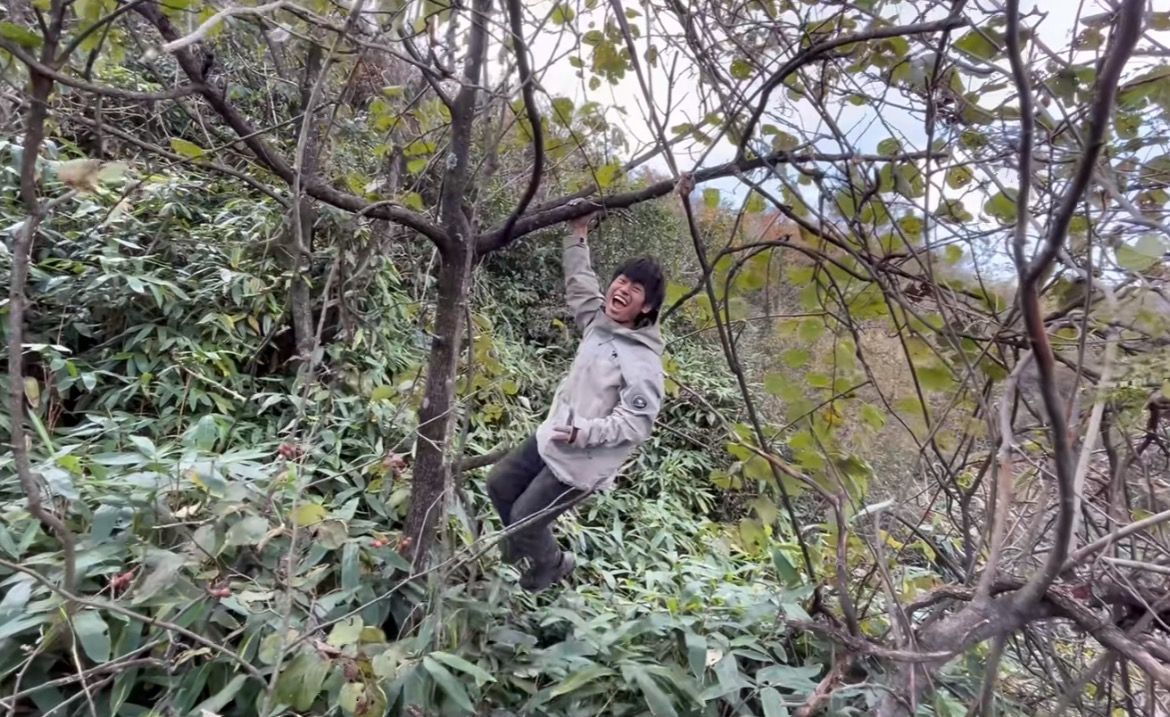
Pharmacy graduate Zhang Bolin, also known as Lin Bei, has drawn millions of fans with his humor, ingenuity, and optimistic attitude in the wild (screenshot from Douyin)
The online frenzy mirrors China’s growing interest in outdoor pursuits. According to an industry report released by the General Administration of Sport this October, more than 400 million people in the country now participate in outdoor activities, including running, hiking, camping, and skiing. For many urban professionals, wilderness survival challenges, once mostly a foreign pastime, have also become a legitimate escape from the tightening pressures of urban life, even as real-life risks loom for the participants.
“[The survival show] made me realize that once you’re away from electronic devices, life can still feel genuinely full,” one viewer wrote on Xiaohongshu (RedNote).
Discover more about growing outdoors craze in China:
- Deadly Summit: Why Chinese Climbers Flock to the World’s Highest Peak
- Was China’s Love for Camping Just a Pandemic-Fueled Fad?
- The Trails and Tribulations of China's Outdoors Boom
The “Camel Cup,” organized by the authorities of Qixing scenic spot and local outdoor clubs, reduces survival to its barest essentials. Armed with only a woodcutting knife and a bamboo pole, nearly 100 contestants must survive off the land deep in the wild Qixing mountains, part of the famous Zhangjiajie region known for its dramatic karst landscapes, caves, diverse wildlife, and as the inspiration for James Cameron’s Avatar series. The last contestant remaining in the game will take home the ultimate 200,000-yuan prize, while each survivor who lasts 30 days earns 10,000 yuan, 14,000 yuan for 40 days, and an additional 5,000 yuan for every 10 days beyond 40.
The chief organizer, Long Wu, explained to Jimu News in November that the endurance test was designed to see how participants cope without technology in the wild. “People today underestimate how hard it is to survive in nature,” Long said. “This competition is meant to restore that sense of awe, and remind both viewers and participants how to save ourselves when things go wrong [in the wild].”
Emotional release
“Participants aren’t seeking extreme thrills here,” Tian Lei, another of the show’s organizers, told Guangdong-based media outlet Young Pai in October. “They are looking to rediscover themselves in nature.” Nearly 90 percent of the participants, Tian notes, are from all walks of life and lack formal survival skills training.
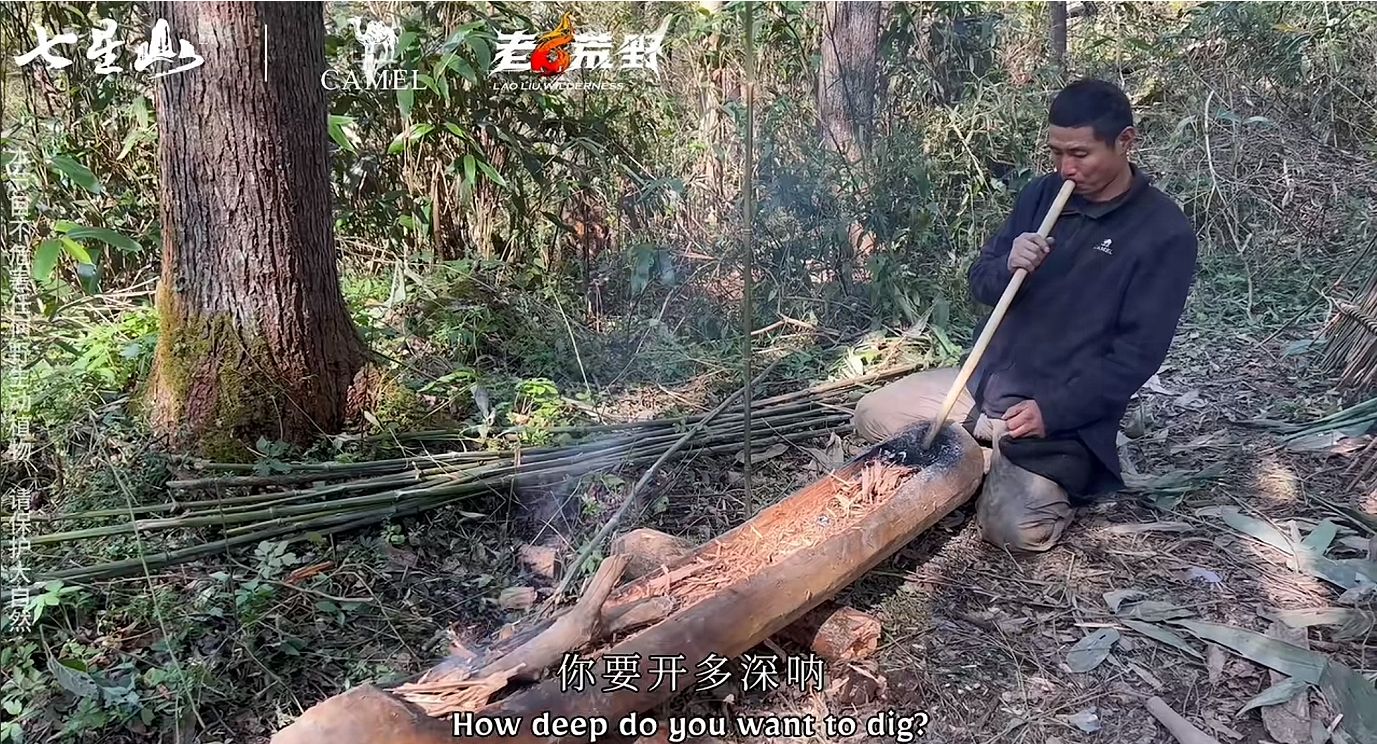
Contestants must learn to start fires and build shelters to stay warm at night and cook whatever they can forage, from mushrooms to grasshoppers (screenshot from Douyin)
Yang Chaoqin, a 30-year-old freelancer from Yunnan, described the contest as a form of therapy after a year of emotional highs and lows. She hoped the contest might help her understand what she truly wants from life. “I’m not here to play or just have an experience. I feel like I’m here to be reborn,” she said during one of the event livestreams in November. “You don’t touch your phone, you learn to embrace solitude, to face the harshness of the weather. It’s just you, thinking about how to cope and how to overcome everything in life,” she added. On November 14, Yang, however, withdrew from the contest due to health concerns after a routine check.
A medical school graduate, Zhang shared in this emotional release. “Every day, all I need to do is eat and sleep. I don’t feel tired anymore,” he said during a livestream. “I don’t really care about the money. I just want to switch my life to airplane mode for a while.”
And it’s not just the participants who are finding emotional release. In a November interview with Yangtse Evening Post, psychologist Dr. Chen Zhilin said that watching these contestants on screen can give also viewers a low-cost “retreat of the heart.”
Dangers beyond the screen
China’s craving for the wilderness isn’t new. Survivor Games, the Chinese edition of British adventurer Bear Grylls’ Man vs. Wild, was a nationwide hit in 2015, leading to a wave of local adventure shows and celebrity camping series. It also helps drive the popularity of other outdoor endurance events, such as marathons and trail running, both of which have become bigger than ever.
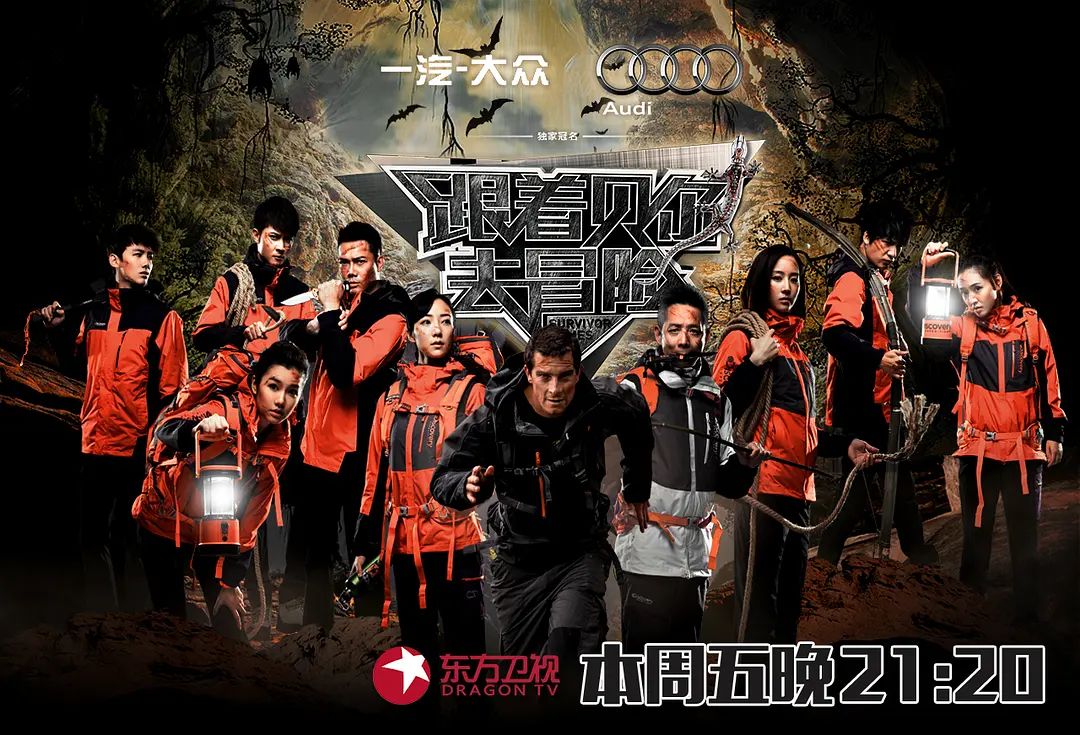
Survivor Games, a 2015 reality show co-produced by China and the UK, is believed to be the country’s first adventure reality program. It put Bear Grylls and Chinese actors like Bai Jingting through harsh wilderness trials in Guizhou and even jet-flight stunts, shocking viewers with its intensity, before being canceled due to low ratings.
Following the success of “Camel Cup,” scenic areas and outdoor clubs in many other regions, including Yunnan, Henan, and Zhejiang, have raced to replicate the rugged appeal of the wilderness survival contests, with some still awaiting official approval.
However, many participants and organizers, caught up in the excitement and rushing to cash in on the trend, are ignoring the very real dangers these contests carry. In Henan, a proposed survival challenge at Fuxi Mountain set for November 26 raised alarms over harsh winter forecasts. In Heilongjiang, a wilderness event with expected temperatures between -1 and -20 degrees Celsius also stirred debate over what counts as “too extreme” after its announcement in early November. Though local authorities later clarified that no such officially registered competition existed.
Extreme weather is not the only concern. “In the mountains, there are always uncontrollable factors—poisonous snakes, falls, toxic plants...I recommend that people think twice before trying to organize similar competitions,” cautioned Long, the Camel Cup organizer.
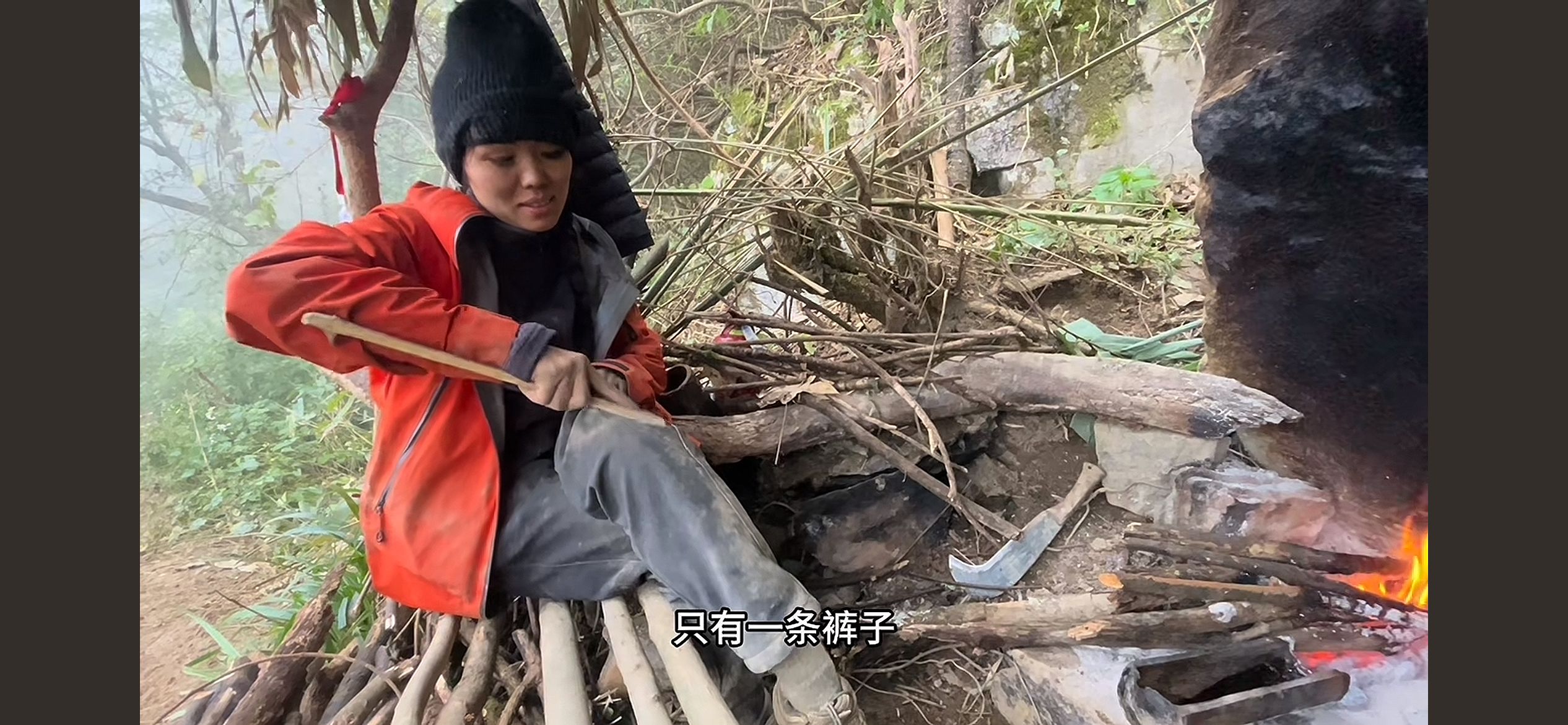
Yang Chaoqin, better known online as “Cold Beauty” and the only woman to endure most of the competition, pushed through menstrual pain but withdrew on day 37 after failing a routine physical check (screenshot from Douyin)
According to the China Adventure Association, there were 335 outdoor adventure accidents nationwide in 2024, resulting in 84 deaths and 11 missing persons. This October, hundreds of hiking enthusiasts entered the undeveloped Lenglongling area of the Qilian Mountain in Qinghai, leaving 251 people stranded and resulting in one death from hypothermia.
To reduce such risks, the General Administration of Sport and other authorities released guidelines this March to develop around 100 high-quality outdoor sports destinations by 2030, complete with improved infrastructure and standardized safety management.
Long’s team has also introduced numerous safeguarding measures, from rotating security staff to routine health checks. “If participants don’t meet the standards, they must withdraw. We can’t allow irreversible harm to their health.”
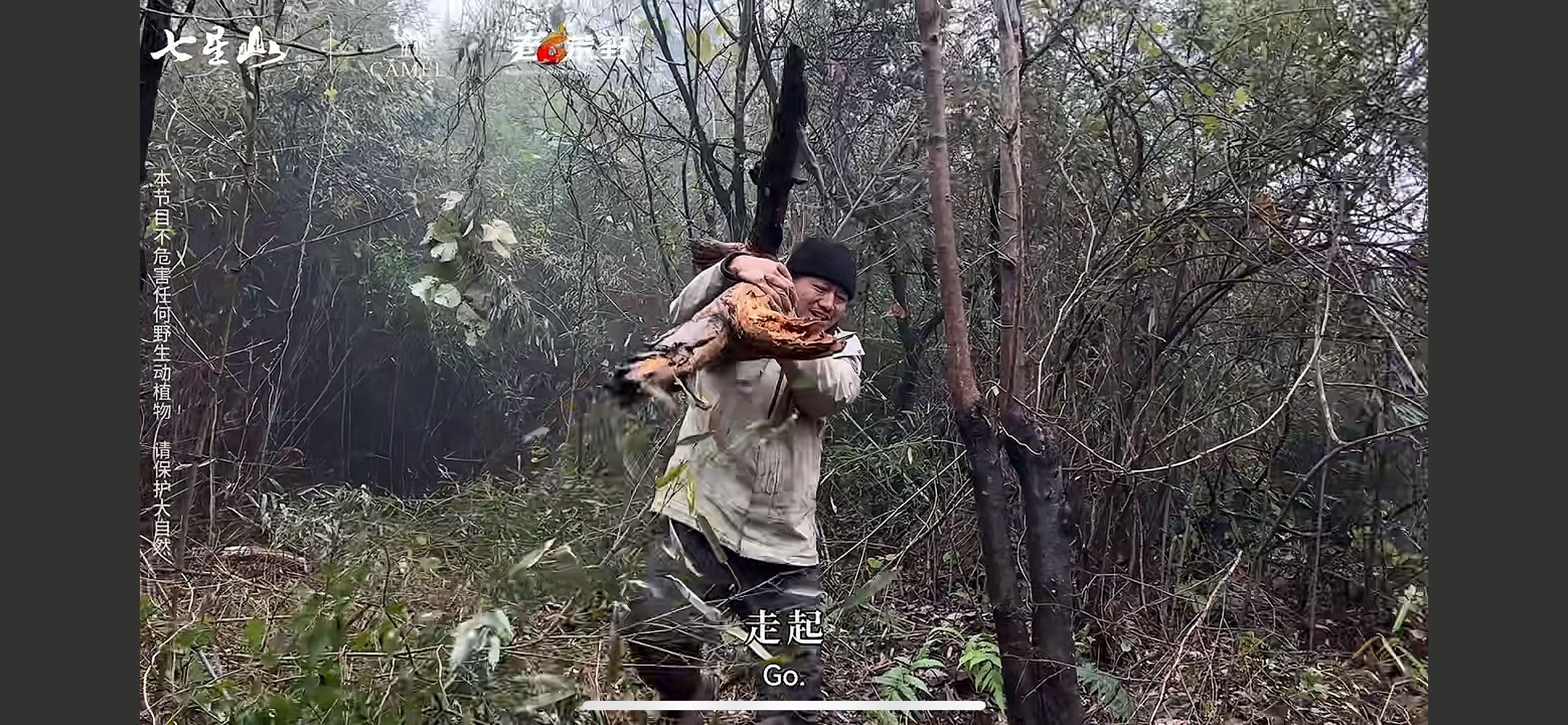
In October, organizers faced criticism for allegedly allowing contestants to cut down trees for firewood, though they later clarified that they had reported the activity to forestry and environmental authorities (screenshot from Douyin)
Despite all the precautions, accidents can still occur behind the spectacle. On November 11, the 34th day of the “Camel Cup” challenge, contestant Yang Yichen from Hunan mistook the toxic plant Arisaema triphyllum, or Jack-in-the-pulpit, for wild yam. “The toxin hit me within a few seconds,” Yang later recounted, describing his mouth burning and face swelling. Luckily, he managed to spit it out before swallowing. Other participants have also reported physical strains, including cracked skin and prolonged menstrual cycles.
As temperatures begin to drop in the Qixing Mountains, Zhang’s livestream remains among the most popular on Douyin. In his cave, he peels wild kiwis and recites melancholic verses like “Fallen leaves mark the deep autumn, the chill sets in, yet no one asks if I’m warmly clad.” At times, he still climbs trees and mimics monkey howls, grinning before the camera.
For now, the game goes on. After five days of rest in a fully equipped mountain cottage, the 13 remaining contestants kicked off the final round and returned to the wild with a knife, a military-style shovel, 200 grams of salt, a mess tin, and packets of cabbage and radish seeds on November 24.
Without any time limit, no one knows how long they’ll be out in the mountains, or what new dangers and obstacles might lie ahead. But the craze shows no signs of slowing, as sign-ups for the third installment of the contest have already started, drawing over 1,000 enthusiasts nationwide for just 60 limited slots. Many point to the 500,000-yuan prize as the main attraction.
As a top contender for the 200,000-yuan prize this round, Zhang, a medical school graduate, isn’t thinking beyond the contest just yet. When Hunan Daily asked about his plans afterward, he simply shook his head while packing his bags. “Nah, I’m just focusing on getting through it first,” he said.
Why China’s Youth Are Seeking Solitude in the Wild is a story from our issue, “New Markets, Young Makers.” To read the entire issue, become a subscriber and receive the full magazine.
Related Articles