As World Consumer Rights Day on March 15 put corporate misconduct under the microscope once again, it wasn’t only consumer products that found themselves in the spotlight this year. A book influencer’s video exposé of the dubious practices in his own community sparked widespread discussion about the credibility of online book reviews and recommendations.
In the 25-minute video on the social media platform Xiaohongshu (RedNote), the Tianjin-based vlogger known as “Chief Reading Officer” unfurled a nearly five-meter-long printed Excel spreadsheet listing the more than 700 books an unnamed influencer with half a million followers had recommended in 2025 alone.
The visual alone was striking, but even more revealing were the repeated patterns in the language they used: their worldview had supposedly been “reshaped” more than 17 times, and they had been “healed” by books over 33 times in just one year.
Find more book recommendations from TWOC:
- Seven Chinese Sci-Fi Writers You Should Be Reading in 2026
- Recommended Reads from The Commercial Press
- Five Must-Read Works By Chinese Female Writers
The video struck a nerve in China’s online reading community, exposing a growing tension at the heart of the country’s book industry: as reading influencers become an increasingly indispensable marketing asset for publishers, concerns over authenticity, credibility, and a manufactured reading culture are also intensifying. After all, for book influencers, the need to chase trends and maintain a constant online presence may be inherently at odds with reading as a private experience.
Over the past five years, Chinese book influencers have flourished across platforms, posting reading notes, photo essays, and short videos, while regularly hosting livestreams that have become a powerful force in book sales.
Cherry Chen, a 23-year-old postgraduate student in Beijing, has always struggled to get through many Western literary works. But in April last year, after watching a 48-minute video essay on W. Somerset Maugham’s The Painted Veil (1925) titled “The Reality of Love and Marriage Through a Man’s Perspective” by her favorite book influencer Zhou Xiaola, she bought a copy of the book through the purchase link pinned to the top of the comment section.
“Book influencers [like Zhou] can make difficult text more accessible by offering their own interpretations,” Chen tells TWOC.
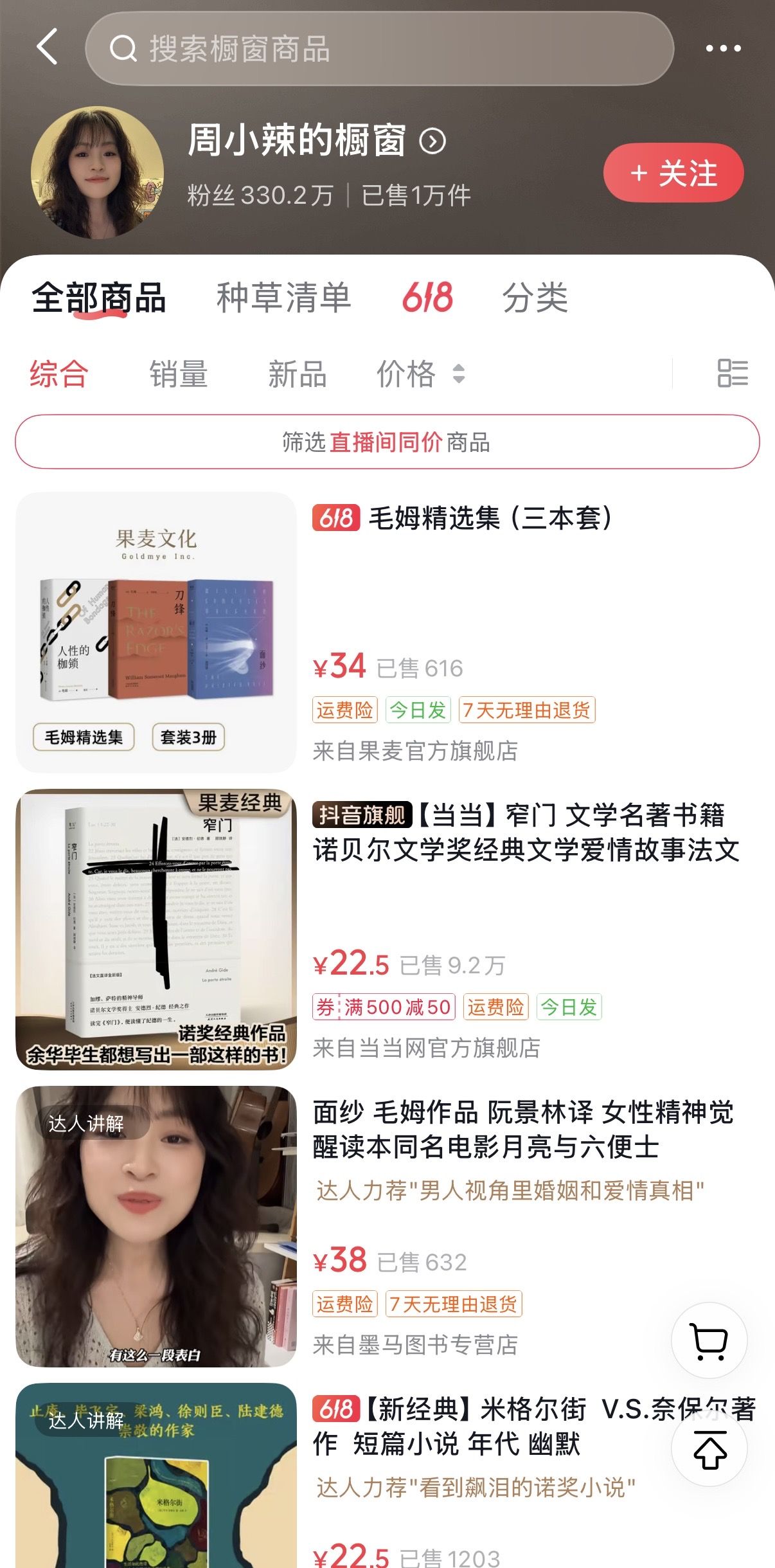
Zhou Xiaola has most of the books she has talked about listed on her Douyin store, with over 10,000 copies sold so far (screenshot via Douyin)
Zhou, with over 3.3 million followers on Douyin, China’s version of TikTok, has a highly recognizable formula for her videos: a close-up of her face, emotionally charged titles such as “What Is It Like to Date a Prostitute?—Reading The Lady of the Camellias,” and a blend of evocative language and personal reflections designed to spark viewers’ curiosity about a book. A purchase link is typically pinned in the comment section.
This kind of collaboration between influencers and publishers seems to have become an industry standard in recent years. “If you’re targeting the mass market and want a book to sell well, working with book influencers is essential,” Bai Bai (pseudonym), a commissioning editor with five years of experience at a leading private publishing house in China, tells TWOC. “[In today’s publishing industry,] how much budget you can devote to promotion, and what tier of influencers you’re able to collaborate with can largely determine whether a book succeeds or fails.” For example, after one of the country’s top book influencers, Dong Yuhui, recommended noted author Chi Zijian’s 2005 novel The Last Quarter of the Moon, which tells the story of a nomadic Ewenki woman in northeastern China, its total run surged from 600,000 to over six million.
These partnerships can begin at almost any stage of a book’s marketing campaign and take many different forms. Publishers typically select which influencers to work with based on a book’s subject matter and target audience. To promote a children’s title, for example, publishers tend to reach out to parenting vloggers or teachers with online followings.
Collaboration strategies also vary according to an influencer’s reach and visibility. For smaller influencers, editors often maintain informal but steady relationships through online communities and group chats. When a new title is released, publishers notify the group, recruit interested content creators, and send complimentary copies in exchange for reviews or reading reflections. The arrangement benefits both sides: publishers gain exposure and publicity, while influencers receive fresh material for original content.
Zhang, a marketing editor at a Beijing-based publishing house who agreed to be identified only by her surname, recalls one particularly successful campaign in 2025. To mark the 25th anniversary of the Chinese edition of the Harry Potter series, the publisher partnered with fan art creators and book vloggers on Xiaohongshu to promote a new edition of the series. The campaign generated more than 10,000 sales on its first day alone, according to Zhang.
With larger, more established influencers, publishers tend to pursue longer-term and more strategic partnerships, often supported by dedicated promotional budgets and direct relationships between senior publishing executives and top creators. These collaborations are typically commercial arrangements, with influencers either receiving a commission of 15 to 30 percent of book sales generated through their channels or a fixed fee for promotional content.
“In many cases, if no influencer is willing to take on a book or promote it, the book is basically dead the moment it’s published,” says Bai.
But that doesn’t mean book influencers now hold all the sway in the publishing industry. Not all influencers are as powerful as Dong, and not all books are as lucky as Harry Potter. For the vast majority of smaller influencers and editors, success on social media remains unpredictable—sometimes there’s gain, but no pay; other times there’s pay, but no gain.
For two years, a Yunnan-based creator who goes by the handle “Anqian Reads” experimented, on and off, as a book influencer. At first, he tried producing original content, but it drew little attention. Later, he began following popular trends, running several accounts across multiple social media platforms to drive traffic. “A few posts suddenly went viral, earning a few thousand yuan in a short period of time. After several viral hits, the earnings add up,” the influencer, who has made 30,000 yuan in total from his content, tells TWOC. But the income, he says, is far from stable and hardly worth the effort. There is no clear formula for what goes viral, and relying on luck alone is unsustainable.
Bai, the commissioning editor, has had a similar experience with the unpredictable forces that drive virality. When the publishing house where she worked released a nonfiction book by an American female author a decade ago, it attracted little attention. Earlier this year, however, when two celebrities casually mentioned the book on their podcast—without any formal partnership or promotional arrangement—sales surged past 20,000 copies and have continued at around 100 copies a day ever since.
“Book promotion [on social media] is basically a gamble,” she concludes. “Sometimes the results are unexpectedly huge, and other times there’s barely any response at all.”
Indeed, most of what Anqian spends hours creating disappears into the vast sea of online content. What exhausts him even more is the nature of the work itself. He dislikes the constant trend-chasing and the copycat content that the algorithms seem to reward, while his mood has become increasingly tied to volatile traffic and engagement numbers. “The irony is that after becoming a book influencer, I actually had less time to read,” he says.
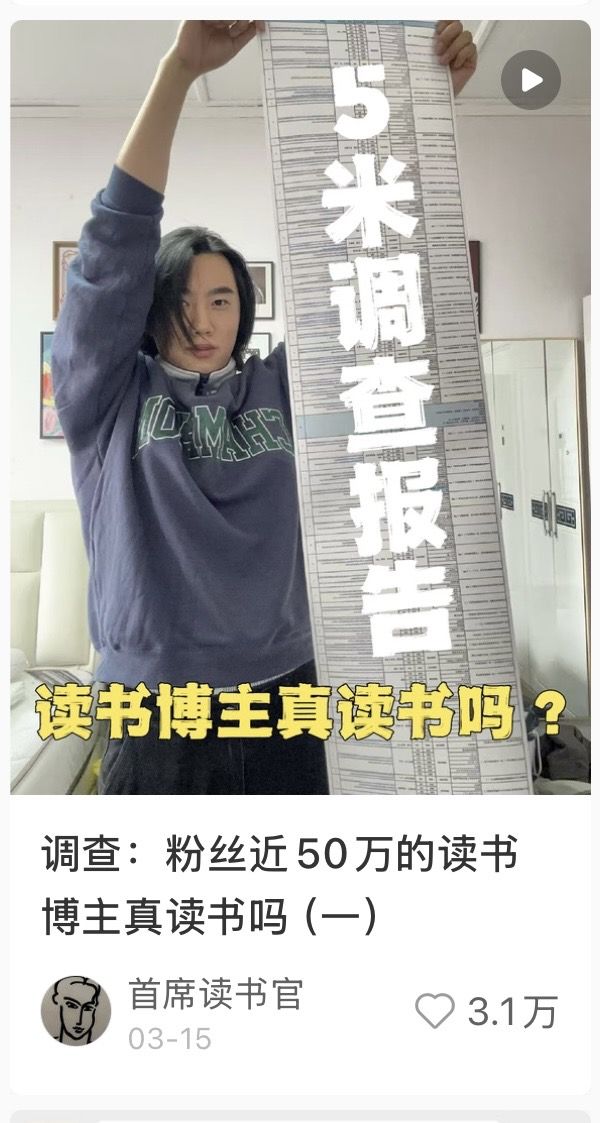
The exposé has become the Tianjin-based influencer’s most viral post, generating over 31,000 likes on Xiaohongshu (screenshot via Xiaohongshu)
His experience echoes the doubts shared by the Tianjin-based book influencer, who questions how the big names could possibly find time to read so extensively while uploading new content every day, often with titles such as “Six Books to Recommend After Reading 1,000.” Yet for influencers trying to make a living, there seems to be no choice but to claim that books they barely have time to read have changed their lives, as social media algorithms reward quantity over quality. Even Zhou Xiaola, who remains a trusted voice among many readers, has had to supplement her book-related content with more popular topics such as love, relationships, and psychology to maintain a posting schedule of three to four videos a month.
In April last year, Anqian stepped away from posting to reset and rethink his approach. Three months later, he relaunched his channel with a new goal: to focus on reading itself and share his genuine thoughts with viewers. From late July through December, he earned almost nothing from the account, despite remaining open to commissions. Yet during those months, he read more than 20 books, wrote tens of thousands of words, and gained over 8,000 followers across multiple platforms by documenting his reading journey and life as a book influencer. “Even some vloggers I used to follow started following me,” he tells TWOC.
Though he is still pessimistic about the future of being a book influencer, as monetization remains a persistent issue, and the lack of engagement when he simply recommends books he likes without an on-camera presence is gradually wearing down his motivation to keep posting.
But for general viewers like Chen, these book influencers remain a valuable asset in today’s fast-paced world. “Compared with mindlessly scrolling through short videos for entertainment, watching book-related content at least allows me to absorb something meaningful,” says Chen. “And even though it’s impossible to take in everything while watching, I think if just one idea or insight suddenly sticks with you, that already counts as gaining something.”
The Precarious Business of Being a Book Influencer in China is a story from our issue, “I, Humanoid.” To read the entire issue, become a subscriber and receive the full magazine.
Related Articles